Center for Cancer and Blood Disorders, Connecticut Children's Medical Center, Hartford, CT, USA.
University of Connecticut College of Medicine, Storrs, CT, USA.
Cancer Med. 2021 Aug;10(15):5110-5119. doi: 10.1002/cam4.4077. Epub 2021 Jun 15.
Sexual health (SH) is an important concern for adolescents and young adults (AYAs). This study determined current SH communication practices, barriers, and additional resources needed among pediatric oncology clinicians who treat AYAs.
A cross-sectional survey was developed by the Children's Oncology Group (COG) AYA Committee and sent to pediatric oncologists (n = 1,987; 85.9%) and advanced practice providers (APPs, n = 326; 14.1%) at 226 COG institutions. Responses were tabulated and compared using tests of proportion and trend.
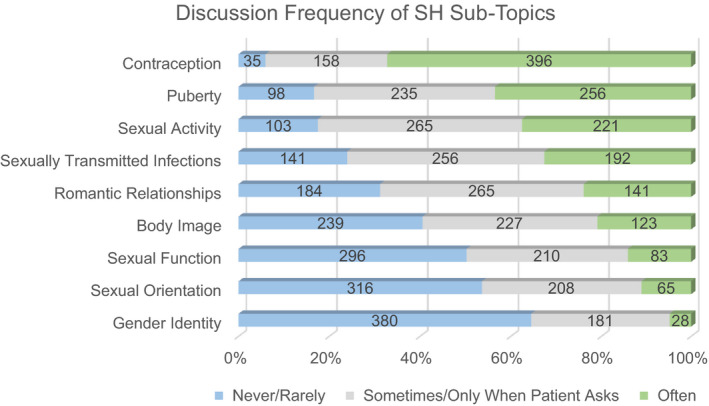
The sample comprised 602 respondents from 168 institutions and was proportionally representative (468 oncologists [77.7%], 76 APPs [12.6%], 58 unidentified [9.6%]; institutional and provider response rates 74.3% and 26.2%, respectively). Almost half of respondents (41.7%) reported no/small role in SH care. Medical topics were discussed most often, including contraception (67.2%), puberty (43.5%), and sexual activity (37.5%). Topics never/rarely discussed included gender identity (64.5%), sexual orientation (53.7%), and sexual function (50.3%). Frequently cited communication barriers included lack of time, low priority, perceived patient discomfort, and the presence of a parent/guardian. Respondents endorsed the need for further education/resources on sexual function (66.1%), gender identity/sexual orientation (59.5%), and body image (46.6%). Preferred education modalities included dissemination of published guidelines (64.7%), skills training modules (62.9%), and webinars (45.3%). By provider type, responses were similar overall but differed for perception of role, barriers identified, and resources desired.
Many pediatric oncology clinicians play minimal roles in SH care of AYAs and most SH topics are rarely discussed. Provider-directed education/training interventions have potential for improving SH care of AYA cancer patients.
性健康(SH)是青少年和年轻人(AYA)关注的重要问题。本研究旨在确定治疗 AYA 的儿科肿瘤临床医生在 SH 沟通实践、障碍和额外资源方面的现状。
由儿童肿瘤学组(COG)AYA 委员会制定了一项横断面调查,并分发给 226 家 COG 机构的儿科肿瘤学家(n=1987;85.9%)和高级实践提供者(APPs,n=326;14.1%)。使用比例和趋势检验对回答进行制表和比较。
该样本由来自 168 家机构的 602 名受访者组成,具有代表性(468 名肿瘤学家[77.7%]、76 名 APPs[12.6%]、58 名身份不明[9.6%];机构和提供者的回复率分别为 74.3%和 26.2%)。近一半的受访者(41.7%)报告在 SH 护理中发挥的作用较小/没有作用。最常讨论的医学主题包括避孕(67.2%)、青春期(43.5%)和性行为(37.5%)。从未/很少讨论的主题包括性别认同(64.5%)、性取向(53.7%)和性功能(50.3%)。经常提到的沟通障碍包括缺乏时间、优先级低、患者不适和有家长/监护人在场。受访者赞成进一步教育/资源的需要,包括性功能(66.1%)、性别认同/性取向(59.5%)和身体形象(46.6%)。首选的教育模式包括传播已发表的指南(64.7%)、技能培训模块(62.9%)和网络研讨会(45.3%)。按提供者类型,总体反应相似,但对角色、确定的障碍和所需资源的看法不同。
许多儿科肿瘤临床医生在 AYA 的 SH 护理中发挥的作用很小,大多数 SH 主题很少讨论。以提供者为导向的教育/培训干预措施有可能改善 AYA 癌症患者的 SH 护理。