Li Haoran, Zhou Fang, Cao Zhifei, Tang Yuchen, Huang Yujie, Li Ye, Yi Bin, Yang Jian, Du Peng, Zhu Dongming, Zhou Jian
Department of General Surgery, The First Affiliated Hospital of Soochow University, Suzhou, China.
Department of General Surgery, Changshu No. 2 People's Hospital, Suzhou, China.
Front Oncol. 2021 May 31;11:682969. doi: 10.3389/fonc.2021.682969. eCollection 2021.
This study aimed to develop and validate a nomogram with preoperative nutritional indicators and tumor markers for predicting prognosis of patients with pancreatic ductal adenocarcinoma (PDAC).
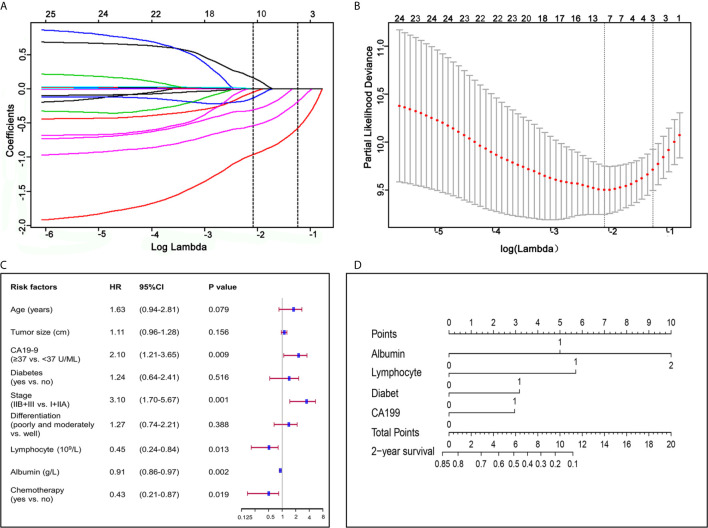
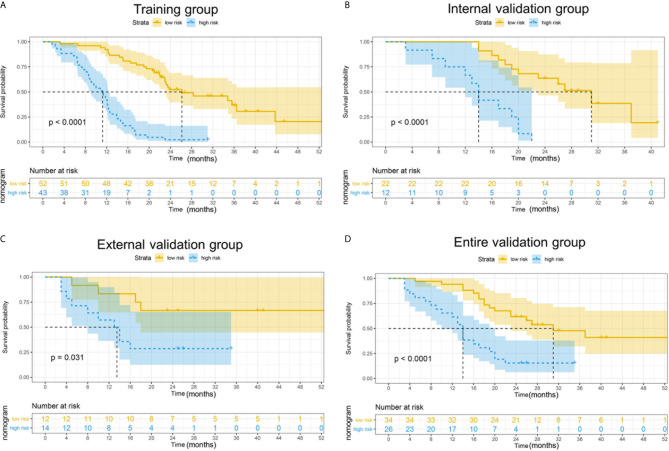
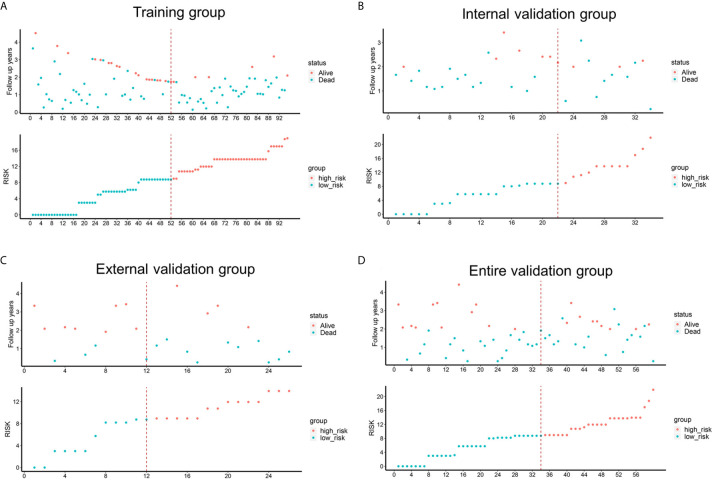
We performed a bicentric, retrospective study including 155 eligible patients with PDAC. Patients were divided into a training group (n = 95), an internal validation group (n = 34), an external validation group (n = 26), and an entire validation group (n = 60). Cox regression analysis was conducted in the training group to identify independent prognostic factors to construct a nomogram for overall survival (OS) prediction. The performance of the nomogram was assessed in validation groups and through comparison with controlling nutritional status (CONUT) and prognostic nutrition index (PNI).
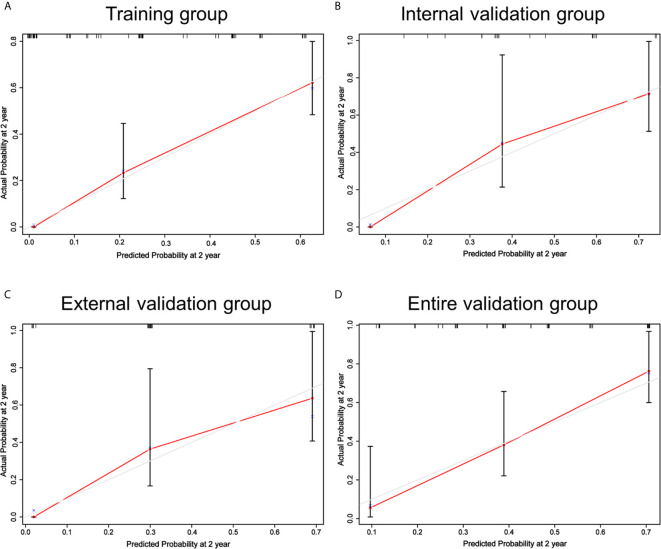
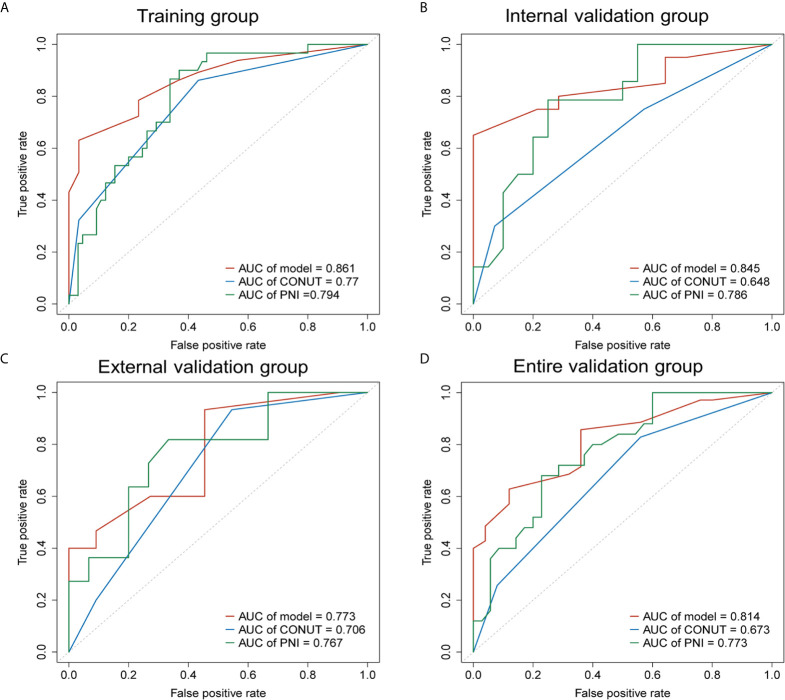
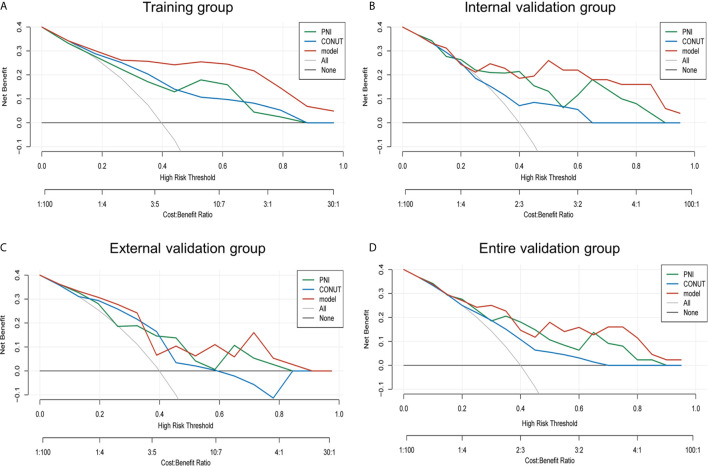
The least absolute shrinkage and selection operator (LASSO) regression, univariate and multivariate Cox regression analysis revealed that serum albumin and lymphocyte count were independent protective factors while CA19-9 and diabetes were independent risk factors. The concordance index (C-index) of the nomogram in the training, internal validation, external validation and entire validation groups were 0.777, 0.769, 0.759 and 0.774 respectively. The areas under curve (AUC) of the nomogram in each group were 0.861, 0.845, 0.773, and 0.814. C-index and AUC of the nomogram were better than those of CONUT and PNI in the training and validation groups. The net reclassification index (NRI), integrated discrimination improvement (IDI) and decision curve analysis showed improvement of accuracy of the nomogram in predicting OS and better net benefit in guiding clinical decisions in comparison with CONUT and PNI.
The nomogram incorporating four preoperative nutritional and tumor markers including serum albumin concentration, lymphocyte count, CA19-9 and diabetes mellitus could predict the prognosis more accurately than CONUT and PNI and may serve as a clinical decision support tool to determine what treatment options to choose.
本研究旨在开发并验证一种包含术前营养指标和肿瘤标志物的列线图,用于预测胰腺导管腺癌(PDAC)患者的预后。
我们进行了一项双中心回顾性研究,纳入了155例符合条件的PDAC患者。患者被分为训练组(n = 95)、内部验证组(n = 34)、外部验证组(n = 26)和整体验证组(n = 60)。在训练组中进行Cox回归分析以识别独立的预后因素,并构建用于总生存期(OS)预测的列线图。在验证组中评估列线图的性能,并与控制营养状况(CONUT)和预后营养指数(PNI)进行比较。
最小绝对收缩和选择算子(LASSO)回归、单因素和多因素Cox回归分析显示,血清白蛋白和淋巴细胞计数是独立的保护因素,而CA19-9和糖尿病是独立的危险因素。训练组、内部验证组、外部验证组和整体验证组中列线图的一致性指数(C-index)分别为0.777、0.769、0.759和0.774。每组中列线图曲线下面积(AUC)分别为0.861、0.845、0.773和0.814。在训练组和验证组中列线图的C-index和AUC均优于CONUT和PNI。净重新分类指数(NRI)、综合判别改善(IDI)和决策曲线分析表明,与CONUT和PNI相比,列线图在预测OS方面的准确性有所提高,在指导临床决策方面具有更好的净效益。
包含血清白蛋白浓度、淋巴细胞计数、CA19-9和糖尿病这四项术前营养和肿瘤标志物的列线图,比CONUT和PNI能更准确地预测预后,可作为临床决策支持工具以确定选择何种治疗方案。