He Bing, Man Ping, Zhang Qichong, Fu Huili, Zhou Zhenyu, Li Chaowei, Li Qiulong, Wei Lei, Yao Yagang
Division of Advanced Nanomaterials, Key Laboratory of Nanodevices and Applications, Joint Key Laboratory of Functional Nanomaterials and Devices, CAS Center for Excellence in Nanoscience, Suzhou Institute of Nano-Tech and Nano-Bionics, Chinese Academy of Sciences, Suzhou, 215123, People's Republic of China.
School of Nano Technology and Nano Bionics, University of Science and Technology of China, Hefei, 230026, People's Republic of China.
Nanomicro Lett. 2019 Nov 20;11(1):101. doi: 10.1007/s40820-019-0332-7.
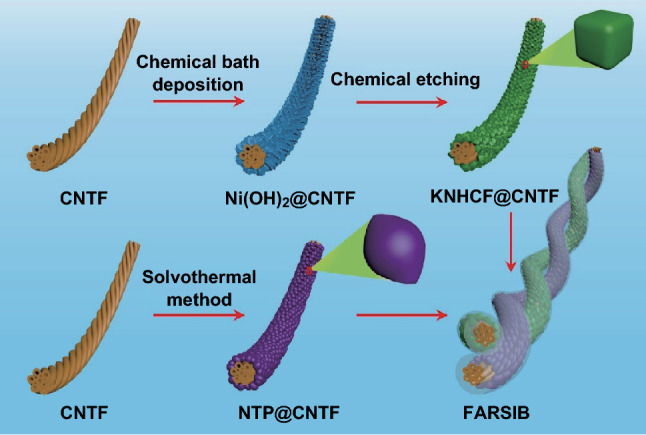
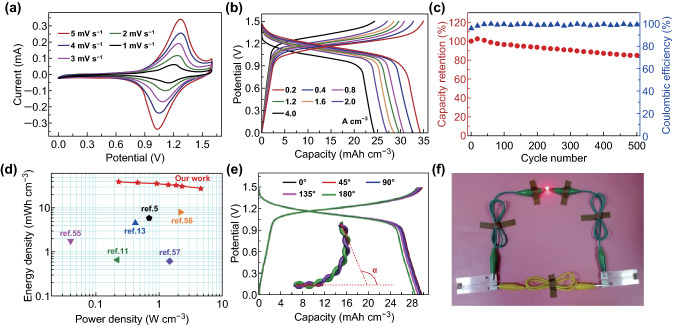
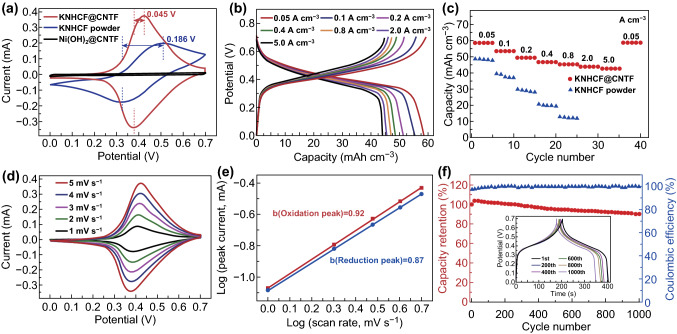
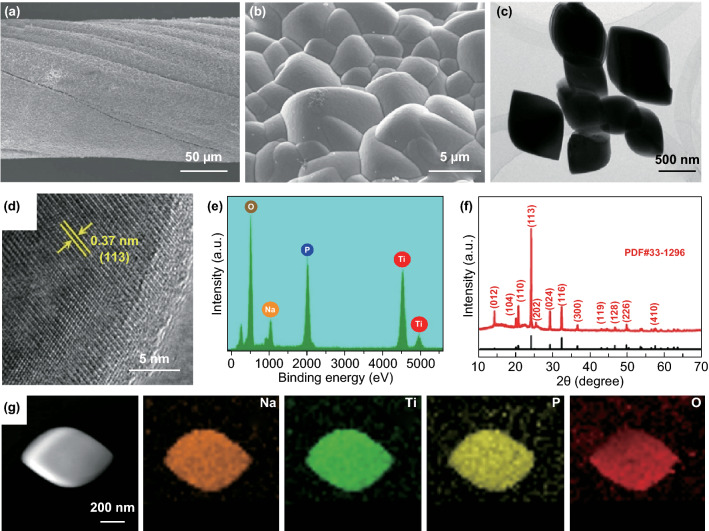
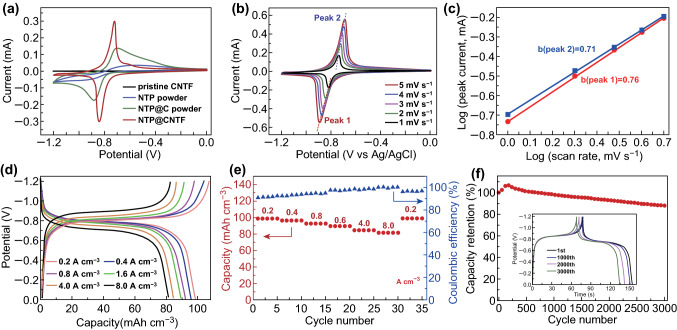
Extensive efforts have recently been devoted to the construction of aqueous rechargeable sodium-ion batteries (ARSIBs) for large-scale energy-storage applications due to their desired properties of abundant sodium resources and inherently safer aqueous electrolytes. However, it is still a significant challenge to develop highly flexible ARSIBs ascribing to the lack of flexible electrode materials. In this work, nanocube-like KNiFe(CN) (KNHCF) and rugby ball-like NaTi(PO) (NTP) are grown on carbon nanotube fibers via simple and mild methods as the flexible binder-free cathode (KNHCF@CNTF) and anode (NTP@CNTF), respectively. Taking advantage of their high conductivity, fast charge transport paths, and large accessible surface area, the as-fabricated binder-free electrodes display admirable electrochemical performance. Inspired by the remarkable flexibility of the binder-free electrodes and the synergy of KNHCF@CNTF and NTP@CNTF, a high-performance quasi-solid-state fiber-shaped ARSIB (FARSIB) is successfully assembled for the first time. Significantly, the as-assembled FARSIB possesses a high capacity of 34.21 mAh cm and impressive energy density of 39.32 mWh cm. More encouragingly, our FARSIB delivers superior mechanical flexibility with only 5.7% of initial capacity loss after bending at 90° for over 3000 cycles. Thus, this work opens up an avenue to design ultraflexible ARSIBs based on all binder-free electrodes for powering wearable and portable electronics.
由于钠资源丰富以及水性电解质本质上更安全等理想特性,近来人们付出了巨大努力来构建用于大规模储能应用的水系可充电钠离子电池(ARSIBs)。然而,由于缺乏柔性电极材料,开发高度柔性的ARSIBs仍然是一项重大挑战。在这项工作中,通过简单温和的方法,在碳纳米管纤维上分别生长出纳米立方体状的KNiFe(CN)(KNHCF)和橄榄球状的NaTi(PO)(NTP),作为柔性无粘结剂阴极(KNHCF@CNTF)和阳极(NTP@CNTF)。利用它们的高导电性、快速的电荷传输路径以及大的可及表面积,所制备的无粘结剂电极展现出令人钦佩的电化学性能。受无粘结剂电极卓越的柔韧性以及KNHCF@CNTF和NTP@CNTF协同作用的启发,首次成功组装出高性能准固态纤维状ARSIB(FARSIB)。值得注意的是,所组装的FARSIB具有34.21 mAh cm的高容量和39.32 mWh cm的令人印象深刻的能量密度。更令人鼓舞的是,我们的FARSIB具有卓越的机械柔韧性,在90°弯曲超过3000次循环后,初始容量损失仅为5.7%。因此,这项工作为设计基于所有无粘结剂电极的超柔性ARSIBs开辟了一条途径,可为可穿戴和便携式电子产品供电。