Funch Donnie, Mortimer Kathleen, Ziyadeh Najat J, D Seeger John, Zhou Li, Ng Eva, Ross Douglas, Major-Pedersen Atheline, Bosch-Traberg Heidrun, Gydesen Helge, Dore David D
Optum Epidemiology, Boston, MA, USA.
Massachusetts General Hospital, Thyroid Associates, Boston, MA, USA.
Diabetes Metab Syndr Obes. 2021 Jun 10;14:2619-2629. doi: 10.2147/DMSO.S305496. eCollection 2021.
Quantify association between the glucagon-like peptide-1 receptor agonist liraglutide and risk of thyroid cancer (TC) compared to other antidiabetics.
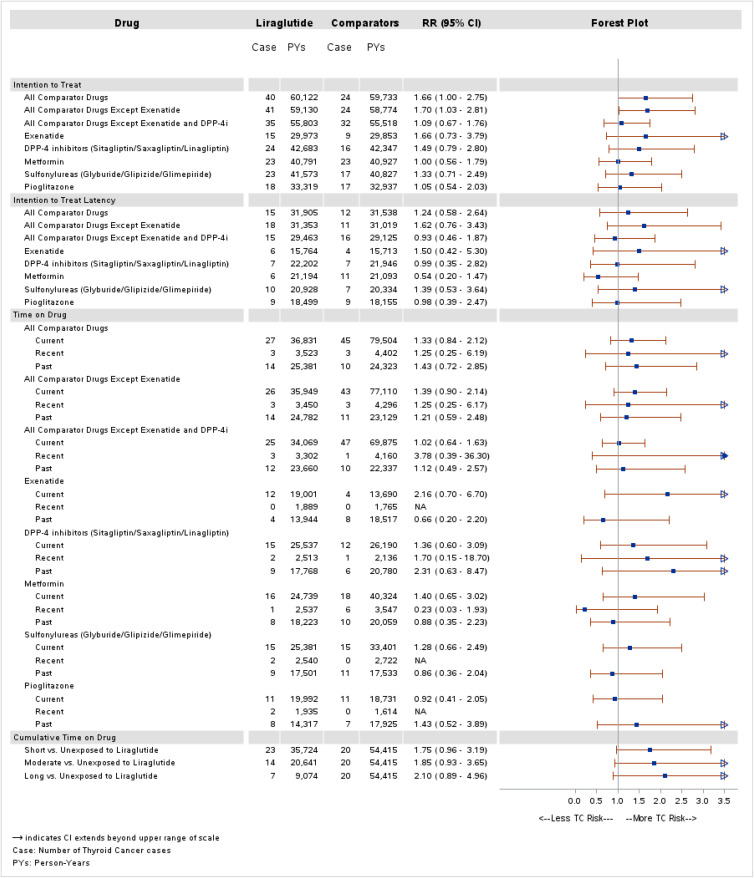
Initiators of liraglutide, exenatide, metformin, pioglitazone or groups of dipeptidyl peptidase-4 inhibitors or sulfonylureas were identified in a US health plan (2010-2014) and followed for a median of 17 months. Thyroid cancer cases during follow-up were identified via a validated algorithm. Incidence rates of TC among liraglutide and comparators were assessed using relative risks estimated within propensity score-matched cohorts using intention to treat (ITT) and time on drug analyses. Latency effects and potential surveillance bias were evaluated.
Relative risks from ITT analyses ranged from 1.00 (95% confidence interval (CI) 0.56-1.79) versus metformin to 1.70 (95% CI 1.03-2.81) versus all comparators excluding exenatide. Effect estimates from latency analyses were slightly attenuated. Time on drug analyses suggested no increased risk for either longer duration or higher cumulative dose of liraglutide. Medical record review found 85% were papillary or a follicular variant of papillary or both; 46% were microcarcinomas (≤10 millimeters), which were more prevalent in the liraglutide cohort (67% versus 43% in all comparators).
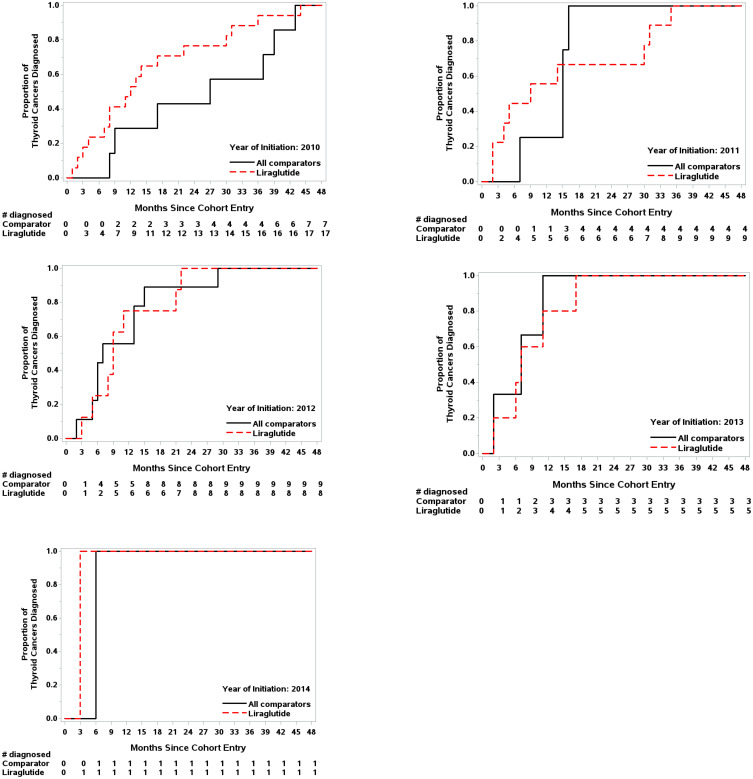
Relative risks were elevated for several comparisons, which should be interpreted cautiously because of potential residual confounding and surveillance bias. Liraglutide cases had smaller thyroid nodules and shorter time-to-diagnosis, suggesting increased surveillance for TC among liraglutide initiators, especially shortly after the drug´s approval. After adjusting the primary analyses (ITT) for latency, no significant elevated risk of TC was observed among liraglutide initiators.
与其他抗糖尿病药物相比,量化胰高血糖素样肽-1受体激动剂利拉鲁肽与甲状腺癌(TC)风险之间的关联。
在美国一项健康计划(2010 - 2014年)中识别出使用利拉鲁肽、艾塞那肽、二甲双胍、吡格列酮的起始使用者,或二肽基肽酶-4抑制剂或磺脲类药物组,并对其进行了为期17个月的中位随访。通过经过验证的算法识别随访期间的甲状腺癌病例。使用倾向评分匹配队列中估计的相对风险,采用意向性治疗(ITT)和药物使用时间分析,评估利拉鲁肽及对照药物中TC的发病率。评估了潜伏期效应和潜在的监测偏倚。
ITT分析得出的相对风险范围为,与二甲双胍相比为1.00(95%置信区间(CI)0.56 - 1.79),与除艾塞那肽外的所有对照药物相比为1.70(95% CI 1.03 - 2.81)。潜伏期分析得出的效应估计值略有减弱。药物使用时间分析表明,利拉鲁肽使用时间较长或累积剂量较高均未增加风险。病历审查发现,85%为乳头状癌或乳头状滤泡变体癌或两者皆有;46%为微癌(≤10毫米),在利拉鲁肽队列中更为常见(67%,而所有对照药物组为43%)。
在多项比较中相对风险有所升高,由于潜在的残余混杂因素和监测偏倚,应谨慎解读。使用利拉鲁肽的病例甲状腺结节较小且诊断时间较短,这表明对开始使用利拉鲁肽的患者,尤其是在药物获批后不久,对TC的监测有所增加。在对潜伏期进行调整后进行的主要分析(ITT)中,未观察到开始使用利拉鲁肽的患者TC风险显著升高。