Douthit Brian J, Staes Catherine J, Del Fiol Guilherme, Richesson Rachel L
School of Nursing, Duke University, Durham, North Carolina, USA.
Department of Learning Health Sciences, School of Medicine, University of Michigan, Ann Arbor, Michigan, USA.
JAMIA Open. 2021 Jun 16;4(2):ooab031. doi: 10.1093/jamiaopen/ooab031. eCollection 2021 Apr.
To identify important barriers and facilitators relating to the feasibility of implementing clinical practice guidelines (CPGs) as clinical decision support (CDS).
We conducted a qualitative, thematic analysis of interviews from seven interviews with dyads (one clinical expert and one systems analyst) who discussed the feasibility of implementing 10 Choosing Wisely guidelines at their institutions. We conducted a content analysis to extract salient themes describing facilitators, challenges, and other feasibility considerations regarding implementing CPGs as CDS.
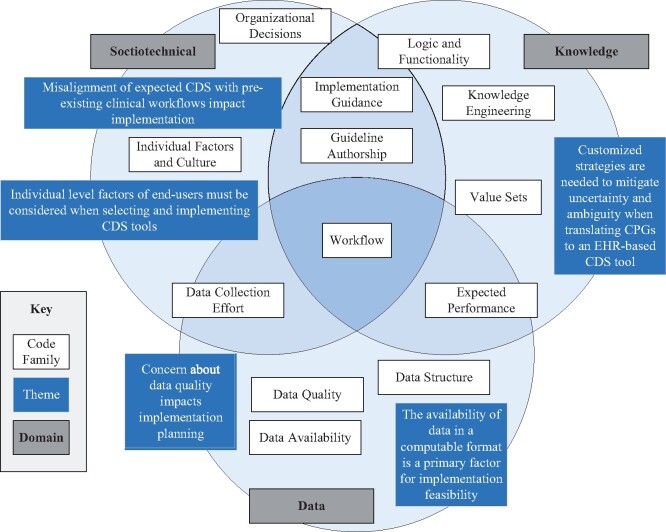
We identified five themes: concern about data quality impacts implementation planning; the availability of data in a computable format is a primary factor for implementation feasibility; customized strategies are needed to mitigate uncertainty and ambiguity when translating CPGs to an electronic health record-based tool; misalignment of expected CDS with pre-existing clinical workflows impact implementation; and individual level factors of end-users must be considered when selecting and implementing CDS tools.
The themes reveal several considerations for CPG as CDS implementations regarding data quality, knowledge representation, and sociotechnical issues. Guideline authors should be aware that using CDS to implement CPGs is becoming increasingly popular and should consider providing clear guidelines to aid implementation. The complex nature of CPG as CDS implementation necessitates a unified effort to overcome these challenges.
Our analysis highlights the importance of cooperation and co-development of standards, strategies, and infrastructure to address the difficulties of implementing CPGs as CDS. The complex interactions between the concepts revealed in the interviews necessitates the need that such work should not be conducted in silos. We also implore that implementers disseminate their experiences.
确定与将临床实践指南(CPG)作为临床决策支持(CDS)实施的可行性相关的重要障碍和促进因素。
我们对七组二元组(一名临床专家和一名系统分析师)的访谈进行了定性的主题分析,他们讨论了在其机构实施10项明智选择指南的可行性。我们进行了内容分析,以提取描述将CPG作为CDS实施的促进因素、挑战及其他可行性考虑因素的突出主题。
我们确定了五个主题:对数据质量影响实施规划的担忧;可计算格式数据的可用性是实施可行性的主要因素;在将CPG转化为基于电子健康记录的工具时,需要定制策略来减轻不确定性和模糊性;预期的CDS与预先存在的临床工作流程不一致会影响实施;在选择和实施CDS工具时,必须考虑最终用户的个体层面因素。
这些主题揭示了将CPG作为CDS实施在数据质量、知识表示和社会技术问题方面的若干考虑因素。指南作者应意识到,使用CDS实施CPG正变得越来越普遍,并应考虑提供明确的指南以帮助实施。将CPG作为CDS实施的复杂性需要各方共同努力来克服这些挑战。
我们的分析强调了合作以及共同制定标准、策略和基础设施以应对将CPG作为CDS实施困难的重要性。访谈中揭示的概念之间的复杂相互作用表明,此类工作不应孤立进行。我们还恳请实施者分享他们的经验。