Center for Pediatric Bone Biology and Translational Research, Scottish Rite for Children, Dallas, TX 75219, USA.
Department of Pediatrics, The University of Texas Southwestern Medical Center, Dallas, TX 75390, USA.
Dis Model Mech. 2021 Jun 1;14(6). doi: 10.1242/dmm.048901. Epub 2021 Jun 18.
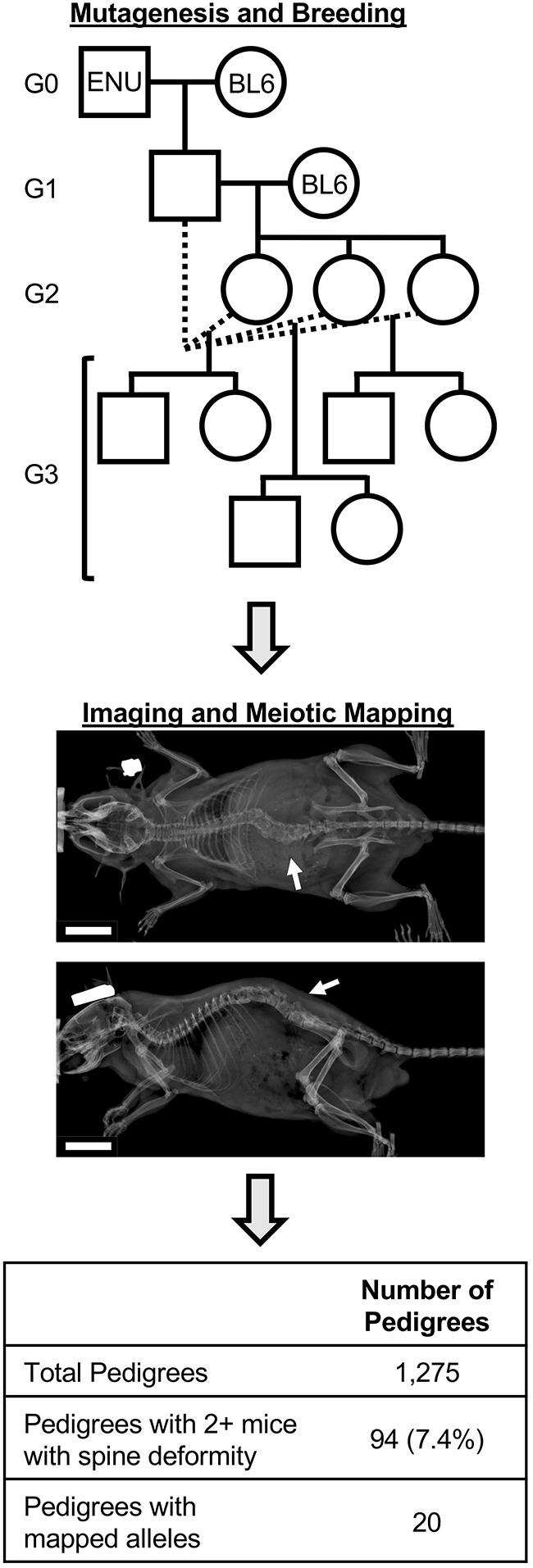
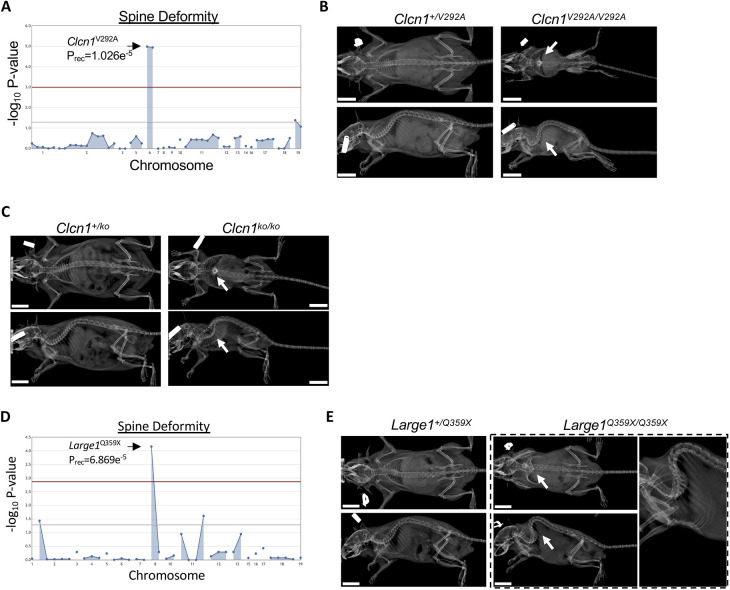
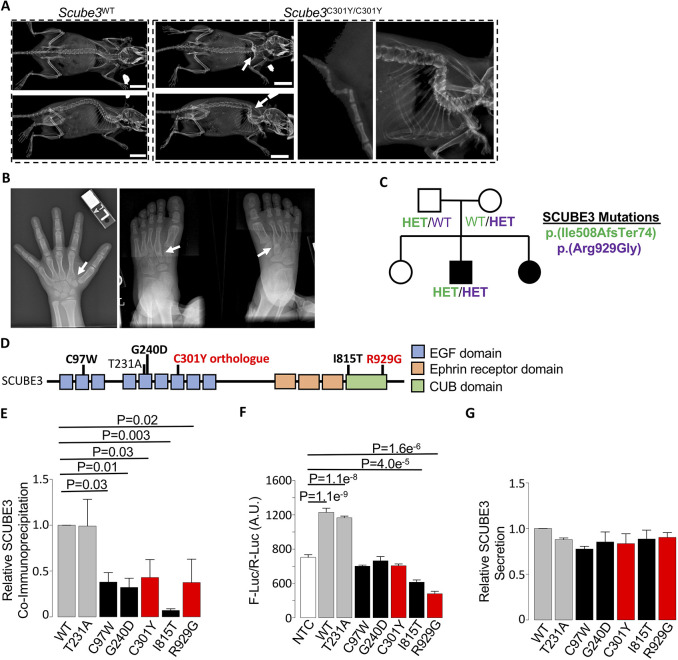
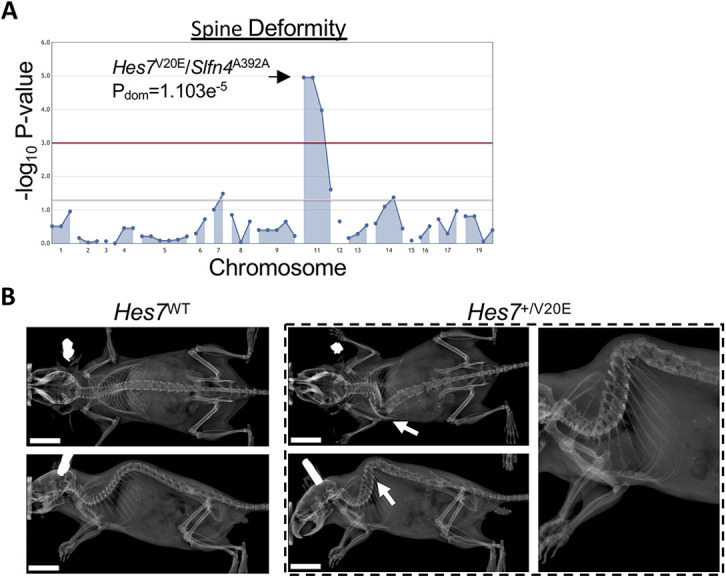
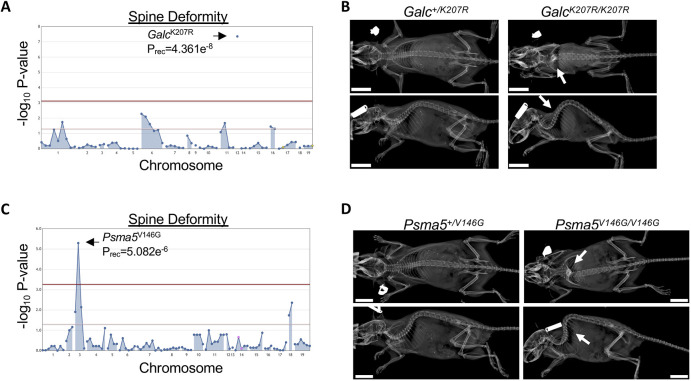
Embryonic formation and patterning of the vertebrate spinal column requires coordination of many molecular cues. After birth, the integrity of the spine is impacted by developmental abnormalities of the skeletal, muscular and nervous systems, which may result in deformities, such as kyphosis and scoliosis. We sought to identify novel genetic mouse models of severe spine deformity by implementing in vivo skeletal radiography as part of a high-throughput saturation mutagenesis screen. We report selected examples of genetic mouse models following radiographic screening of 54,497 mice from 1275 pedigrees. An estimated 30.44% of autosomal genes harbored predicted damaging alleles examined twice or more in the homozygous state. Of the 1275 pedigrees screened, 7.4% presented with severe spine deformity developing in multiple mice, and of these, meiotic mapping implicated N-ethyl-N-nitrosourea alleles in 21% of pedigrees. Our study provides proof of concept that saturation mutagenesis is capable of discovering novel mouse models of human disease, including conditions with skeletal, neural and neuromuscular pathologies. Furthermore, we report a mouse model of skeletal disease, including severe spine deformity, caused by recessive mutation in Scube3. By integrating results with a human clinical exome database, we identified a patient with undiagnosed skeletal disease who harbored recessive mutations in SCUBE3, and we demonstrated that disease-associated mutations are associated with reduced transactivation of Smad signaling in vitro. All radiographic results and mouse models are made publicly available through the Mutagenetix online database with the goal of advancing understanding of spine development and discovering novel mouse models of human disease.
脊椎动物脊柱的胚胎形成和模式形成需要许多分子线索的协调。出生后,脊柱的完整性受到骨骼、肌肉和神经系统发育异常的影响,这可能导致脊柱畸形,如脊柱后凸和脊柱侧凸。我们试图通过实施体内骨骼射线照相术作为高通量饱和诱变筛选的一部分,来鉴定严重脊柱畸形的新型遗传小鼠模型。我们报告了在对来自 1275 个家系的 54497 只小鼠进行放射筛选后,选择的遗传小鼠模型的示例。在纯合状态下两次或更多次检查估计有 30.44%的常染色体基因携带预测的有害等位基因。在所筛选的 1275 个家系中,有 7.4%的家系出现了多发性严重脊柱畸形,其中,减数分裂图谱提示在 21%的家系中存在 N-乙基-N-亚硝脲等位基因。我们的研究提供了概念验证,即饱和诱变能够发现人类疾病的新型小鼠模型,包括骨骼、神经和神经肌肉病理的疾病。此外,我们报告了一个由 Scube3 隐性突变引起的骨骼疾病小鼠模型,包括严重的脊柱畸形。通过将结果与人类临床外显子组数据库相结合,我们鉴定了一名患有未确诊骨骼疾病的患者,该患者携带 SCUBE3 的隐性突变,并且我们证明了与疾病相关的突变与体外 Smad 信号转导的转录激活降低有关。所有放射学结果和小鼠模型都通过 Mutagenetix 在线数据库公开提供,旨在推进对脊柱发育的理解和发现人类疾病的新型小鼠模型。