Department of Physiology, School of Medicine, College of Medicine, Taipei Medical University, Taipei, Taiwan.
Institute of Biomedical Sciences, Academia Sinica, Taipei, Taiwan.
J Biomed Sci. 2023 May 26;30(1):33. doi: 10.1186/s12929-023-00925-3.
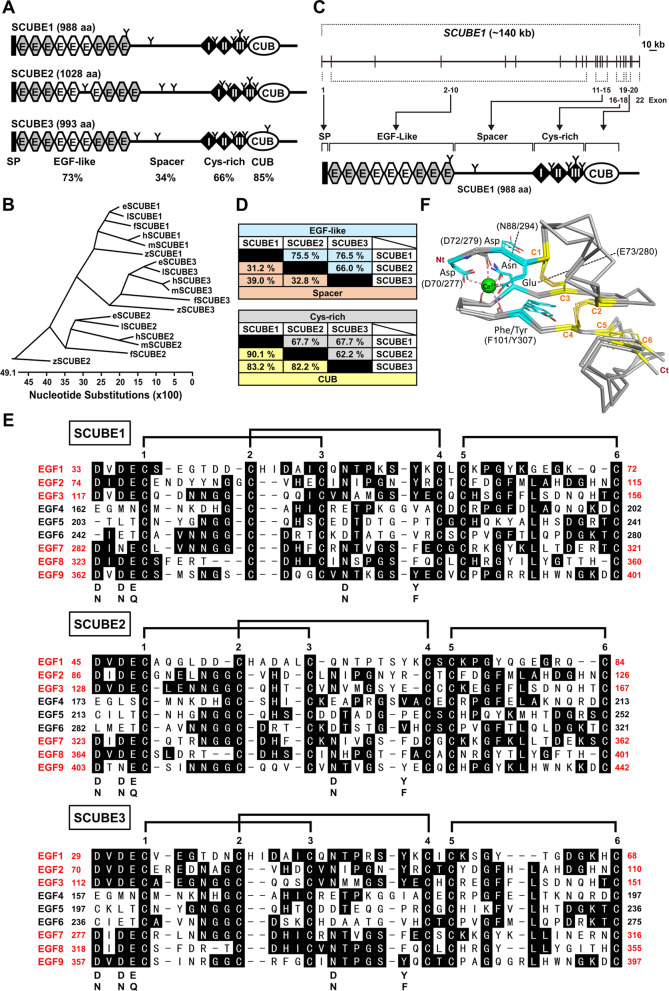
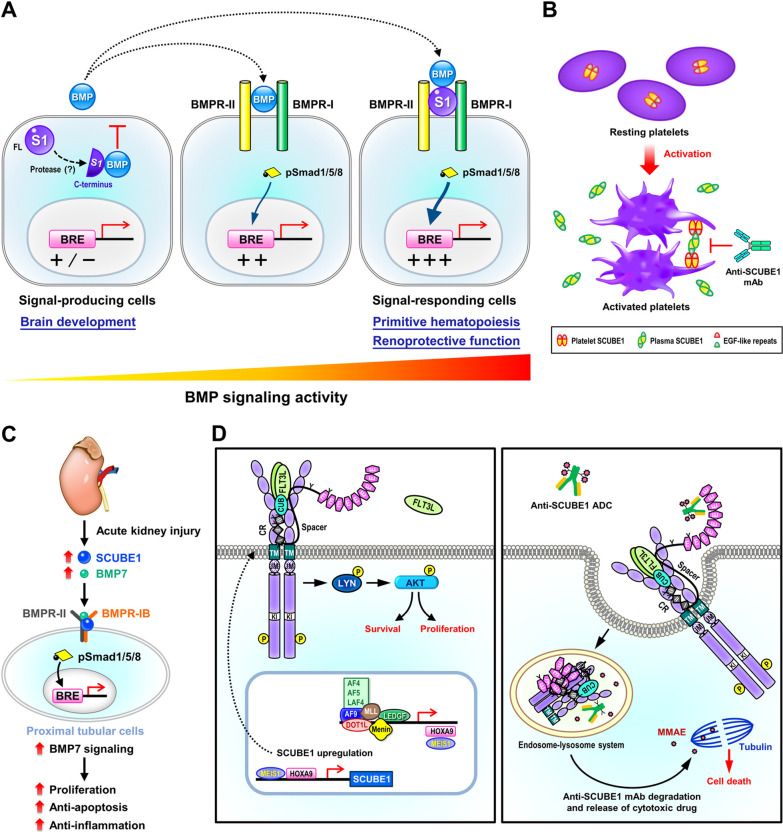
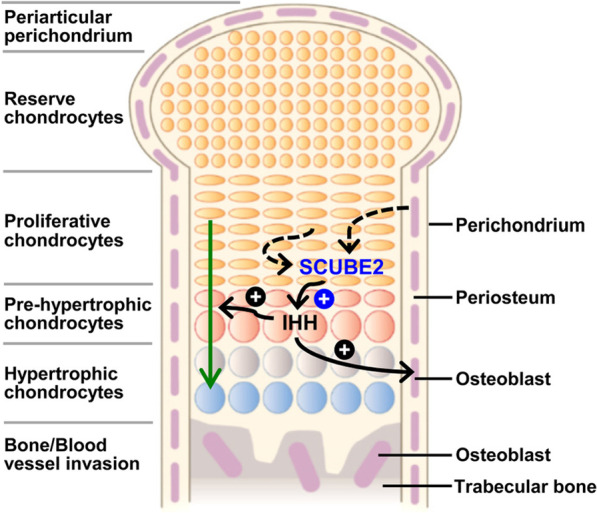
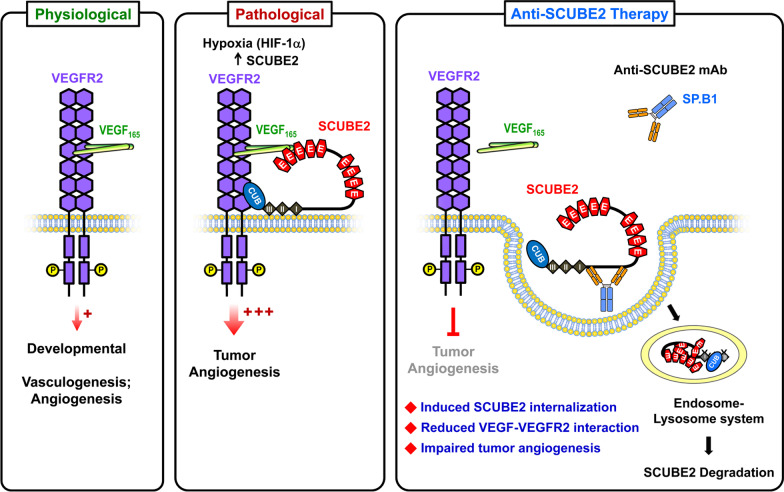
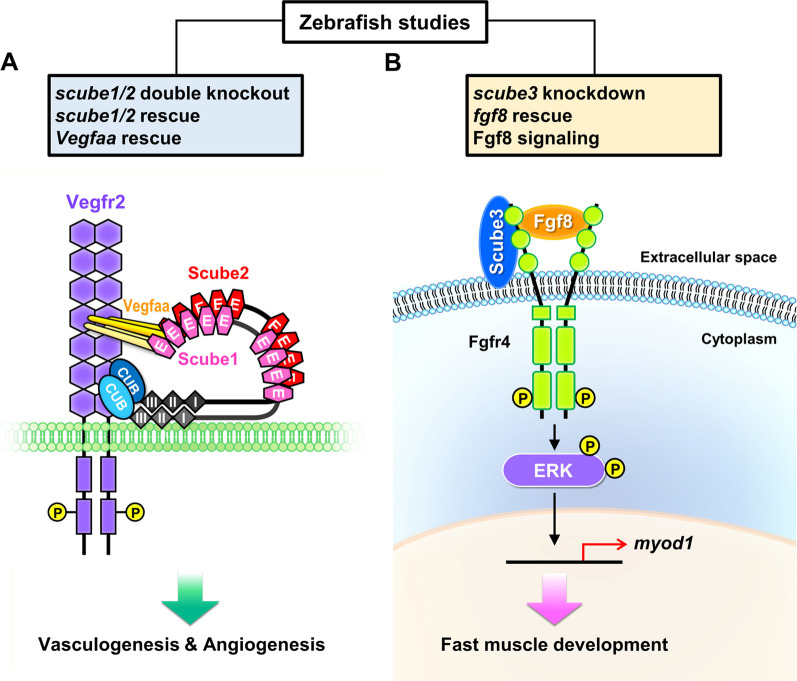
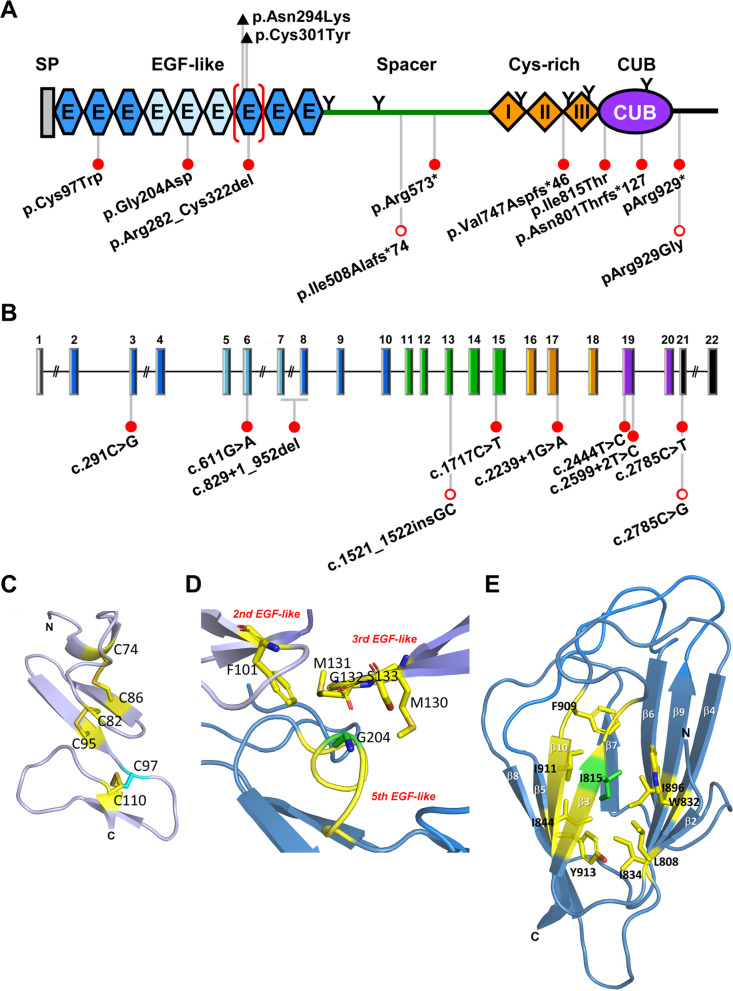
The SCUBE [Signal peptide-Complement C1r/C1s, Uegf, Bmp1 (CUB)-Epithelial growth factor domain-containing protein] family consists of three proteins in vertebrates, SCUBE1, 2 and 3, which are highly conserved in zebrafish, mice and humans. Each SCUBE gene encodes a polypeptide of approximately 1000 amino acids that is organized into five modular domains: (1) an N-terminal signal peptide sequence, (2) nine tandem epidermal growth factor (EGF)-like repeats, (3) a large spacer region, (4) three cysteine-rich (CR) motifs, and (5) a CUB domain at the C-terminus. Murine Scube genes are expressed individually or in combination during the development of various tissues, including those in the central nervous system and the axial skeleton. The cDNAs of human SCUBE orthologs were originally cloned from vascular endothelial cells, but SCUBE expression has also been found in platelets, mammary ductal epithelium and osteoblasts. Both soluble and membrane-associated SCUBEs have been shown to play important roles in physiology and pathology. For instance, upregulation of SCUBEs has been reported in acute myeloid leukemia, breast cancer and lung cancer. In addition, soluble SCUBE1 is released from activated platelets and can be used as a clinical biomarker for acute coronary syndrome and ischemic stroke. Soluble SCUBE2 enhances distal signaling by facilitating the secretion of dual-lipidated hedgehog from nearby ligand-producing cells in a paracrine manner. Interestingly, the spacer regions and CR motifs can increase or enable SCUBE binding to cell surfaces via electrostatic or glycan-lectin interactions. As such, membrane-associated SCUBEs can function as coreceptors that enhance the signaling activity of various serine/threonine kinase or tyrosine kinase receptors. For example, membrane-associated SCUBE3 functions as a coreceptor that promotes signaling in bone morphogenesis. In humans, SCUBE3 mutations are linked to abnormalities in growth and differentiation of both bones and teeth. In addition to studies on human SCUBE function, experimental results from genetically modified mouse models have yielded important insights in the field of systems biology. In this review, we highlight novel molecular discoveries and critical directions for future research on SCUBE proteins in the context of cancer, skeletal disease and cardiovascular disease.
SCUBE [信号肽-补体 C1r/C1s、Uegf、Bmp1(CUB)-表皮生长因子域蛋白]家族在脊椎动物中由三个蛋白组成,即 SCUBE1、2 和 3,在斑马鱼、小鼠和人类中高度保守。每个 SCUBE 基因编码一个约 1000 个氨基酸的多肽,该多肽组织成五个模块域:(1)N 端信号肽序列,(2)9 个串联表皮生长因子(EGF)样重复序列,(3)一个大的间隔区,(4)3 个富含半胱氨酸(CR)的基序,(5)C 端的 CUB 结构域。小鼠 Scube 基因在各种组织的发育过程中单独或组合表达,包括中枢神经系统和轴骨骼中的组织。人 SCUBE 同源物的 cDNA 最初从血管内皮细胞中克隆,但也在血小板、乳腺导管上皮和成骨细胞中发现了 SCUBE 表达。可溶性和膜相关的 SCUBEs 已被证明在生理和病理中发挥重要作用。例如,在急性髓细胞性白血病、乳腺癌和肺癌中报道了 SCUBEs 的上调。此外,从激活的血小板中释放出可溶性 SCUBE1,可作为急性冠状动脉综合征和缺血性中风的临床生物标志物。可溶性 SCUBE2 通过促进旁分泌方式从附近产生配体的细胞中分泌双脂化的 hedgehog,增强远端信号。有趣的是,间隔区和 CR 基序可通过静电或糖-凝集素相互作用增加或使 SCUBE 与细胞表面结合。因此,膜相关的 SCUBEs 可作为增强各种丝氨酸/苏氨酸激酶或酪氨酸激酶受体信号活性的辅助受体。例如,膜相关的 SCUBE3 作为一种辅助受体,可促进骨形态发生中的信号转导。在人类中,SCUBE3 突变与骨骼和牙齿的生长和分化异常有关。除了对人 SCUBE 功能的研究外,遗传修饰小鼠模型的实验结果为系统生物学领域提供了重要的见解。在这篇综述中,我们强调了在癌症、骨骼疾病和心血管疾病背景下 SCUBE 蛋白的新的分子发现和未来研究的关键方向。