CRONICAS Center of Excellence in Chronic Diseases, Universidad Peruana Cayetano Heredia, Lima, Peru.
School of Medicine, Universidad Peruana Cayetano Heredia, Lima, Peru.
Obesity (Silver Spring). 2021 Aug;29(8):1363-1374. doi: 10.1002/oby.23188. Epub 2021 Jun 19.
This study assessed the relationship between urbanization and the double burden of malnutrition (DBM) in Peru.
A cross-sectional analysis of the Demographic and Health Survey (2009 to 2016) was conducted. A DBM "case" comprised a child with undernutrition and a mother with overweight/obesity. For urbanization, three indicators were used: an eight-category variable based on district-level population density (inhabitants/km ), a dichotomous urban/rural variable, and place of residence (countryside, towns, small cities, or capital/large cities).
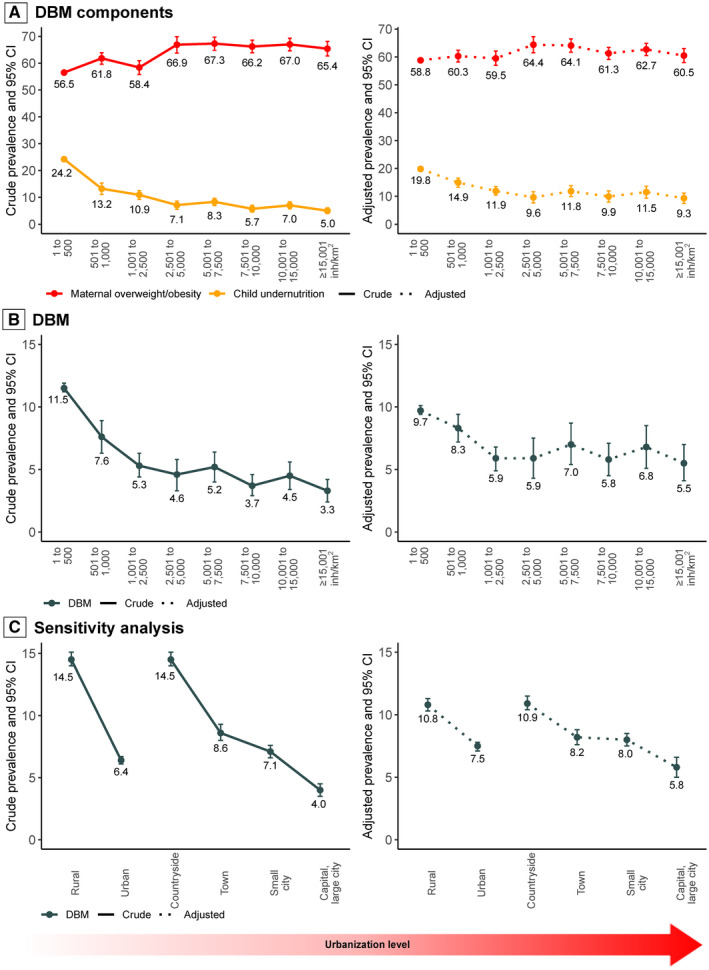
The prevalence of DBM was lower in urban than in rural areas (prevalence ratio [PR] 0.70; 95% CI: 0.65-0.75), and compared with the countryside, DBM was less prevalent in towns (PR 0.75; 95% CI: 0.69-0.82), small cities (PR 0.73; 95% CI: 0.67-0.79), and capital/large cities (PR 0.53; 95% CI: 0.46-0.61). Using population density, the adjusted prevalence of DBM was 9.7% (95% CI: 9.4%-10.1%) in low-density settings (1 to 500 inhabitants/km ), 5.9% (95% CI: 4.9%-6.8%) in mid-urbanized settings (1,001 to 2,500 inhabitants/km ), 5.8% (95% CI: 4.5%-7.1%) in more densely populated settings (7,501 to 10,000 inhabitants/km ), and 5.5% (95% CI: 4.1%-7.0%) in high-density settings (>15,000 inhabitants/km ).
The prevalence of DBM is higher in the least-urbanized settings such as rural and peri-urban areas, particularly those under 2,500 inhabitants/km .
本研究评估了城市化与秘鲁营养不良双重负担(DBM)之间的关系。
对 2009 年至 2016 年人口与健康调查(Demographic and Health Survey)进行了横断面分析。DBM“病例”包括营养不良的儿童和超重/肥胖的母亲。对于城市化,使用了三个指标:基于区县级人口密度的八分类变量(居民/km )、城乡二元变量和居住地(农村、城镇、小城市或首都/大城市)。
与农村地区相比,城市地区 DBM 的患病率较低(患病率比 [PR] 0.70;95%可信区间:0.65-0.75),与农村地区相比,城镇(PR 0.75;95%可信区间:0.69-0.82)、小城市(PR 0.73;95%可信区间:0.67-0.79)和首都/大城市(PR 0.53;95%可信区间:0.46-0.61)的 DBM 患病率较低。使用人口密度,低人口密度(1 至 500 居民/km )、中城市化程度(1,001 至 2,500 居民/km )、人口密度较高(7,501 至 10,000 居民/km )和高人口密度(>15,000 居民/km )地区的 DBM 调整后患病率分别为 9.7%(95%可信区间:9.4%-10.1%)、5.9%(95%可信区间:4.9%-6.8%)、5.8%(95%可信区间:4.5%-7.1%)和 5.5%(95%可信区间:4.1%-7.0%)。
在城市化程度最低的地区,如农村和城郊地区,DBM 的患病率较高,尤其是人口密度低于 2500 居民/km 的地区。