Wright Eugene E, Kerr Matthew S D, Reyes Ignacio J, Nabutovsky Yelena, Miller Eden
Charlotte Area Health Education Center, Charlotte, NC.
Abbott, Sylmar, CA.
Diabetes Spectr. 2021 May;34(2):184-189. doi: 10.2337/ds20-0069. Epub 2021 Feb 10.
Glycemic control is suboptimal in many individuals with type 2 diabetes. Although use of flash continuous glucose monitoring (CGM) has demonstrated A1C reductions in patients with type 2 diabetes treated with a multiple daily injection or insulin pump therapy regimen, the glycemic benefit of this technology in patients with type 2 diabetes using nonintensive treatment regimens has not been well studied.
This retrospective, observational study used the IBM Explorys database to assess changes in A1C after flash CGM prescription in a large population with suboptimally controlled type 2 diabetes treated with nonintensive therapy. Inclusion criteria were diagnosis of type 2 diabetes, age <65 years, treatment with basal insulin or noninsulin therapy, naive to any CGM, baseline A1C ≥8%, and a prescription for the FreeStyle Libre flash CGM system during the period between October 2017 and February 2020. Patients served as their own control subject.
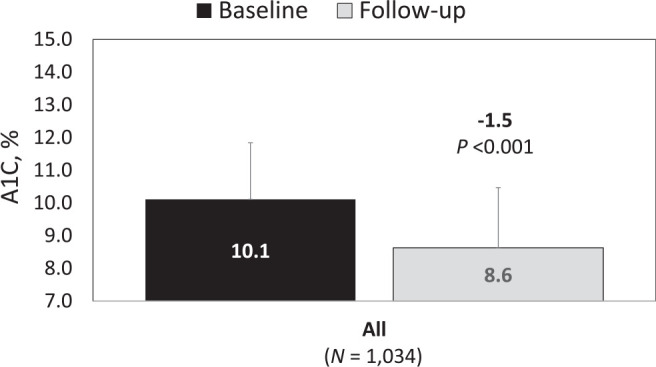
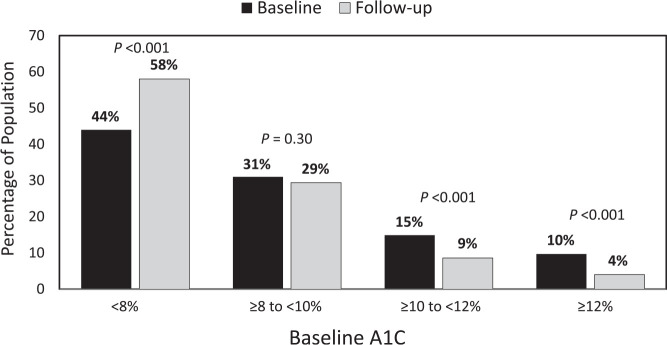
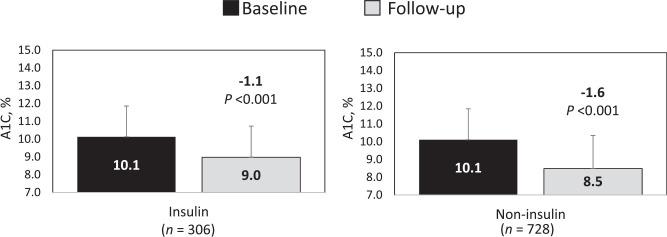
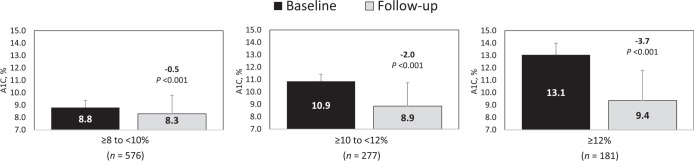
A total of 1,034 adults with type 2 diabetes (mean age 51.6 ± 9.2 years, 50.9% male, baseline A1C 10.1 ± 1.7%) were assessed. More patients received noninsulin treatments ( = 728) than basal insulin therapy ( = 306). We observed a significant reduction in A1C within the full cohort: from 10.1 ± 1.7 to 8.6 ± 1.8%; Δ -1.5 ± 2.2% ( <0.001). The largest reductions were seen in patients with a baseline A1C ≥12.0% ( = 181, A1C reduction -3.7%, <0.001). Significant reductions were seen in both treatment groups (basal insulin -1.1%, noninsulin -1.6%, both <0.001).
Prescription of the flash CGM system was associated with significant reductions in A1C in patients with type 2 diabetes treated with basal insulin or noninsulin therapy. These findings provide evidence for expanding access to flash CGM within the broader population of people with type 2 diabetes.
许多2型糖尿病患者的血糖控制并不理想。尽管使用实时连续葡萄糖监测(CGM)已证明,接受每日多次注射或胰岛素泵治疗方案的2型糖尿病患者的糖化血红蛋白(A1C)有所降低,但该技术在采用非强化治疗方案的2型糖尿病患者中的血糖获益尚未得到充分研究。
这项回顾性观察性研究使用IBM Explorys数据库,评估在接受非强化治疗且血糖控制不佳的大量2型糖尿病患者中,开具实时CGM处方后A1C的变化。纳入标准为2型糖尿病诊断、年龄<65岁、接受基础胰岛素或非胰岛素治疗、未使用过任何CGM、基线A1C≥8%,以及在2017年10月至2020年2月期间开具了FreeStyle Libre实时CGM系统的处方。患者自身作为对照。
共评估了1034例2型糖尿病成人患者(平均年龄51.6±9.2岁,50.9%为男性,基线A1C为10.1±1.7%)。接受非胰岛素治疗的患者(n = 728)多于接受基础胰岛素治疗的患者(n = 306)。我们观察到整个队列中的A1C显著降低:从10.1±1.7降至8.6±1.8%;Δ -1.5±2.2%(P<0.001)。基线A1C≥12.0%的患者(n = 181)降幅最大(A1C降低-3.7%,P<0.001)。两个治疗组均有显著降低(基础胰岛素组-1.1%,非胰岛素组-1.6%,均P<0.001)。
实时CGM系统的处方与接受基础胰岛素或非胰岛素治疗的2型糖尿病患者的A1C显著降低相关。这些发现为在更广泛的2型糖尿病患者群体中扩大实时CGM的使用提供了证据。