Wang Han-Lin, Chen Jia-Wei, Yang Shih-Hung, Lo Yu-Chun, Pan Han-Chi, Liang Yao-Wen, Wang Ching-Fu, Yang Yi, Kuo Yun-Ting, Lin Yi-Chen, Chou Chin-Yu, Lin Sheng-Huang, Chen You-Yin
Department of Biomedical Engineering, National Yang Ming Chiao Tung University, Taipei, Taiwan.
Department of Mechanical Engineering, National Cheng Kung University, Tainan, Taiwan.
Front Cell Neurosci. 2021 Jun 3;15:655305. doi: 10.3389/fncel.2021.655305. eCollection 2021.
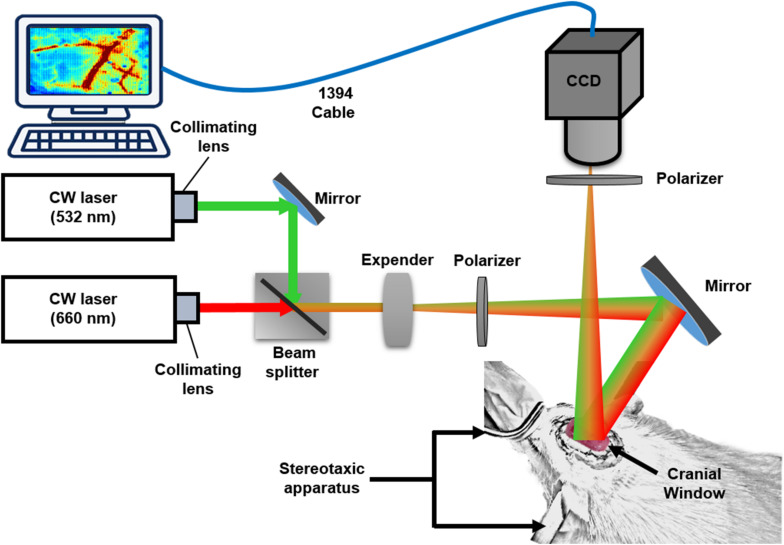
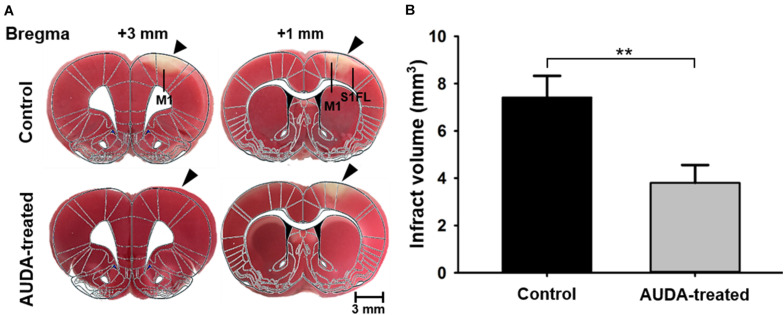
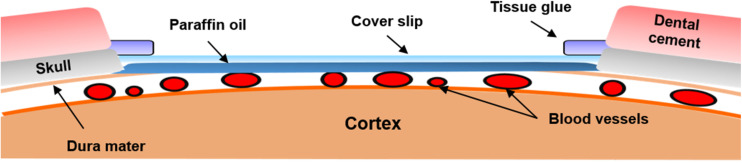
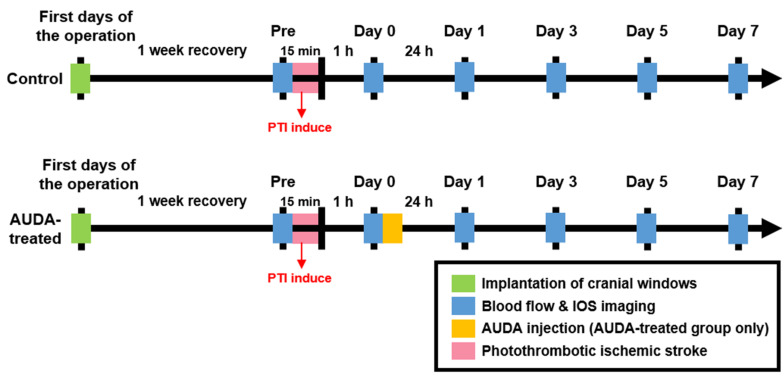
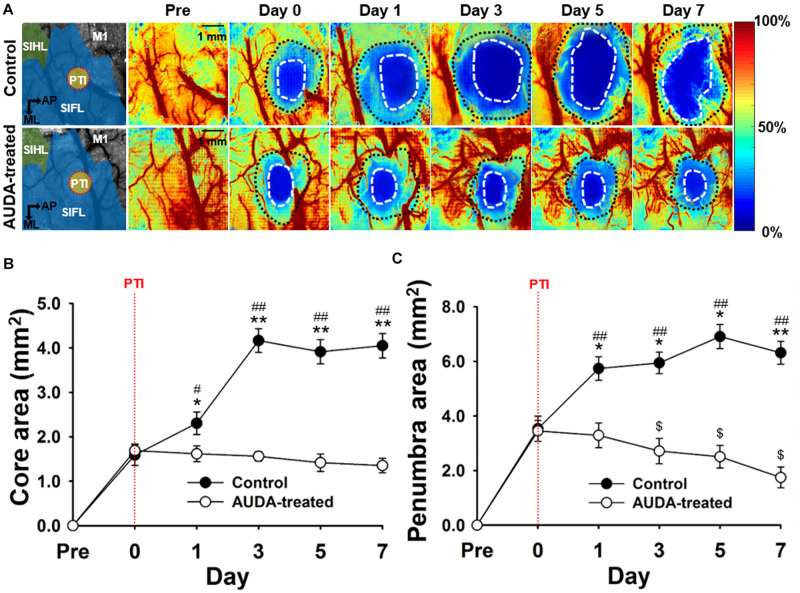
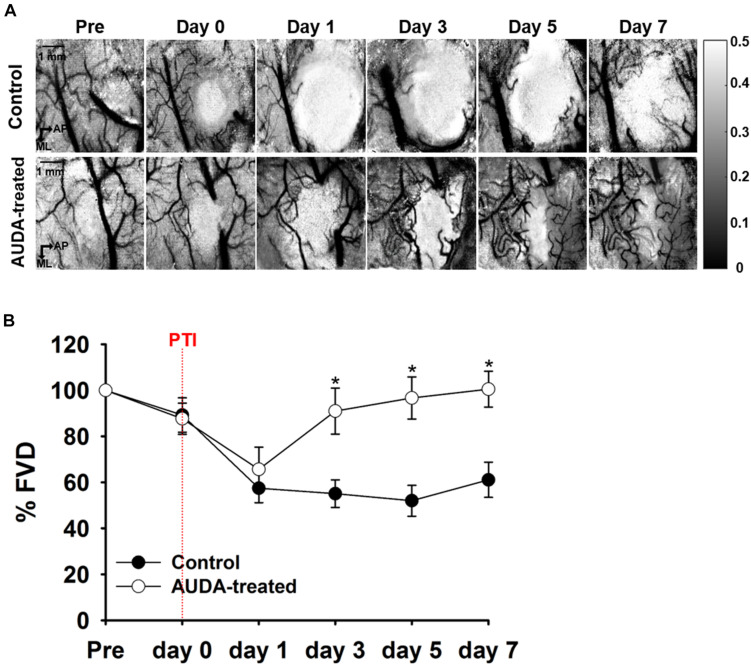
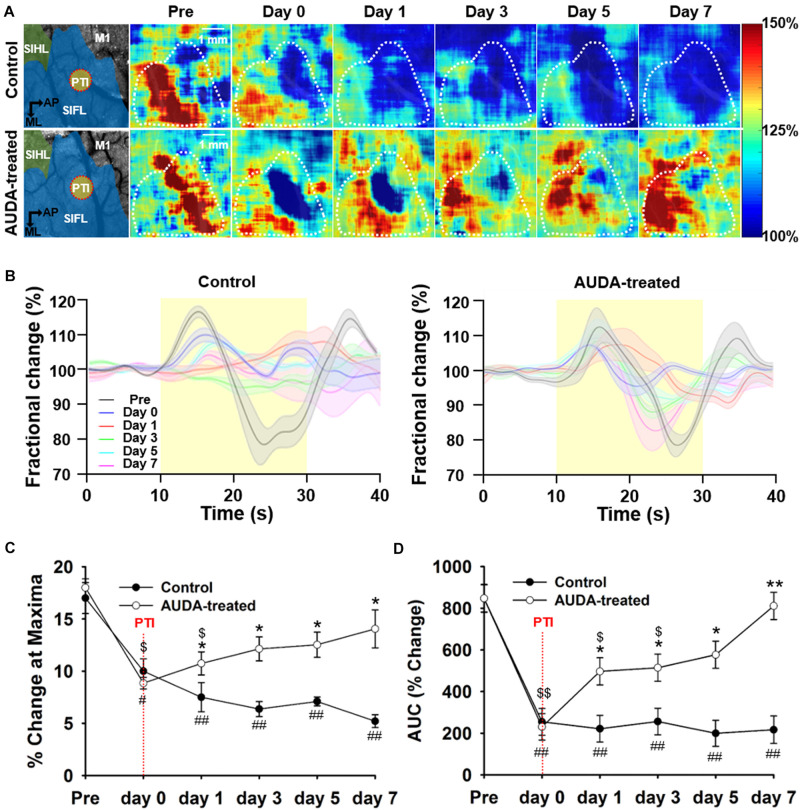
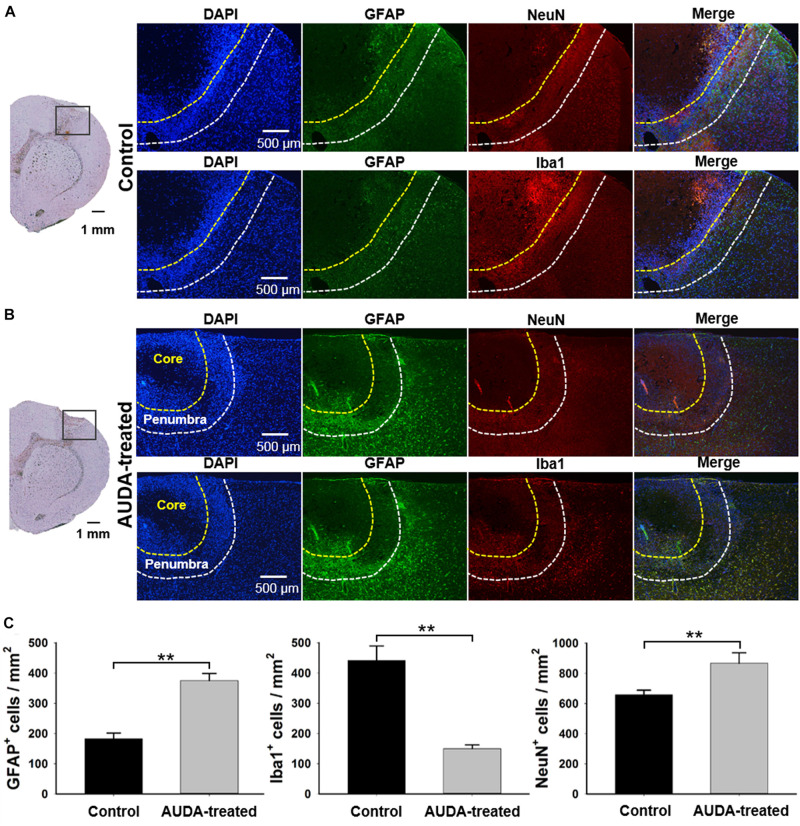
Administration of 12-(3-adamantan-1-yl-ureido)-dodecanoic acid (AUDA) has been demonstrated to alleviate infarction following ischemic stroke. Reportedly, the main effect of AUDA is exerting anti-inflammation and neovascularization via the inhibition of soluble epoxide hydrolase. However, the major contribution of this anti-inflammation and neovascularization effect in the acute phase of stroke is not completely elucidated. To investigate the neuroprotective effects of AUDA in acute ischemic stroke, we combined laser speckle contrast imaging and optical intrinsic signal imaging techniques with the implantation of a lab-designed cranial window. Forepaw stimulation was applied to assess the functional changes via measuring cerebral metabolic rate of oxygen (CMRO) that accompany neural activity. The rats that received AUDA in the acute phase of photothrombotic ischemia stroke showed a 30.5 ± 8.1% reduction in the ischemic core, 42.3 ± 15.1% reduction in the ischemic penumbra ( < 0.05), and 42.1 ± 4.6% increase of CMRO in response to forepaw stimulation at post-stroke day 1 ( < 0.05) compared with the control group ( = 10 for each group). Moreover, at post-stroke day 3, increased functional vascular density was observed in AUDA-treated rats (35.9 ± 1.9% higher than that in the control group, < 0.05). At post-stroke day 7, a 105.4% ± 16.4% increase of astrocytes ( < 0.01), 30.0 ± 10.9% increase of neurons ( < 0.01), and 65.5 ± 15.0% decrease of microglia ( < 0.01) were observed in the penumbra region in AUDA-treated rats ( = 5 for each group). These results suggested that AUDA affects the anti-inflammation at the beginning of ischemic injury and restores neuronal metabolic rate of O and tissue viability. The neovascularization triggered by AUDA restored CBF and may contribute to ischemic infarction reduction at post-stroke day 3. Moreover, for long-term neuroprotection, astrocytes in the penumbra region may play an important role in protecting neurons from apoptotic injury.
已证明给予12-(3-金刚烷-1-基-脲基)-十二烷酸(AUDA)可减轻缺血性中风后的梗死。据报道,AUDA的主要作用是通过抑制可溶性环氧化物水解酶发挥抗炎和促进新血管形成的作用。然而,这种抗炎和促进新血管形成作用在中风急性期的主要贡献尚未完全阐明。为了研究AUDA在急性缺血性中风中的神经保护作用,我们将激光散斑对比成像和光学内在信号成像技术与实验室设计的颅骨窗植入相结合。通过测量伴随神经活动的脑氧代谢率(CMRO)来应用前爪刺激以评估功能变化。与对照组(每组n = 10)相比,在光血栓性缺血性中风急性期接受AUDA治疗的大鼠在中风后第1天,缺血核心区减少30.5±8.1%,缺血半暗带减少42.3±15.1%(P<0.05),并且对前爪刺激的CMRO增加42.1±4.6%(P<0.05)。此外,在中风后第3天,在接受AUDA治疗的大鼠中观察到功能性血管密度增加(比对照组高35.9±1.9%,P<0.05)。在中风后第7天,在接受AUDA治疗的大鼠的半暗带区域观察到星形胶质细胞增加105.4%±16.4%(P<0.01),神经元增加30.0±10.9%(P<0.01),小胶质细胞减少65.5±15.0%(P<0.01)(每组n = 5)。这些结果表明,AUDA在缺血性损伤开始时影响抗炎作用,并恢复神经元的氧代谢率和组织活力。由AUDA触发的新血管形成恢复了脑血流量,并可能有助于在中风后第3天减少缺血性梗死。此外,对于长期神经保护,半暗带区域的星形胶质细胞可能在保护神经元免受凋亡损伤中起重要作用。