Kalra Rajkumar Singh, Dhanjal Jaspreet Kaur, Meena Avtar Singh, Kalel Vishal C, Dahiya Surya, Singh Birbal, Dewanjee Saikat, Kandimalla Ramesh
AIST-INDIA DAILAB, National Institute of Advanced Industrial Science and Technology (AIST), Tsukuba, Japan.
Department of Computational Biology, Indraprastha Institute of Information Technology Delhi, Okhla Industrial Estate, New Delhi, India.
Front Aging Neurosci. 2021 Jun 3;13:662786. doi: 10.3389/fnagi.2021.662786. eCollection 2021.
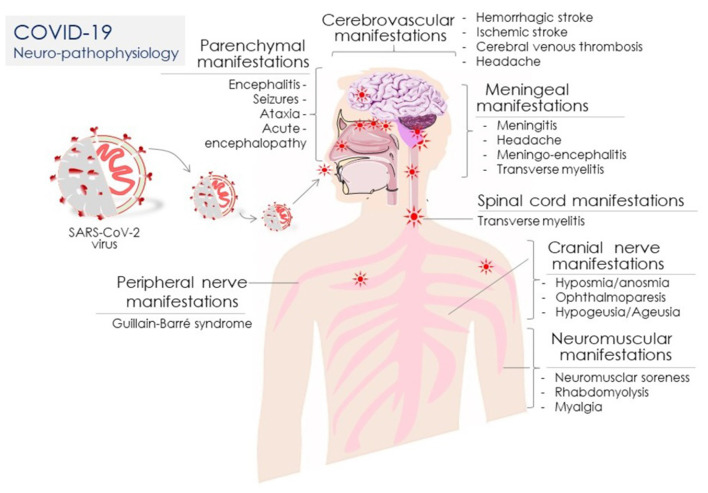
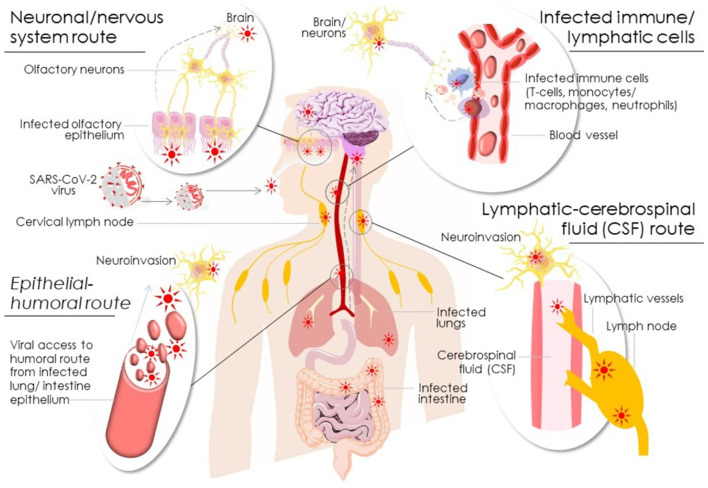
The spectrum of health complications instigated by coronavirus disease 2019 (COVID-19, caused by the novel severe acute respiratory syndrome coronavirus 2 or SARS-CoV-2) pandemic has been diverse and complex. Besides the evident pulmonary and cardiovascular threats, accumulating clinical data points to several neurological complications, which are more common in elderly COVID-19 patients. Recent pieces of evidence have marked events of neuro infection and neuroinvasion, producing several neurological complications in COVID-19 patients; however, a systematic understanding of neuro-pathophysiology and manifested neurological complications, more specifically in elderly COVID-19 patients is largely elusive. Since the elderly population gradually develops neurological disorders with aging, COVID-19 inevitably poses a higher risk of neurological manifestations to the aged patients. In this report, we reviewed SARS-CoV-2 infection and its role in neurological manifestations with an emphasis on the elderly population. We reviewed neuropathological events including neuroinfection, neuroinvasion, and their underlying mechanisms affecting neuromuscular, central- and peripheral- nervous systems. We further assessed the imminent neurological challenges in the COVID-19 exposed population, post-SARS-CoV-2-infection. Given the present state of clinical preparedness, the emerging role of AI and machine learning was also discussed concerning COVID-19 diagnostics and its management. Taken together, the present review summarizes neurological outcomes of SARS-CoV-2 infection and associated complications, specifically in elderly patients, and underlines the need for their clinical management in advance.
2019年冠状病毒病(COVID-19,由新型严重急性呼吸综合征冠状病毒2即SARS-CoV-2引起)大流行引发的健康并发症范围多样且复杂。除了明显的肺部和心血管威胁外,越来越多的临床数据表明存在几种神经并发症,这些并发症在老年COVID-19患者中更为常见。最近的证据表明了神经感染和神经侵袭事件,在COVID-19患者中产生了几种神经并发症;然而,对神经病理生理学以及所表现出的神经并发症的系统理解,尤其是在老年COVID-19患者中,在很大程度上仍然难以捉摸。由于老年人群随着年龄增长逐渐出现神经障碍,COVID-19不可避免地给老年患者带来更高的神经表现风险。在本报告中,我们回顾了SARS-CoV-2感染及其在神经表现中的作用,重点关注老年人群。我们回顾了神经病理事件,包括神经感染、神经侵袭及其影响神经肌肉、中枢和周围神经系统的潜在机制。我们进一步评估了SARS-CoV-2感染后COVID-19暴露人群面临的紧迫神经挑战。鉴于目前的临床准备状态,还讨论了人工智能和机器学习在COVID-19诊断及其管理方面的新作用。综上所述,本综述总结了SARS-CoV-2感染的神经学结果及相关并发症,特别是在老年患者中,并强调了提前对其进行临床管理的必要性。