Pupier Chloé A, Grover Renaud, Fine Maoz, Rottier Cécile, van de Water Jeroen A J M, Ferrier-Pagès Christine
Marine Department, Centre Scientifique de Monaco, Monaco, Monaco.
Collège Doctoral, Sorbonne Université, Paris, France.
Front Microbiol. 2021 Jun 4;12:657759. doi: 10.3389/fmicb.2021.657759. eCollection 2021.
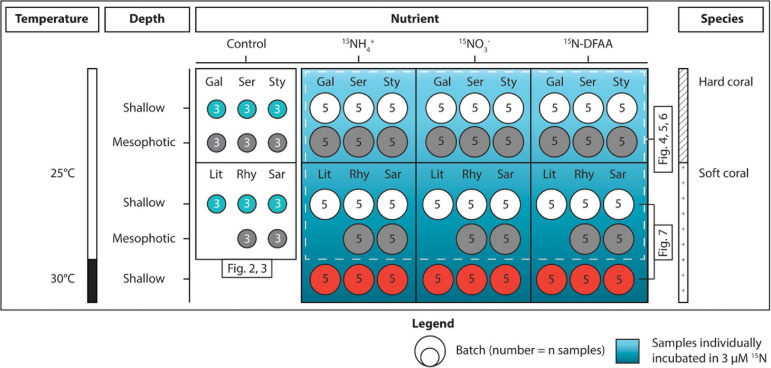
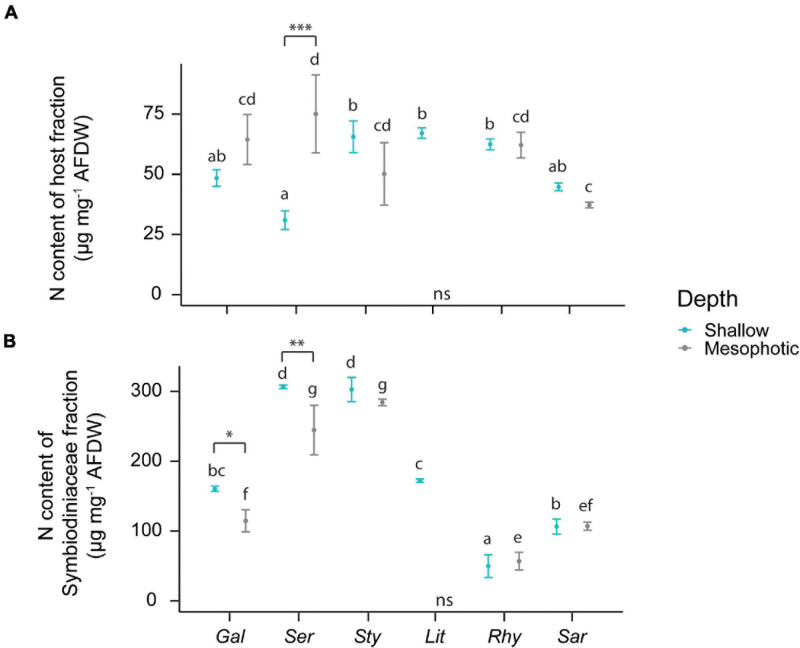
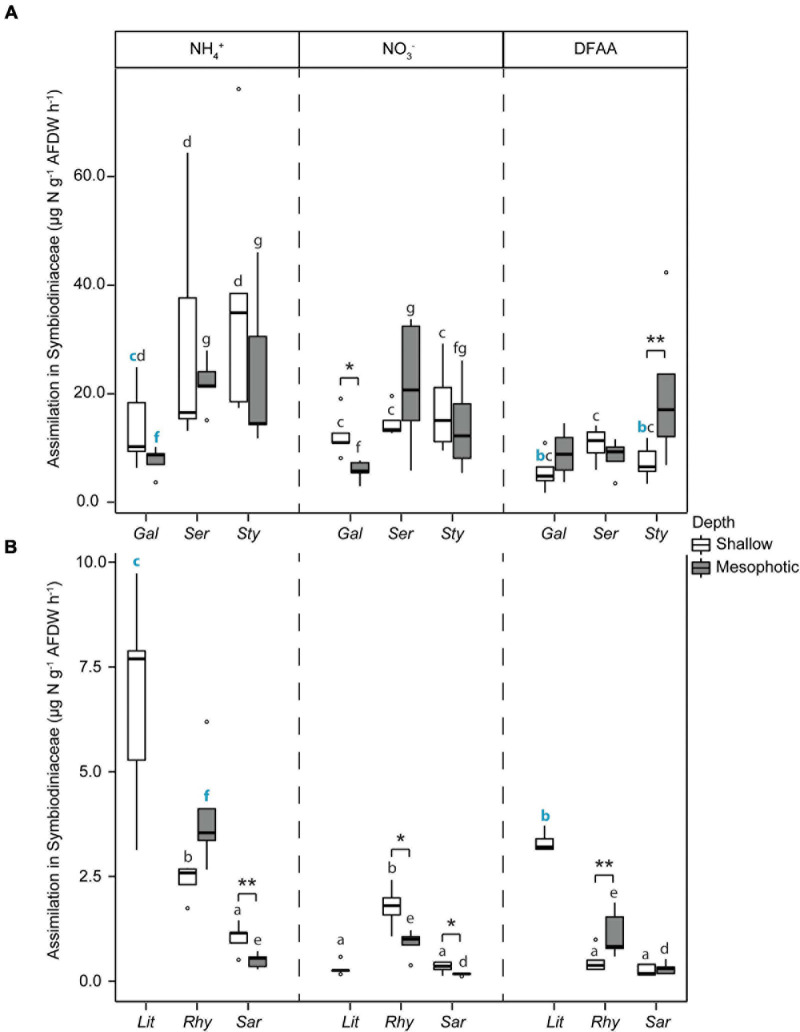
Nitrogen is one of the limiting nutrients for coral growth and primary productivity. Therefore, the capacity of different associations between corals and their algal symbionts (Symbiodiniaceae) to efficiently exploit the available nitrogen sources will influence their distribution and abundance. Recent studies have advanced our understanding of nitrogen assimilation in reef-building scleractinian (hard) coral-Symbiodiniaceae symbioses. However, the nutrient metabolism of other coral taxa, such as Alcyoniina (soft corals), remains underexplored. Using stable isotope labeling, we investigated the assimilation of dissolved nitrogen (i.e., ammonium, nitrate, and free amino acids) by multiple species of soft and hard corals sampled in the Gulf of Aqaba in shallow (8-10 m) and mesophotic (40-50 m) reefs. Our results show that dissolved nitrogen assimilation rates per tissue biomass were up to 10-fold higher in hard than in soft coral symbioses for all sources of nitrogen. Although such differences in assimilation rates could be linked to the Symbiodiniaceae density, Symbiodiniaceae species, or the C:N ratio of the host and algal symbiont fractions, none of these parameters were different between the two coral taxa. Instead, the lower assimilation rates in soft coral symbioses might be explained by their different nutritional strategy: whereas soft corals may obtain most of their nitrogen via the capture of planktonic prey by the coral host (heterotrophic feeding), hard corals may rely more on dissolved nitrogen assimilation by their algal symbionts to fulfill their needs. This study highlights different nutritional strategies in soft and hard coral symbioses. A higher reliance on heterotrophy may help soft corals to grow in reefs with higher turbidity, which have a high concentration of particles in suspension in seawater. Further, soft corals may benefit from lower dissolved nitrogen assimilation rates in areas with low water quality.
氮是珊瑚生长和初级生产力的限制营养素之一。因此,珊瑚与其藻类共生体(共生藻科)之间不同组合有效利用可用氮源的能力将影响它们的分布和丰度。最近的研究增进了我们对造礁石珊瑚(硬珊瑚)-共生藻科共生体中氮同化的理解。然而,其他珊瑚类群,如软珊瑚亚纲(软珊瑚)的营养代谢仍未得到充分研究。我们使用稳定同位素标记法,研究了在亚喀巴湾浅海(8 - 10米)和中光层(40 - 50米)珊瑚礁采集的多种软珊瑚和硬珊瑚对溶解态氮(即铵、硝酸盐和游离氨基酸)的同化情况。我们的结果表明,对于所有氮源,硬珊瑚共生体中每单位组织生物量的溶解态氮同化率比软珊瑚共生体高多达10倍。尽管同化率的这种差异可能与共生藻密度、共生藻种类,或宿主与藻类共生体部分的碳氮比有关,但这两个珊瑚类群之间这些参数并无差异。相反,软珊瑚共生体中较低的同化率可能由其不同的营养策略来解释:软珊瑚可能通过珊瑚宿主捕获浮游猎物(异养摄食)获取大部分氮,而硬珊瑚可能更多地依赖其藻类共生体对溶解态氮的同化来满足自身需求。这项研究突出了软珊瑚和硬珊瑚共生体不同的营养策略。对异养的更高依赖可能有助于软珊瑚在海水悬浮颗粒浓度高、浊度更高的珊瑚礁中生长。此外,在水质较差的区域,软珊瑚可能受益于较低的溶解态氮同化率