Department of Experimental Psychology, Regensburg University, 93040, Regensburg, Germany.
Mem Cognit. 2021 Nov;49(8):1677-1689. doi: 10.3758/s13421-021-01192-z. Epub 2021 Jun 23.
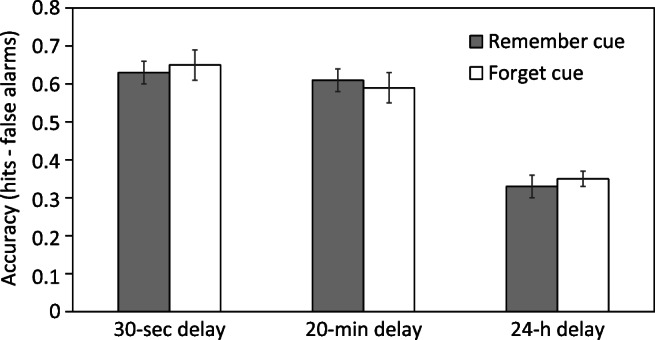
People can purposefully forget information that has become irrelevant, as is demonstrated in list-method directed forgetting (LMDF). In this task, participants are cued to intentionally forget an already studied list (list 1) before encoding a second list (list 2); this induces forgetting of the first-list items. Most research on LMDF has been conducted with short retention intervals, but very recent studies indicate that such directed forgetting can be lasting. We examined in two experiments whether core findings in the LMDF literature generalize from short to long retention intervals. The focus of Experiment 1 was on the previous finding that, with short retention interval, list-2 encoding is necessary for list-1 forgetting to arise. Experiment 1 replicated the finding after a short delay of 3 min between study and test and extended it to a longer delay of 20 min. The focus of Experiment 1 was on the absence of list-1 forgetting in item recognition, previously observed after short retention interval. Experiment 1 replicated the finding after a short delay of 3 min between study and test and extended it to longer delays of 20 min and 24 h. Implications of the results for theoretical explanations of LMDF are discussed.
人们可以有目的地忘记已经变得无关的信息,这在列表法定向遗忘(LMDF)中得到了证明。在这个任务中,参与者在编码第二个列表(列表 2)之前被提示有意忘记已经学习过的列表(列表 1);这会导致对第一个列表项目的遗忘。大多数关于 LMDF 的研究都是在短的保留间隔内进行的,但最近的研究表明,这种定向遗忘可以持续很长时间。我们在两项实验中检验了 LMDF 文献中的核心发现是否可以从短的保留间隔推广到长的保留间隔。实验 1 的重点是先前的发现,即在短的保留间隔内,列表 2 的编码对于列表 1 的遗忘的出现是必要的。实验 1 在研究和测试之间的 3 分钟短延迟后复制了这一发现,并将其扩展到 20 分钟的更长延迟。实验 1 的重点是在短的保留间隔后,在项目识别中观察到的列表 1 遗忘的缺失。实验 1 在研究和测试之间的 3 分钟短延迟后复制了这一发现,并将其扩展到更长的 20 分钟和 24 小时延迟。这些结果对 LMDF 的理论解释的影响进行了讨论。