Program in Public Health, Department of Family, Population, and Preventive Medicine, Stony Brook University, Stony Brook, NY, United States of America.
Department of Anesthesiology, Stony Brook University, Stony Brook, NY, United States of America.
PLoS One. 2021 Jun 24;16(6):e0253053. doi: 10.1371/journal.pone.0253053. eCollection 2021.
As the global burden of dementia increases, the absence of treatment underscores the need for identification of factors that may improve cognitive reserve-the ability to stave off cognitive decline in old age. The beneficial association between musical instrument engagement and episodic memory has been identified in children, young adults, and older adults. Yet, previous studies in musical instrument engagement have rarely examined the potential for adolescence and adulthood exposures to independently improve cognition, nor have they been linked with the rate of memory decline over time in older adults. We investigated whether adolescent musical instrument engagement and continued musical instrument engagement over the adult life course were separately associated with higher episodic memory, as well as rate of decline in a large longitudinal cohort.
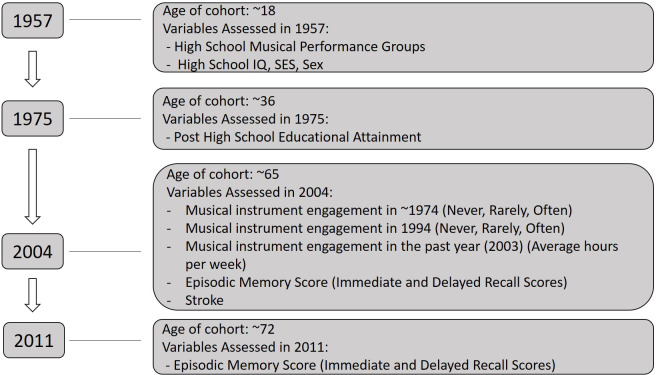
Data were from a prospective cohort of high school graduates from 1957. High school music engagement (HSME) was ascertained through graduate yearbooks and assessed as membership in musical performance groups. A questionnaire was used to assess musical engagement through adulthood (MEA) at ages 35, 55, and 65. The episodic memory score was composed of immediate and delayed recall task scores, and was assessed when participants were aged approximately 65 and 72 years old among 5,718 individuals. Linear mixed models were used to assess the association between music, and memory performance and decline over time.
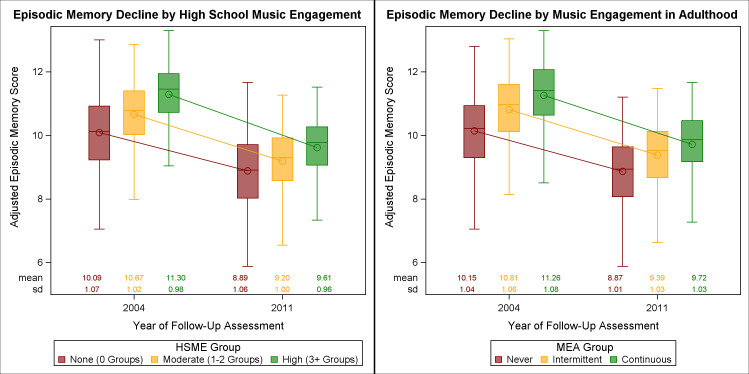
Of high school graduates who participated in the study, 38.1% played music in high school, and 21.1% played music in adulthood. While musical engagement was more common in those who played in childhood, 40% of those who played continuously as an adult did not play in high school. High HSME (B = 0.348, p = 0.049) and continuous MEA (B = 0.424, p = 0.012) were associated with higher memory scores at age 65 after covariate adjustment. When examining memory decline, the benefits of high HSME decreased over time (B = -0.435, p = 0.048), while the rate of decline did not differ between MEA groups. Exploratory models revealed differential benefits for HSME and immediate recall, and MEA and delayed recall.
This study provides further evidence that musical engagement in childhood or adulthood is associated with non-musical cognitive reserve. These two exposures may act differentially in different domains of episodic memory. Further work is needed to determine the relationship between musicianship and the rate of cognitive decline.
随着全球痴呆症负担的增加,缺乏治疗方法突显了识别可能提高认知储备能力的因素的必要性——认知储备能力是指在老年时避免认知能力下降的能力。在儿童、年轻人和老年人中,乐器演奏与情景记忆之间存在有益的关联。然而,以前关于乐器演奏的研究很少考察青少年和成年期的暴露是否能独立提高认知能力,也没有将其与老年人随时间推移的记忆衰退速度联系起来。我们调查了青少年时期的乐器演奏参与度以及成年后持续的乐器演奏参与度是否分别与较高的情景记忆能力以及较大的纵向队列中的记忆衰退速度有关。
数据来自于 1957 年的一项高中毕业生前瞻性队列研究。通过毕业年鉴确定高中时期的音乐参与度(HSME),并评估是否参加过音乐表演团体。使用问卷评估 35 岁、55 岁和 65 岁时的成年音乐参与度(MEA)。情景记忆评分由即时和延迟回忆任务评分组成,在 5718 名参与者中,大约在 65 岁和 72 岁时进行评估。线性混合模型用于评估音乐与记忆表现和随时间的衰退之间的关系。
在参加研究的高中毕业生中,38.1%的人在高中时演奏过音乐,21.1%的人在成年后演奏过音乐。虽然在童年时期演奏音乐更为常见,但 40%的连续成年演奏者在高中时并未演奏过音乐。较高的 HSME(B=0.348,p=0.049)和持续的 MEA(B=0.424,p=0.012)在调整协变量后与 65 岁时较高的记忆评分相关。在检查记忆衰退时,较高的 HSME 益处随时间减少(B=-0.435,p=0.048),而 MEA 组之间的衰退速度没有差异。探索性模型显示 HSME 与即时回忆、MEA 与延迟回忆之间存在不同的益处。
本研究进一步证明了儿童期或成年期的乐器演奏与非音乐认知储备有关。这两种暴露可能在情景记忆的不同领域中发挥不同的作用。需要进一步研究来确定音乐才能与认知衰退速度之间的关系。