Buckley Georgina Louise, Hall Linden Elizabeth, Lassemillante Annie-Claude M, Belski Regina
Department of Nursing and Allied Health, Swinburne University of Technology, John St, Hawthorn, Victoria, 3122, Australia.
Charles Perkins Centre, Inside Out Institute, Sydney University, John Hopkins Drive, Camperdown, New South Wales, 2050, Australia.
J Eat Disord. 2021 Jun 24;9(1):73. doi: 10.1186/s40337-021-00427-3.
The COVID-19 pandemic has seen worsened mental health as a result of lockdowns, isolation and changes to sociocultural functioning. The postponement of the Tokyo 2020 Olympics is representative of global cancellations of sporting events, reduced facility access and support restrictions that have affected both current and former athlete's psychological wellbeing. This study aimed to determine whether current (n = 93) and former (n = 111) athletes experienced worsened body image, relationship with food or eating disorder symptomatology during acute COVID-19 transitions.
The study was a Convergent Mixed Methods design whereby qualitative content analysis was collected and analysed simultaneously with quantitative cross-sectional data using the EAT-26 and self-report COVID-19 questions. Data were collected from April until May 2020 to capture data pertaining to transitions related to the pandemic and included individuals across 41 different individual and team sports from club to international competition levels.
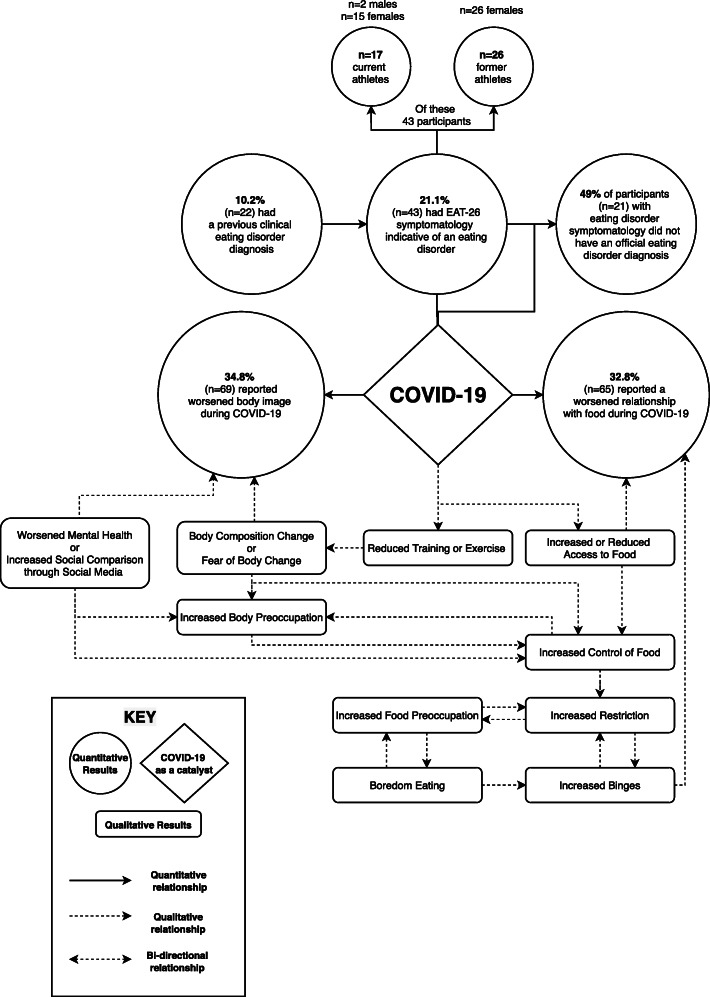
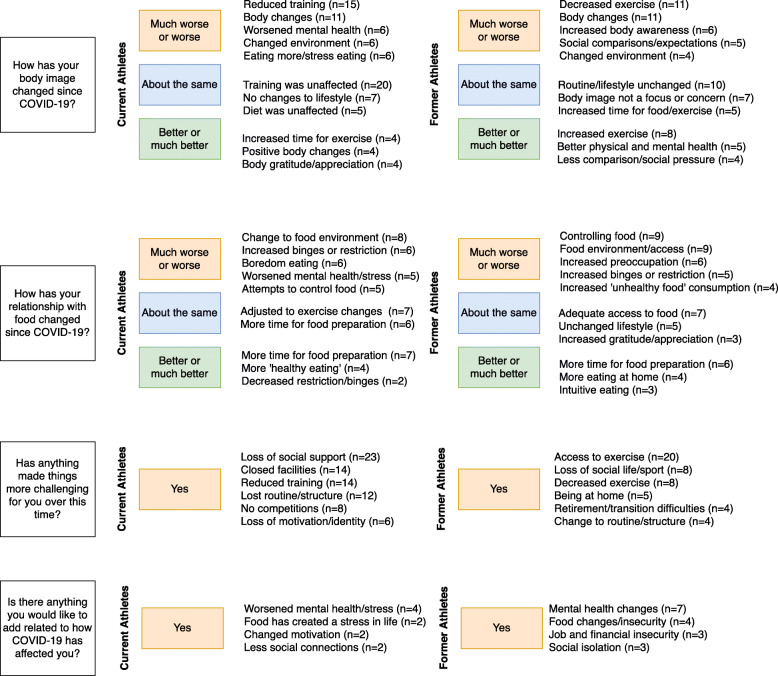
There was a surge in disordered eating in current and former athletes as a result of the early COVID-19 response. Eating disorders were suggested to occur in 21.1% of participants (18% current athletes n = 17, 25% former athletes (n = 26). There was a significant difference between males and females (p = 0.018, r = 0.17), but interestingly no differences between groups from individual vs team sports, type of sporting category (endurance, antigravitational, ball sport, power, technical and aesthetic) or level of competition (club, state, national or international). 34.8% (n = 69) self-reported worsened body image and 32.8% (n = 65) self-reported a worsened food relationship directly from COVID-19. Qualitative analysis indicated that disordered eating occurred predominantly in the form of body preoccupation, inhibitory food control, fear of body composition changes and binge eating.
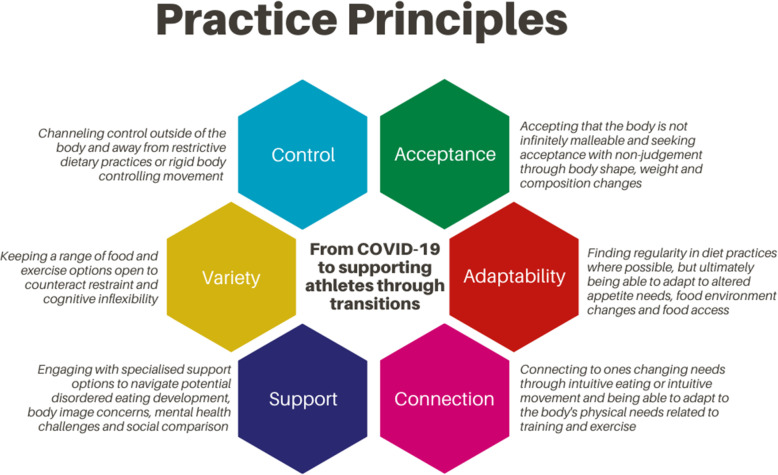
This study indicates that transitions in COVID-19 have worsened food-body relationships in current and former athletes and must be treated as an at-risk time for eating disorder development. We suggest that resources are allocated appropriately to assist athletes to foster psychologically positive food and body relationships through COVID-19 transitions. This study makes practice suggestions in supporting athletes to manage control, seek support, adapt and accept change and promote connection and variety through athletic transitions.
由于封锁、隔离以及社会文化功能的改变,新冠疫情期间人们的心理健康状况恶化。2020年东京奥运会的延期是全球体育赛事取消、场馆使用受限以及支持措施减少的一个典型例子,这些都影响了现役和退役运动员的心理健康。本研究旨在确定现役(n = 93)和退役(n = 111)运动员在新冠疫情急性期是否出现了身体意象变差、与食物的关系改变或饮食失调症状。
本研究采用收敛性混合方法设计,通过EAT - 26问卷和自我报告的新冠疫情相关问题,同时收集和分析定性内容分析与定量横断面数据。数据收集时间为2020年4月至5月,以获取与疫情相关转变的数据,涵盖了41种不同的个人和团体运动项目中的运动员,包括从俱乐部到国际比赛水平的各个层次。
由于新冠疫情初期的应对措施,现役和退役运动员中饮食失调现象激增。据推测,21.1%的参与者(18%的现役运动员,n = 17;25%的退役运动员,n = 26)出现了饮食失调。男性和女性之间存在显著差异(p = 0.018,r = 0.17),但有趣的是,个人项目与团体项目的运动员、不同运动类别(耐力、反重力、球类运动、力量、技术和审美类)或比赛水平(俱乐部、州、国家或国际级)的运动员之间没有差异。34.8%(n = 69)的人自我报告身体意象变差,32.8%(n = 65)的人自我报告因新冠疫情直接导致与食物的关系变差。定性分析表明,饮食失调主要表现为对身体的过度关注、抑制性的食物控制、对身体成分变化的恐惧和暴饮暴食。
本研究表明,新冠疫情期间的转变使现役和退役运动员与食物和身体的关系变差,必须将其视为饮食失调发展的高危时期。我们建议适当分配资源,以帮助运动员在新冠疫情期间建立积极的心理状态,处理好与食物和身体的关系。本研究为支持运动员管理控制情绪、寻求支持、适应和接受变化以及在运动转变过程中促进联系和多样化提供了实践建议。