Turku University Hospital Neurocenter, Turku, Finland.
Department of Clinical Neurosciences, University of Turku, Turku, Finland.
J Neurol. 2022 Feb;269(2):913-922. doi: 10.1007/s00415-021-10673-9. Epub 2021 Jun 25.
The optimal treatment strategy with disease-modifying therapies (DMTs) in relapsing-remitting multiple sclerosis (RRMS) remains uncertain.
To compare outcomes of initial treatment with infusion therapies and starting therapy with medium efficacy therapy in a propensity-matched cohort of Finnish RRMS patients.
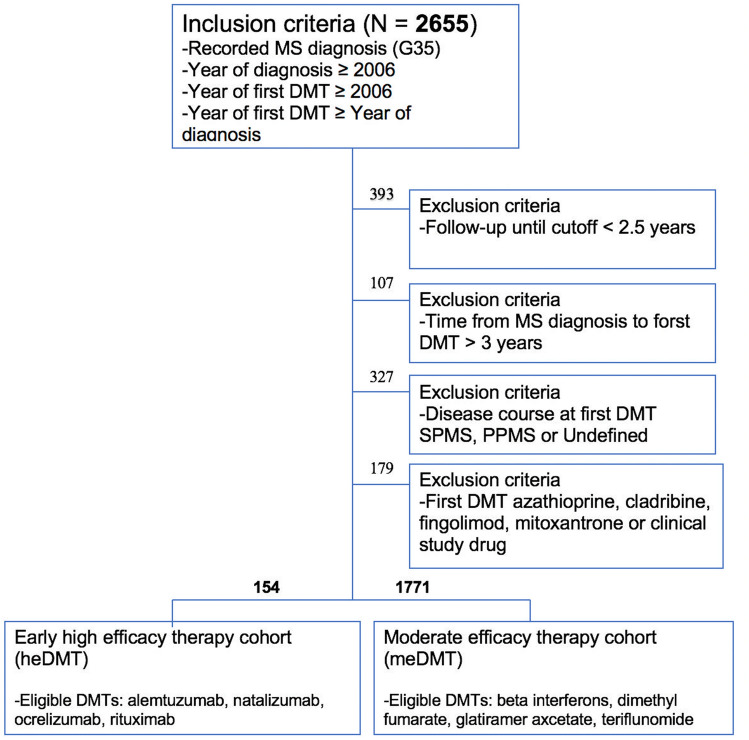
A total of 154 RRMS patients initiating natalizumab, alemtuzumab, ocrelizumab or rituximab as first DMT (high efficacy DMT, heDMT group) and 1771 patients initially treated with injectable therapies, teriflunomide or dimethylfumarate and escalated based on disease activity (moderate efficacy DMT, meDMT group) were identified from the Finnish MS registry. Nearest neighbor propensity matching (1:1, caliper 0.1) was performed for age, sex, baseline Expanded Disability Status Scale (EDSS), annual relapse rate (ARR) one year prior DMT and time since MS symptom onset. Primary outcome was time to 6-month confirmed EDSS progression and the secondary outcome time to first relapse.
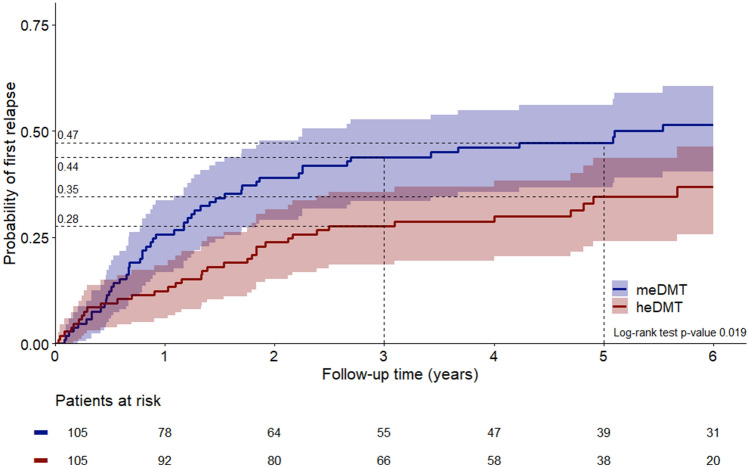
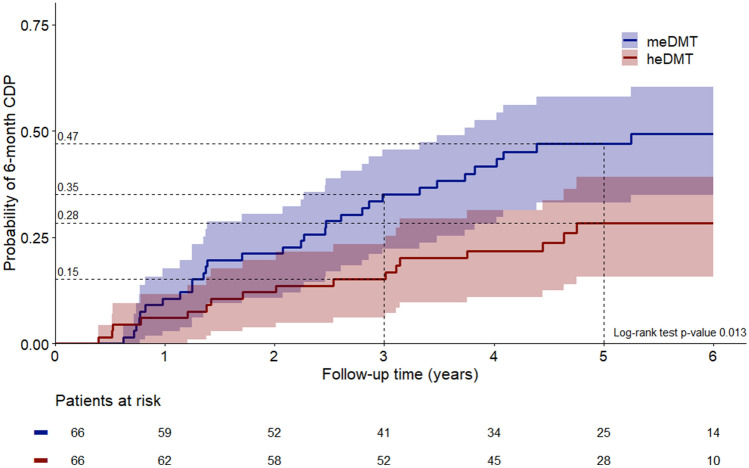
In the propensity-matched group comparisons, the probability of 6-month confirmed disability progression (CDP) at 5 years after DMT start was 28.4% (95% CI 15.7-39.3) in the heDMT group (n = 66) and 47.0% (95% CI 33.1-58.1) in meDMT group (n = 66), p = 0.013. Probability of relapse at 5 years was 34.6% (95% CI 24.1-43.6) for heDMT (n = 105) and 47.2% (95% CI 36.6-56.1) for meDMT (n = 105), p = 0.019.
Initiating MS-therapy with heDMT significantly reduced the risk of 5-year disability progression and relapse compared to using meDMT as first DMT choice in propensity-matched groups of Finnish MS-patients.
在复发缓解型多发性硬化症(RRMS)中,采用疾病修正治疗(DMT)的最佳治疗策略仍不确定。
在芬兰 RRMS 患者的倾向匹配队列中,比较输注治疗和中等疗效治疗初始治疗的结果。
从芬兰 MS 登记处确定了 154 例首次接受那他珠单抗、阿仑单抗、奥瑞珠单抗或利妥昔单抗作为一线 DMT(高效能 DMT,heDMT 组)和 1771 例首次接受注射治疗、特立氟胺或二甲基富马酸,并根据疾病活动度升级为中等疗效 DMT(meDMT 组)的 RRMS 患者。采用最近邻倾向匹配(1:1,卡尺 0.1),匹配年龄、性别、基线扩展残疾状况量表(EDSS)、DMT 前一年的年复发率(ARR)和 MS 症状发作后的时间。主要结局是 6 个月时确认的 EDSS 进展时间,次要结局是首次复发时间。
在倾向匹配组比较中,在 DMT 开始后 5 年,heDMT 组(n=66)6 个月时确认残疾进展(CDP)的概率为 28.4%(95%CI 15.7-39.3),meDMT 组(n=66)为 47.0%(95%CI 33.1-58.1),p=0.013。heDMT 组(n=105)5 年时的复发率为 34.6%(95%CI 24.1-43.6),meDMT 组(n=105)为 47.2%(95%CI 36.6-56.1),p=0.019。
在芬兰 MS 患者的倾向匹配组中,与使用 meDMT 作为一线 DMT 选择相比,起始使用 heDMT 治疗可显著降低 5 年残疾进展和复发的风险。