Tian Yongan, Xu Hongen, Liu Danhua, Zhang Juanli, Yang Zengguang, Zhang Sen, Liu Huanfei, Li Ruijun, Tian Yingtao, Zeng Beiping, Li Tong, Lin Qianyu, Wang Haili, Li Xiaohua, Lu Wei, Shi Ying, Zhang Yan, Zhang Hui, Jiang Chang, Xu Ying, Chen Bei, Liu Jun, Tang Wenxue
BGI College, Zhengzhou University, Zhengzhou, China.
Henan Institute of Medical and Pharmaceutical Sciences, Zhengzhou University, Zhengzhou, China.
Mol Genet Genomic Med. 2021 Aug;9(8):e1734. doi: 10.1002/mgg3.1734. Epub 2021 Jun 25.
The enlarged vestibular aqueduct (EVA) is the commonest malformation of inner ear accompanied by sensorineural hearing loss in children. Three genes SLC26A4, FOXI1, and KCNJ10 have been associated with EVA, among them SLC26A4 being the most common. Yet, hotspot mutation screening can only diagnose a small number of patients.
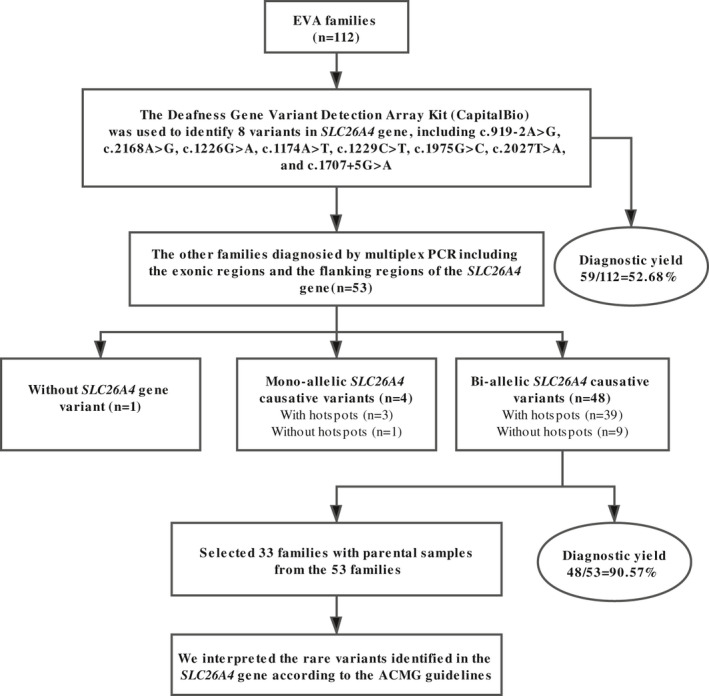
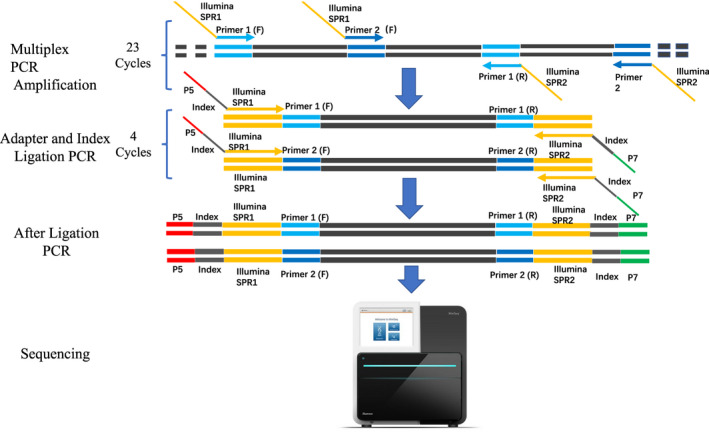
Thus, in this study, we designed a new molecular diagnosis panel for EVA based on multiplex PCR enrichment and next-generation sequencing of the exon and flanking regions of SLC26A4. A total of 112 hearing loss families with EVA were enrolled and the pathogenicity of the rare variants detected was interpreted according to the American College of Medical Genetics and Genomics (ACMG) guidelines.
Our results showed that 107/112 (95.54%) families carried SLC26A4 biallelic mutations, 4/112 (3.57%) carried monoallelic variants, and 1/112 (0.89%) had none variant, resulting in a diagnostic rate of 95.54%. A total of 49 different variants were detected in those patients and we classified 30 rare variants as pathogenic/likely pathogenic, of which 13 were not included in the Clinvar database.
Our diagnostic panel has an increased diagnostic yield with less cost, and the curated list of pathogenic variants in the SLC26A4 gene can be directly used to aid the genetic counseling to patients.
扩大的前庭导水管(EVA)是儿童内耳最常见的畸形,常伴有感音神经性听力损失。三个基因SLC26A4、FOXI1和KCNJ10与EVA相关,其中SLC26A4最为常见。然而,热点突变筛查仅能诊断少数患者。
因此,在本研究中,我们基于多重PCR富集和SLC26A4外显子及侧翼区域的二代测序设计了一种新的EVA分子诊断面板。共纳入112个伴有EVA的听力损失家庭,并根据美国医学遗传学与基因组学学会(ACMG)指南解释所检测到的罕见变异的致病性。
我们的结果显示,107/112(95.54%)的家庭携带SLC26A4双等位基因突变,4/112(3.57%)携带单等位基因变异,1/112(0.89%)无变异,诊断率为95.54%。在这些患者中共检测到49种不同的变异,我们将30种罕见变异分类为致病性/可能致病性,其中13种未包含在Clinvar数据库中。
我们的诊断面板提高了诊断率且成本更低,SLC26A4基因中经过整理的致病性变异列表可直接用于帮助患者进行遗传咨询。