Schiergens Katharina A, Weiss Katharina J, Röschinger Wulf, Lotz-Havla Amelie S, Schmitt Joachim, Dalla Pozza Robert, Ulrich Sarah, Odenwald Birgit, Kreuder Joachim, Maier Esther M
Department of Inborn Errors of Metabolism, Dr. von Hauner Children's Hospital, Ludwig-Maximilians-University, Lindwurmstr. 4, 80337, Munich, Germany.
Newborn Screening Unit, Becker and colleagues laboratory, Ottobrunner Str. 6, 81737, Munich, Germany.
Mol Genet Metab Rep. 2021 Jun 12;28:100776. doi: 10.1016/j.ymgmr.2021.100776. eCollection 2021 Sep.
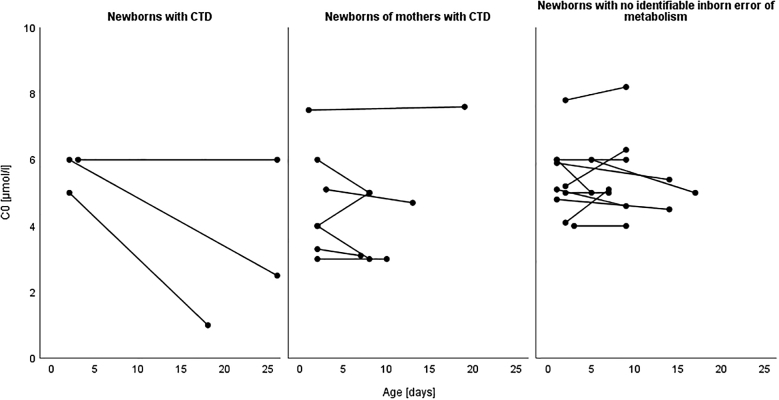
Carnitine transporter defect (CTD) is a potentially life-threatening disorder causing acute metabolic decompensation, cardiac arrhythmia, and cardiac and skeletal myopathies. CTD is included in many newborn screening (NBS) programs. The screening parameter free carnitine, however, is influenced by maternal conditions due to placental transfer. This study reviewed the NBS results for CTD as part of a pilot study in Bavaria, Germany, and the long-term follow-up of the identified patients treated in our center between January 1999 and June 2018. Among 1,816,000 Bavarian NBS samples, six newborns were diagnosed with CTD (incidence of 1:302,667; positive predictive value (PPV) of 1.63% from 2008 to 2018). In the 24 newborns presented to our center for confirmatory testing, we detected four newborns and six mothers with CTD, one newborn and three mothers in whom CTD was presumed but not genetically confirmed, and one mother with glutaric aciduria type I. In 11 newborns, no indication for an inborn error of metabolism was found. The newborns and mothers with CTD had no serious cardiac adverse events or relevant muscular symptoms at diagnosis and during treatment for up to 14 years. Three mothers were lost to follow-up. Revealing a lower incidence than expected, our data confirm that NBS for CTD most likely misses newborns with CTD. It rather produces high numbers of false-positives and a low PPV picking up asymptomatic mothers with a diagnosis of uncertain clinical significance. Our data add to the growing evidence that argues against an implementation of CTD in NBS programs.
肉碱转运体缺陷(CTD)是一种可能危及生命的疾病,可导致急性代谢失代偿、心律失常以及心脏和骨骼肌病变。CTD已被纳入许多新生儿筛查(NBS)项目。然而,由于胎盘转运,筛查参数游离肉碱会受到母体状况的影响。本研究回顾了德国巴伐利亚州一项试点研究中CTD的NBS结果,以及1999年1月至2018年6月在我们中心接受治疗的确诊患者的长期随访情况。在1,816,000份巴伐利亚州NBS样本中,有6名新生儿被诊断为CTD(发病率为1:302,667;2008年至2018年的阳性预测值(PPV)为1.63%)。在转诊至我们中心进行确诊检测的24名新生儿中,我们检测到4名新生儿和6名母亲患有CTD,1名新生儿和3名母亲疑似患有CTD但未得到基因确诊,以及1名患有I型戊二酸血症的母亲。在11名新生儿中,未发现先天性代谢缺陷的迹象。患有CTD的新生儿和母亲在诊断时以及长达14年的治疗期间均未出现严重的心脏不良事件或相关肌肉症状。3名母亲失访。我们的数据显示发病率低于预期,证实CTD的NBS很可能遗漏了患有CTD的新生儿。它反而产生了大量假阳性结果,且PPV较低,检出了临床意义不确定的无症状母亲。我们的数据进一步证明了反对在NBS项目中实施CTD筛查的证据越来越多。