Yang Ying, Liu Zhuogang, Wang Hongtao, Zhang Guojun
Department of Hematology, Shengjing Hospital of China Medical University, Shenyang, China.
Front Oncol. 2021 Jun 9;11:670673. doi: 10.3389/fonc.2021.670673. eCollection 2021.
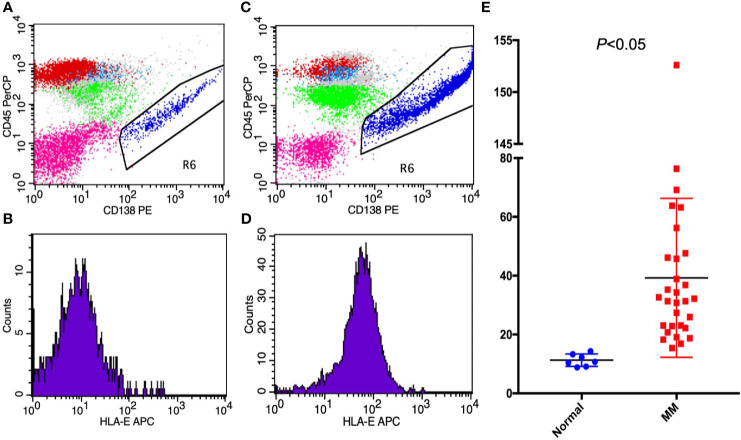
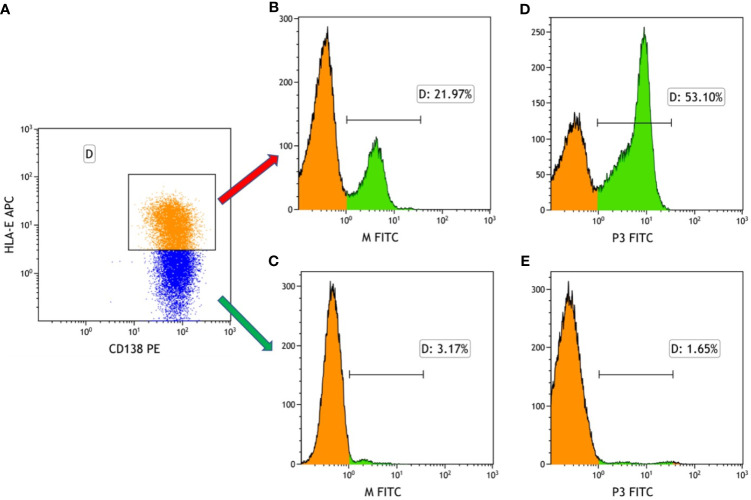
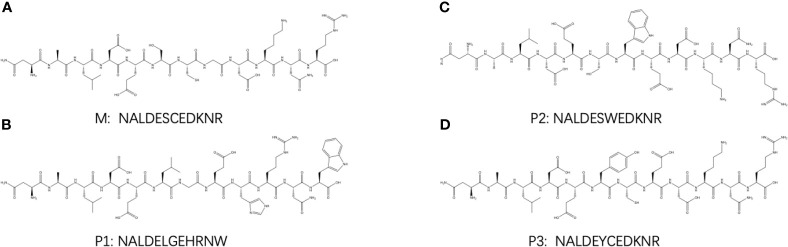
Human leukocyte antigen-E (HLA-E) has been putatively associated with the pathogenesis of multiple myeloma (MM). Our study first showed that HLA-E was differentially expressed on MM and normal plasma cells (39.27 ± 27.01 and 11.28 ± 0.79, respectively). Based on the median value of HLA-E expression, we further stratified MM patients into high and low-expression groups, and then found high expression of HLA-E was correlated with advanced ISS stage (p = 0.025) and high-risk cytogenetics risk stratification (p = 0.000) by the Pearson Chi-square test, suggesting that HLA-E could be considered as a biomarker for high-risk MM. Furthermore, peptide 3 (P3) from our previous study was confirmed to possess a high affinity to HLA-E positive MM cells. Taken together, HLA-E could be considered as a new marker and candidate treatment target for MM, while peptide P3 may act as a potential treatment choice for targeting MM cells.
人类白细胞抗原E(HLA-E)被推测与多发性骨髓瘤(MM)的发病机制有关。我们的研究首次表明,HLA-E在MM细胞和正常浆细胞上存在差异表达(分别为39.27±27.01和11.28±0.79)。基于HLA-E表达的中位数,我们进一步将MM患者分为高表达组和低表达组,然后通过Pearson卡方检验发现HLA-E高表达与国际分期系统(ISS)晚期(p = 0.025)和高危细胞遗传学风险分层(p = 0.000)相关,这表明HLA-E可被视为高危MM的生物标志物。此外,我们之前研究中的肽3(P3)被证实对HLA-E阳性的MM细胞具有高亲和力。综上所述,HLA-E可被视为MM的新标志物和候选治疗靶点,而肽P3可能作为靶向MM细胞的潜在治疗选择。