Nuffield Department of Medicine, Jenner Institute, University of Oxford, Oxford, UK.
Nuffield Department of Medicine, NDM Research Building, University of Oxford, Oxford, UK.
Clin Exp Immunol. 2019 May;196(2):167-177. doi: 10.1111/cei.13292. Epub 2019 Apr 9.
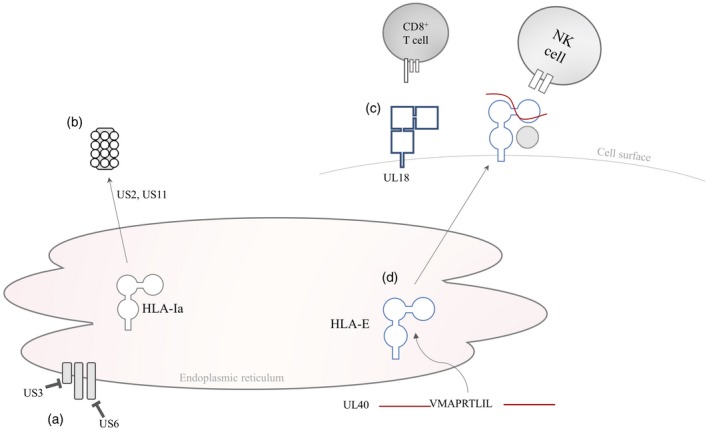
Viruses, when used as vectors for vaccine antigen delivery, can induce strong cellular and humoral responses against target epitopes. Recent work by Hansen et al. describes the use of a cytomegalovirus-vectored vaccine, which is able to generate a stable effector-memory T cell population at the sites of vaccination in rhesus macaques. This vaccine, targeted towards multiple epitopes in simian immunodeficiency virus (SIV), did not induce classical CD8 T cells. However, non-canonical CD8 T cell induction occurred via major histocompatibility complex (MHC) class II and MHC-E. The MHC-E-restricted T cells could recognize broad epitopes across the SIV peptides, and conferred protection against viral challenge to 55% of vaccinated macaques. The human homologue, human leucocyte antigen (HLA)-E, is now being targeted as a new avenue for vaccine development. In humans, HLA-E is an unusually oligomorphic class Ib MHC molecule, in comparison to highly polymorphic MHC class Ia. Whereas MHC class Ia presents peptides derived from pathogens to T cells, HLA-E classically binds defined leader peptides from class Ia MHC peptides and down-regulates NK cell cytolytic activity when presented on the cell surface. HLA-E can also restrict non-canonical CD8 T cells during natural infection with various pathogens, although the extent to which they are involved in pathogen control is mostly unknown. In this review, an overview is provided of HLA-E and its ability to interact with NK cells and non-canonical T cells. Also discussed are the unforeseen beneficial effects of vaccination, including trained immunity of NK cells from bacille Calmette-Guérin (BCG) vaccination, and the broad restriction of non-canonical CD8 T cells by cytomegalovirus (CMV)-vectored vaccines in pre-clinical trials.
病毒作为疫苗抗原传递载体,可诱导针对靶表位的强烈细胞和体液反应。Hansen 等人最近的工作描述了使用巨细胞病毒载体疫苗,该疫苗能够在恒河猴的疫苗接种部位产生稳定的效应记忆 T 细胞群体。这种针对猿猴免疫缺陷病毒 (SIV) 多个表位的疫苗不会诱导经典的 CD8 T 细胞。然而,通过主要组织相容性复合体 (MHC) Ⅱ类和 MHC-E 发生了非典型的 CD8 T 细胞诱导。MHC-E 限制性 T 细胞能够识别 SIV 肽中的广泛表位,并为 55%接种疫苗的猕猴提供了对病毒攻击的保护。人类同源物 HLA-E 现在作为疫苗开发的新途径正在被靶向。在人类中,与高度多态性的 MHC Ⅰ类相比,HLA-E 是一种异常寡态的Ⅰ类 MHC 分子。MHC Ⅰ类将来自病原体的肽呈递给 T 细胞,而 HLA-E 经典地结合来自 MHC Ⅰ类肽的特定前导肽,并在细胞表面呈递时下调 NK 细胞细胞毒性活性。HLA-E 还可以在各种病原体的自然感染中限制非典型的 CD8 T 细胞,尽管它们在病原体控制中的参与程度大多未知。在这篇综述中,概述了 HLA-E 及其与 NK 细胞和非典型 T 细胞相互作用的能力。还讨论了疫苗接种的意外有益效果,包括卡介苗 (BCG) 接种的 NK 细胞的训练免疫,以及在临床前试验中巨细胞病毒 (CMV) 载体疫苗对非典型 CD8 T 细胞的广泛限制。