Cheng Yunyun, Li Wanqiao, Gui Ruirui, Wang Chunli, Song Jie, Wang Zhaoguo, Wang Xue, Shen Yannan, Wang Zhicheng, Hao Linlin
NHC Key Laboratory of Radiobiology, School of Public Health, Jilin University, Changchun, China.
College of Animal Science, Jilin University, Changchun, China.
Front Cell Dev Biol. 2021 Jun 9;9:671247. doi: 10.3389/fcell.2021.671247. eCollection 2021.
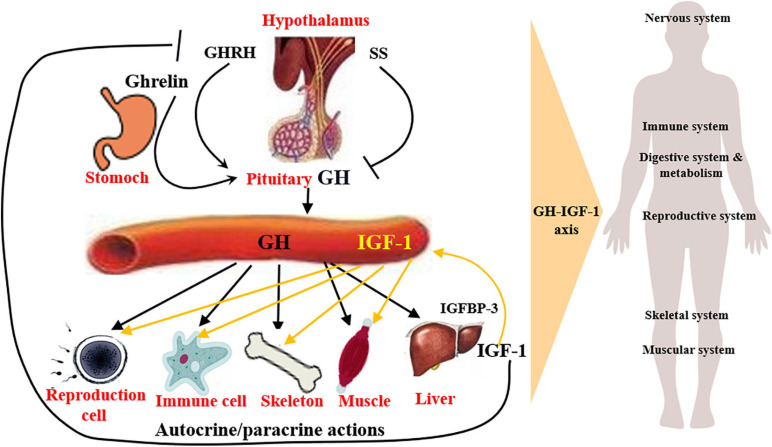
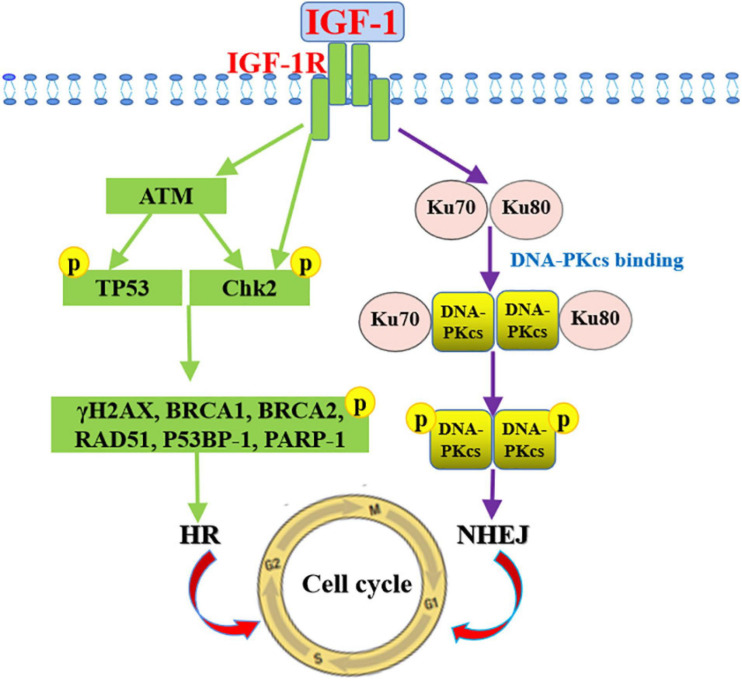
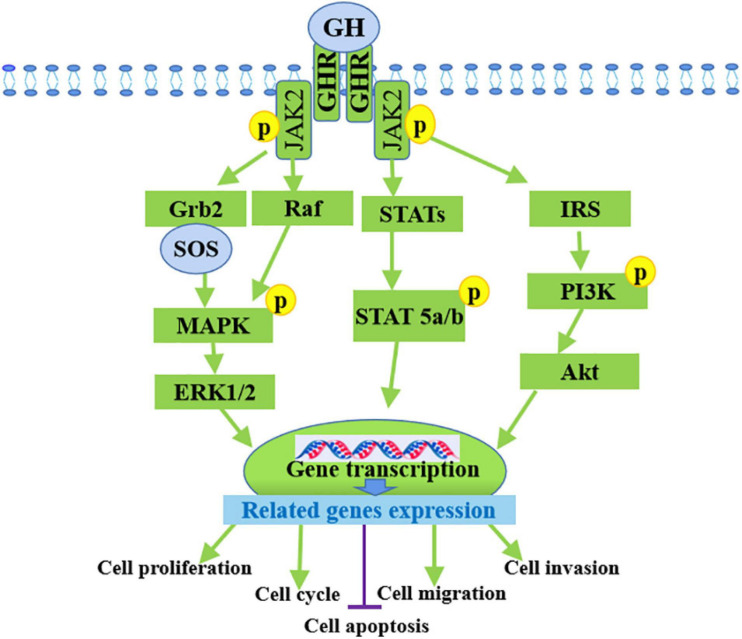
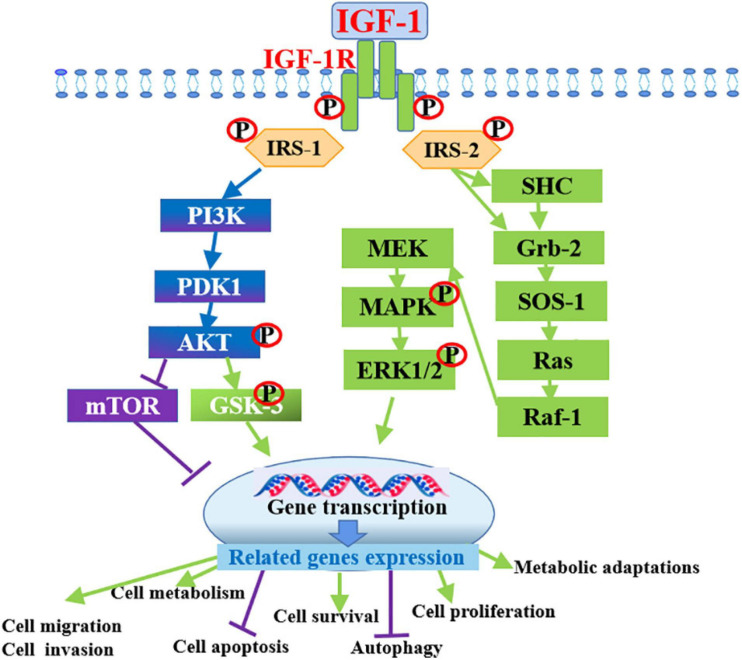
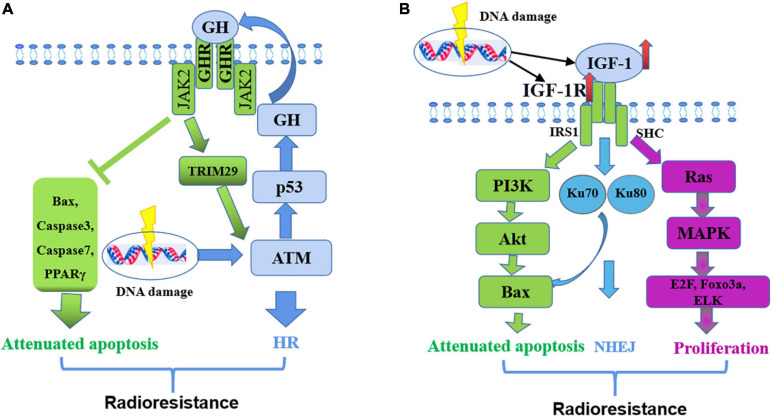
Radiotherapy remains one of the most important cancer treatment modalities. In the course of radiotherapy for tumor treatment, the incidental irradiation of adjacent tissues could not be completely avoided. DNA damage is one of the main factors of cell death caused by ionizing radiation, including single-strand (SSBs) and double-strand breaks (DSBs). The growth hormone-Insulin-like growth factor 1 (GH-IGF1) axis plays numerous roles in various systems by promoting cell proliferation and inhibiting apoptosis, supporting its effects in inducing the development of multiple cancers. Meanwhile, the GH-IGF1 signaling involved in DNA damage response (DDR) and DNA damage repair determines the radio-resistance of cancer cells subjected to radiotherapy and repair of adjacent tissues damaged by radiotherapy. In the present review, we firstly summarized the studies on GH-IGF1 signaling in the development of cancers. Then we discussed the adverse effect of GH-IGF1 signaling in radiotherapy to cancer cells and the favorable impact of GH-IGF1 signaling on radiation damage repair to adjacent tissues after irradiation. This review further summarized recent advances on research into the molecular mechanism of GH-IGF1 signaling pathway in these effects, expecting to specify the dual characters of GH-IGF1 signaling pathways in radiotherapy and post-radiotherapy repair of cancers, subsequently providing theoretical basis of their roles in increasing radiation sensitivity during cancer radiotherapy and repairing damage after radiotherapy.
放射治疗仍然是最重要的癌症治疗方式之一。在肿瘤放射治疗过程中,相邻组织的附带照射无法完全避免。DNA损伤是电离辐射导致细胞死亡的主要因素之一,包括单链(SSB)和双链断裂(DSB)。生长激素-胰岛素样生长因子1(GH-IGF1)轴通过促进细胞增殖和抑制细胞凋亡在各种系统中发挥多种作用,支持其在诱导多种癌症发生发展中的作用。同时,参与DNA损伤反应(DDR)和DNA损伤修复的GH-IGF1信号决定了接受放射治疗的癌细胞的放射抗性以及放射治疗损伤的相邻组织的修复。在本综述中,我们首先总结了关于GH-IGF1信号在癌症发生发展中的研究。然后我们讨论了GH-IGF1信号在放射治疗中对癌细胞的不利影响以及GH-IGF1信号对照射后相邻组织辐射损伤修复的有利影响。本综述进一步总结了GH-IGF1信号通路在这些效应中的分子机制研究的最新进展,期望明确GH-IGF1信号通路在癌症放射治疗和放射治疗后修复中的双重特性,随后为其在提高癌症放射治疗期间的放射敏感性和放射治疗后损伤修复中的作用提供理论依据。