University Division of Anaesthesia, Department of Medicine, Addenbrooke's Hospital, Hills Road, Cambridge, CB2 0QQ, UK.
Department of Clinical Neurosciences, University of Cambridge, Cambridge, CB2 0QQ, UK.
Acta Neurochir (Wien). 2021 Sep;163(9):2629-2637. doi: 10.1007/s00701-021-04879-z. Epub 2021 Jun 28.
Chronic subdural haematoma (cSDH) is a common neurosurgical pathology frequently occurring in older patients. The impact of population ageing on cSDH caseload has not been examined, despite relevance for health system planning.
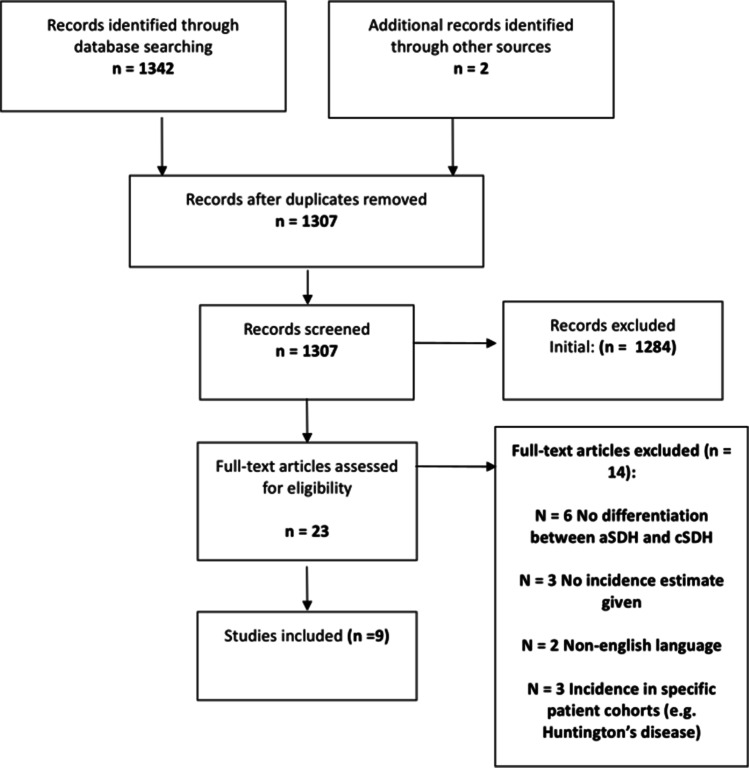
This is a single-centre study from the UK. Operated cases of cSDH (n = 446) for 2015-2018 were identified. Crude and directly standardised incidence rates were calculated. Medline and EMBASE were systematically searched to identify studies reporting on the incidence of cSDH by year, so an estimate of rate of incidence change could be determined. Local incidence rates were then applied to population projections for local catchment area to estimate operated cSDH numbers at 5 yearly intervals due to shifting demographics.
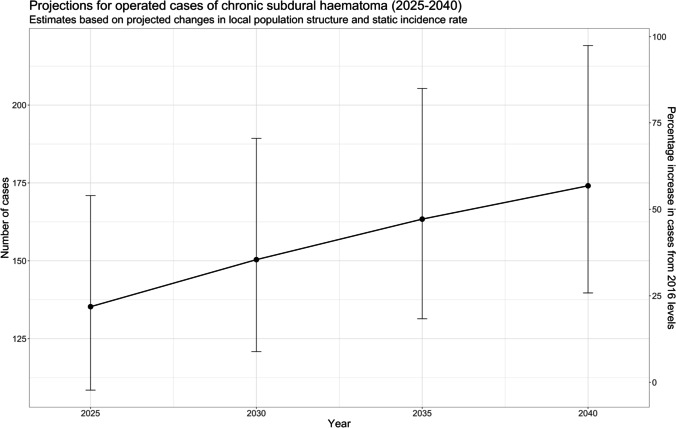
We identified nine studies presenting incidence estimates. Crude estimates for operative cases ranged from 1.3/100,000/year (1.4-2.2) to 5.3/100,000/year (4.3-6.6). When non-operated cases were included, incidence was higher: 8.2/100,000/year (6.0-11.2) to 48/100,000/year (37.7-61.1). Four pairs of studies demonstrated incidence rate increases of 200-600% over the last 50 years, but data was deemed too heterogeneous to generate formal estimate of incidence change. Local crude incidence of operated cSDH was 3.50/100,000/year (3.19-3.85). Directly standardised incidence was 1.58/100,000/year (1.26-1.90). After applying local incidence rates to population projections, case numbers were predicted to increase by 53% over the next 20 years.
The incidence of cSDH is increasing. We project a 53% increase in operative caseload within our region by 2040. These are important findings for guiding future healthcare planning.
慢性硬脑膜下血肿(cSDH)是一种常见的神经外科疾病,常发生于老年患者。尽管对卫生系统规划具有重要意义,但人口老龄化对 cSDH 发病情况的影响尚未得到研究。
这是一项来自英国的单中心研究。确定了 2015 年至 2018 年接受手术治疗的 cSDH(n=446)病例。计算了粗发病率和直接标准化发病率。系统检索了 Medline 和 EMBASE,以确定按年份报告 cSDH 发病率的研究,从而确定发病率变化的估计值。然后将当地发病率应用于当地集水区的人口预测,以估计由于人口结构变化导致的每 5 年间隔的手术治疗 cSDH 数量。
我们确定了 9 项报告发病率估计的研究。手术治疗病例的粗发病率范围为 1.3/100,000/年(1.4-2.2)至 5.3/100,000/年(4.3-6.6)。当包括非手术治疗病例时,发病率更高:8.2/100,000/年(6.0-11.2)至 48/100,000/年(37.7-61.1)。四对研究表明,在过去 50 年中,发病率增加了 200-600%,但数据差异太大,无法生成发病率变化的正式估计值。当地手术治疗 cSDH 的粗发病率为 3.50/100,000/年(3.19-3.85)。直接标准化发病率为 1.58/100,000/年(1.26-1.90)。将当地发病率应用于人口预测后,预计未来 20 年内该地区的病例数将增加 53%。
cSDH 的发病率正在增加。我们预计到 2040 年,该地区手术治疗的病例数将增加 53%。这些发现对指导未来的医疗保健规划具有重要意义。