Institute of Systems Motor Science, Center of Brain, Behavior and Metabolism, University of Lübeck, Lübeck, Germany.
Cognitive Neurophysiology, Department of Child and Adolescent Psychiatry, Faculty of Medicine, TU Dresden, Dresden, Germany.
Sci Rep. 2021 Jun 28;11(1):13388. doi: 10.1038/s41598-021-92761-4.
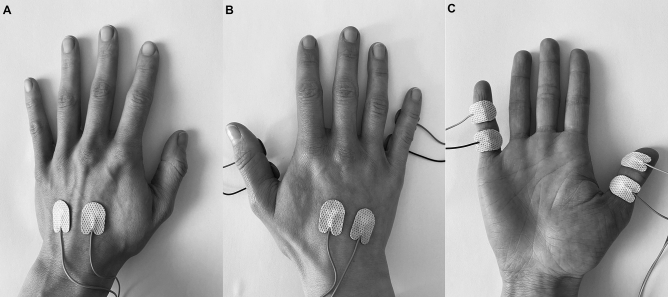
It is a common phenomenon that somatosensory sensations can trigger actions to alleviate experienced tension. Such "urges" are particularly relevant in patients with Gilles de la Tourette (GTS) syndrome since they often precede tics, the cardinal feature of this common neurodevelopmental disorder. Altered sensorimotor integration processes in GTS as well as evidence for increased binding of stimulus- and response-related features ("hyper-binding") in the visual domain suggest enhanced perception-action binding also in the somatosensory modality. In the current study, the Theory of Event Coding (TEC) was used as an overarching cognitive framework to examine somatosensory-motor binding. For this purpose, a somatosensory-motor version of a task measuring stimulus-response binding (S-R task) was tested using electro-tactile stimuli. Contrary to the main hypothesis, there were no group differences in binding effects between GTS patients and healthy controls in the somatosensory-motor paradigm. Behavioral data did not indicate differences in binding between examined groups. These data can be interpreted such that a compensatory "downregulation" of increased somatosensory stimulus saliency, e.g., due to the occurrence of somatosensory urges and hypersensitivity to external stimuli, results in reduced binding with associated motor output, which brings binding to a "normal" level. Therefore, "hyper-binding" in GTS seems to be modality-specific.
体感感觉可以引发缓解体验到的紧张感的动作,这是一种常见现象。这种“冲动”在 Gilles de la Tourette(GTS)综合征患者中尤为相关,因为它们通常先于抽动,这是这种常见神经发育障碍的主要特征。GTS 中感觉运动整合过程的改变,以及刺激和反应相关特征结合增加的证据(“超结合”)在视觉领域表明,体感模态中的感知-动作结合也增强了。在当前的研究中,事件编码理论(TEC)被用作一个总体认知框架来检查体感运动结合。为此,使用电触觉刺激测试了一种测量刺激-反应结合的体感运动任务(S-R 任务)的体感运动版本。与主要假设相反,在体感运动范式中,GTS 患者和健康对照组之间的结合效应没有差异。行为数据没有表明检查组之间的结合存在差异。这些数据可以解释为,由于体感冲动和对外界刺激的敏感性增加等原因,增加的体感刺激显著性的补偿性“下调”导致与相关运动输出的结合减少,从而使结合达到“正常”水平。因此,GTS 中的“超结合”似乎是特定于模态的。