Harvard Medical School Boston MA.
Department of Epidemiology and Biostatistics School of Public HealthImperial College London London UK.
J Am Heart Assoc. 2021 Jul 6;10(13):e020331. doi: 10.1161/JAHA.120.020331. Epub 2021 Jun 29.
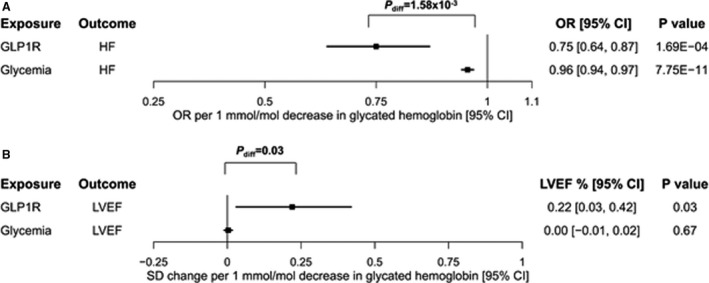
Background This study was designed to investigate the genetic evidence for repurposing of GLP1R (glucagon-like peptide-1 receptor) agonists to prevent heart failure (HF) and whether the potential benefit exceeds the benefit conferred by more general glycemic control. Methods and Results We applied 2-sample Mendelian randomization of genetically proxied GLP1R agonism on HF as the main outcome and left ventricular ejection fraction as the secondary outcome. The associations were compared with those of general glycemic control on the same outcomes. Genetic associations were obtained from genome-wide association study summary statistics of type 2 diabetes mellitus (228 499 cases and 1 178 783 controls), glycated hemoglobin (n=344 182), HF (47,309 cases and 930 014 controls), and left ventricular ejection fraction (n=16 923). Genetic proxies for GLP1R agonism associated with reduced risk of HF (odds ratio per 1 mmol/mol decrease in glycated hemoglobin 0.75; 95% CI, 0.64-0.87; =1.69×10), and higher left ventricular ejection fraction (SD change in left ventricular ejection fraction per 1 mmol/mol decrease in glycated hemoglobin 0.22%; 95% CI, 0.03-0.42; =0.03). The magnitude of these benefits exceeded those expected from improved glycemic control more generally. The results were similar in sensitivity analyses, and we did not find evidence to suggest that these associations were mediated by reduced coronary artery disease risk. Conclusions This genetic evidence supports the repurposing of GLP1R agonists for preventing HF.
背景 本研究旨在探讨 GLP1R(胰高血糖素样肽-1 受体)激动剂用于预防心力衰竭(HF)的遗传证据,以及这种潜在益处是否超过更广泛的血糖控制带来的益处。
方法和结果 我们应用 2 样本 Mendelian 随机化,将遗传上接近的 GLP1R 激动剂用于 HF 作为主要结局,左心室射血分数作为次要结局。将这些关联与血糖控制的一般益处进行比较。遗传关联来自 2 型糖尿病(228499 例和 1178783 例对照)、糖化血红蛋白(n=344182)、HF(47309 例和 930014 例对照)和左心室射血分数(n=16923)的全基因组关联研究汇总统计数据。GLP1R 激动剂的遗传标志物与 HF 风险降低相关(糖化血红蛋白每降低 1mmol/mol,比值比为 0.75;95%置信区间,0.64-0.87;=1.69×10),并且左心室射血分数较高(糖化血红蛋白每降低 1mmol/mol,左心室射血分数的标准差变化为 0.22%;95%置信区间,0.03-0.42;=0.03)。这些益处的程度超过了更广泛的血糖控制所带来的益处。敏感性分析结果相似,我们没有发现这些关联通过降低冠状动脉疾病风险来介导的证据。
结论 这项遗传证据支持将 GLP1R 激动剂重新用于预防 HF。