Sato Takehito, Ohzeki Masayuki, Tanaka Kazuyuki
Graduate School of Information Sciences, Tohoku University, Sendai, Japan.
Institute for Innovative Research, Tokyo Institute of Technology, Yokohama, Japan.
Sci Rep. 2021 Jun 29;11(1):13523. doi: 10.1038/s41598-021-92295-9.
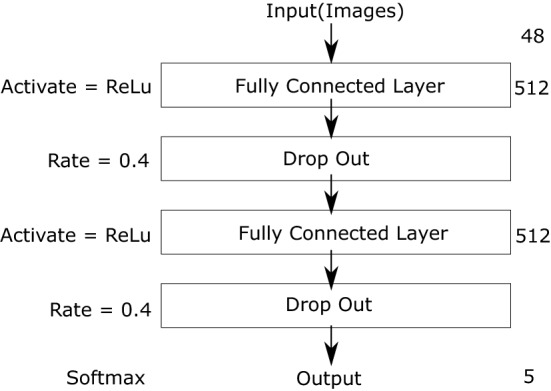
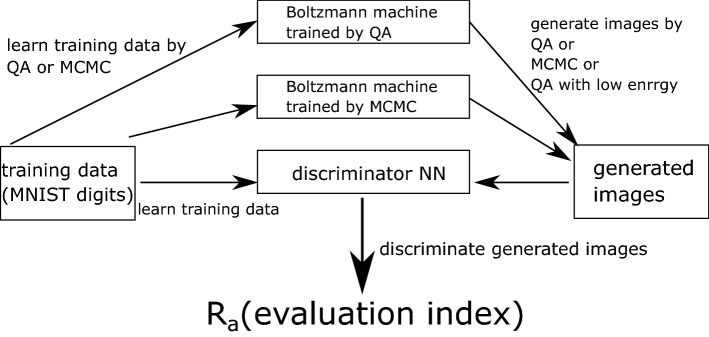
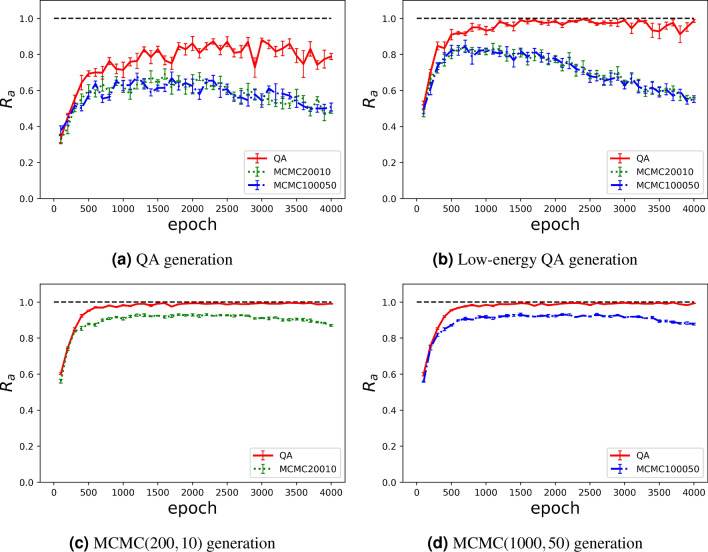
Quantum annealing was originally proposed as an approach for solving combinatorial optimization problems using quantum effects. D-Wave Systems has released a production model of quantum annealing hardware. However, the inherent noise and various environmental factors in the hardware hamper the determination of optimal solutions. In addition, the freezing effect in regions with weak quantum fluctuations generates outputs approximately following a Gibbs-Boltzmann distribution at an extremely low temperature. Thus, a quantum annealer may also serve as a fast sampler for the Ising spin-glass problem, and several studies have investigated Boltzmann machine learning using a quantum annealer. Previous developments have focused on comparing the performance in the standard distance of the resulting distributions between conventional methods in classical computers and sampling by a quantum annealer. In this study, we focused on the performance of a quantum annealer as a generative model from a different aspect. To evaluate its performance, we prepared a discriminator given by a neural network trained on an a priori dataset. The evaluation results show a higher performance of quantum annealer compared with the classical approach for Boltzmann machine learning in training of the generative model. However the generation of the data suffers from the remanent quantum fluctuation in the quantum annealer. The quality of the generated images from the quantum annealer gets worse than the ideal case of the quantum annealing and the classical Monte-Carlo sampling.
量子退火最初被提出作为一种利用量子效应解决组合优化问题的方法。D-Wave系统公司已经发布了量子退火硬件的生产模型。然而,硬件中固有的噪声和各种环境因素阻碍了最优解的确定。此外,在量子涨落较弱的区域中的冻结效应会在极低温下产生近似遵循吉布斯-玻尔兹曼分布的输出。因此,量子退火器也可以作为伊辛自旋玻璃问题的快速采样器,并且有几项研究已经研究了使用量子退火器的玻尔兹曼机器学习。先前的进展主要集中在比较经典计算机中的传统方法与量子退火器采样所得到的分布在标准距离上的性能。在本研究中,我们从不同角度关注量子退火器作为生成模型的性能。为了评估其性能,我们准备了一个由在先验数据集上训练的神经网络给出的判别器。评估结果表明,在生成模型训练中,与玻尔兹曼机器学习的经典方法相比,量子退火器具有更高的性能。然而,量子退火器中剩余的量子涨落会影响数据的生成。从量子退火器生成的图像质量比量子退火和经典蒙特卡罗采样的理想情况要差。