Alhazzani Adel, Kumar Amit, Algahtany Mubarak, Rawat Dimple
Department of Medicine, Division of Neurology, King Saud University, Riyadh, Saudi Arabia.
Department of Neurology, All India Institute of Medical Sciences, New Delhi, India.
Brain Circ. 2021 May 29;7(2):77-84. doi: 10.4103/bc.bc_51_20. eCollection 2021 Apr-Jun.
After acute ischemic stroke, a higher level of troponin has been considered as an important biomarker for predicting mortality.
The study aimed to quantitatively assess the prognostic significance of the effect of baseline troponin levels on all-cause mortality in patients with acute ischemic stroke using a meta-analysis approach.
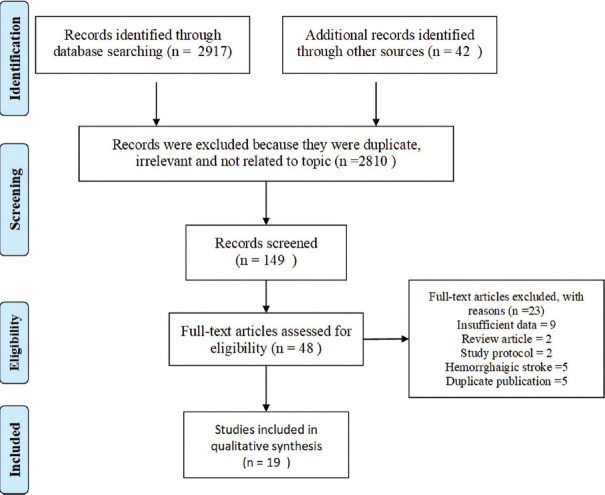
The following electronic databases such as PubMed, Web of Science, Cochrane Central Register of Controlled Trials, TRIP Database, and ClinicalTrialsgov were used for obtaining the relevant articles from literature. Data were extracted in standardized data collection form by two independent investigators. Any disagreements were resolved by consensus. All the statistical analyses were performed in STATA software (Version 13.1).
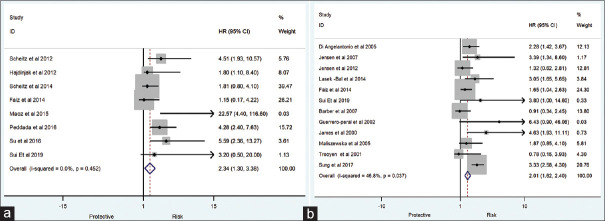
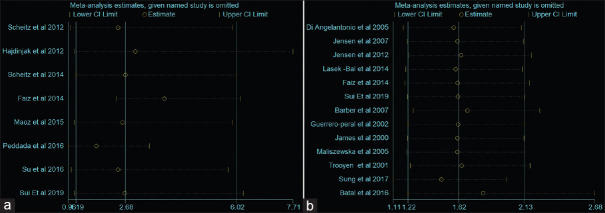
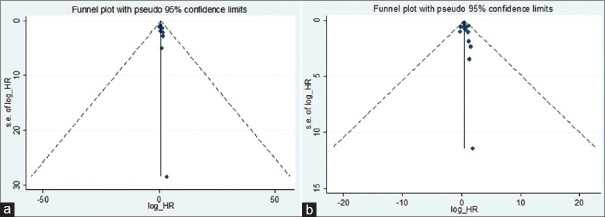
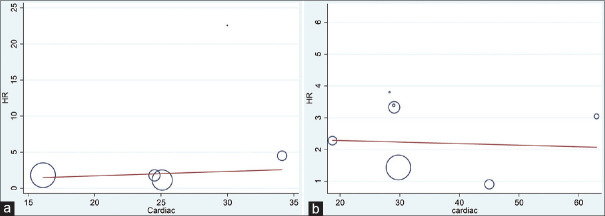
A total of 19 studies were included in the present meta-analysis involving a total of 10,519 patients. The pooled analysis suggested that elevated serum troponin level was associated with inhospital mortality (rate ratios [RR] 2.34, 95% confidence interval [CI] 1.30-3.38) and at the end of last follow-up mortality (RR 2.01; 95% CI 1.62-2.40). Sensitivity analysis by removing a single study by turns indicated that there was no obvious impact of any individual study on the pooled risk estimate. No significant publication bias was observed in the beg test ( = 0.39); however, significant publication bias was observed in the egger test ( = 0.046).
Our findings indicated that a higher level of troponin might be an important prognostic biomarker for all cause in hospital and follow-up mortalities in patients with acute ischemic stroke. These study findings offer insight into further investigation in prospective studies to validate this particular association. The study was registered in OSF registries DOI's 10.17605/OSF. IO/D95GN.
急性缺血性卒中后,肌钙蛋白水平升高被视为预测死亡率的重要生物标志物。
本研究旨在采用荟萃分析方法,定量评估基线肌钙蛋白水平对急性缺血性卒中患者全因死亡率影响的预后意义。
使用PubMed、Web of Science、Cochrane对照试验中央注册库、TRIP数据库和ClinicalTrialsgov等电子数据库从文献中获取相关文章。由两名独立研究人员以标准化数据收集表提取数据。任何分歧通过协商解决。所有统计分析均在STATA软件(版本13.1)中进行。
本荟萃分析共纳入19项研究,涉及10519例患者。汇总分析表明,血清肌钙蛋白水平升高与住院死亡率(率比[RR]2.34,95%置信区间[CI]1.30 - 3.38)及末次随访结束时的死亡率(RR 2.01;95%CI 1.62 - 2.40)相关。轮流剔除单项研究进行的敏感性分析表明,任何单项研究对汇总风险估计均无明显影响。Beg检验未观察到显著的发表偏倚(P = 0.39);然而,Egger检验观察到显著的发表偏倚(P = 0.046)。
我们的研究结果表明,较高水平的肌钙蛋白可能是急性缺血性卒中患者住院和随访期间全因死亡的重要预后生物标志物。这些研究结果为前瞻性研究中进一步验证这一特定关联提供了思路。该研究已在OSF注册库登记,DOI为10.17605/OSF.IO/D95GN。