Babapoor-Farrokhran Savalan, Alzubi Jafar, Port Zachary, Sooknanan Naveen, Ammari Zaid, Al-Sarie Mohammad, Bozorgnia Behnam
Department of Medicine, Division of Cardiology, Einstein Medical Center, 5501 Old York Road, Philadelphia, PA 19141 USA.
Department of Medicine, Einstein Medical Center, Philadelphia, PA 19141 USA.
SN Compr Clin Med. 2021;3(10):2088-2092. doi: 10.1007/s42399-021-01005-z. Epub 2021 Jun 25.
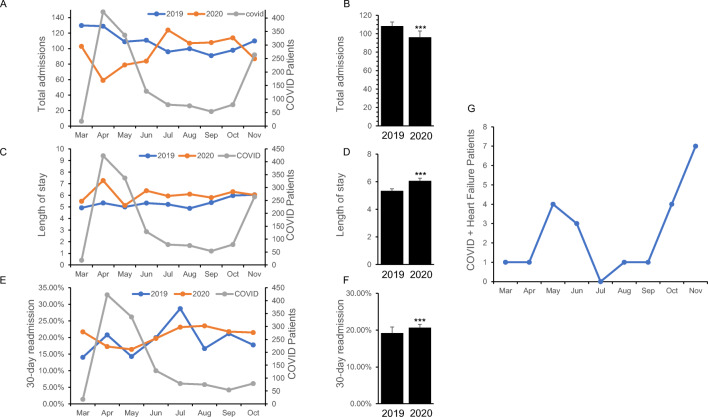
The Novel Coronavirus Disease 2019 (COVID-19) pandemic has transformed individual lives and societal framework on a global scale, and in no other sector is this more evident than healthcare. Herein, we aim to describe the impact of the current COVID-19 pandemic and its associated restrictions on heart failure (HF) admissions. In this retrospective cohort study, we obtained administrative data for patients with a primary discharge diagnosis of HF (identified by ICD-10 code) with discharge dates ranging from January 2019 to November 2020. The study is comprised of 2 distinct sub-cohorts: HF admissions during the COVID-19 pandemic (case) period from March 2020 to October 2020 and corresponding control period during the previous year (March 2019 to December 2019). Primary outcome analysis involved comparison of total and daily HF admissions and secondary outcomes included hospital Length of Stay (LOS) and 30-day readmissions. The number of total HF admissions and average daily admissions were significantly lower in 2020 compared to 2019 (774 vs. 864; p < 0.001 and 3.17 vs. 3.53 days; p < 0.001), respectively. Average length of stay was significantly higher between March and October 2020 relative to the same months in 2019 (6.05 vs. 5.25 days; p < 0.001). Thirty-day readmission rates were also significantly higher in March-October 2020 compared to the same months in 2019 (20.6% vs. 19.1%; p < 0.001). During the pandemic, both readmission rates and length of stay for HF-related admissions were significantly impacted. The COVID-19 pandemic significantly impacted HF-related admissions as well as associated LOS and 30-day readmissions. High-risk patients should be identified carefully, and timely and appropriate treatment should be provided.
2019年新型冠状病毒病(COVID-19)大流行在全球范围内改变了个人生活和社会结构,在医疗保健领域,这种影响比其他任何领域都更为明显。在此,我们旨在描述当前COVID-19大流行及其相关限制措施对心力衰竭(HF)住院情况的影响。在这项回顾性队列研究中,我们获取了主要出院诊断为HF(通过ICD-10编码确定)且出院日期在2019年1月至2020年11月之间患者的管理数据。该研究由两个不同的亚队列组成:2020年3月至2020年10月COVID-19大流行期间(病例)的HF住院情况以及上一年相应的对照期(2019年3月至2019年12月)。主要结局分析包括比较HF住院总数和每日住院情况,次要结局包括住院时间(LOS)和30天再入院率。与2019年相比,2020年HF住院总数和平均每日住院人数显著降低(分别为774例对864例;p<0.001以及3.17天对3.53天;p<0.001)。2020年3月至10月的平均住院时间相对于2019年的相同月份显著延长(6.05天对(5.25)天;p<0.001)。2020年3月至10月的30天再入院率也显著高于2019年的相同月份(20.6%对19.1%;p<0.001)。在大流行期间,HF相关住院的再入院率和住院时间均受到显著影响。COVID-19大流行对HF相关住院情况以及相关的住院时间和30天再入院率产生了显著影响。应仔细识别高危患者,并提供及时且适当的治疗。