Department of Gynecology and Obstetrics, Medical Faculty, University of Cologne, Cologne, Germany.
Department for Diagnostic and Interventional Radiology¸ Medical Faculty, University of Cologne, Cologne, Germany.
Arch Gynecol Obstet. 2022 Jan;305(1):169-177. doi: 10.1007/s00404-021-06128-1. Epub 2021 Jun 29.
The current methods for calculating the ideal implant volume for breast reconstruction are based on pre- or intraoperative volume measurements of the existing breast volume and do not take into account the individual breast density of the woman. This study aims is to identify objective parameters that can help to improve the optimal implant selection.
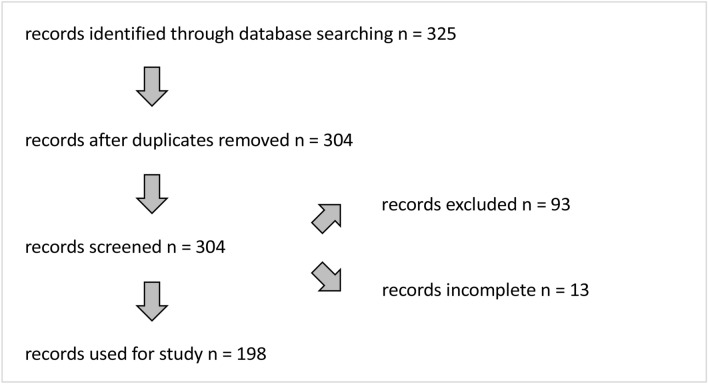
This retrospective analysis includes 198 breast cancer patients who underwent mastectomy. Breast densities (ACR) measured in mammography and MRI were compared with the removed breast tissue weight and volume of the implants used. In addition, the resected weight was compared directly with the implant volume to calculate a mathematical function.
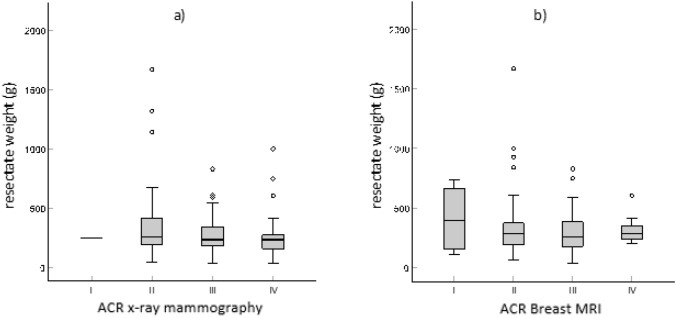
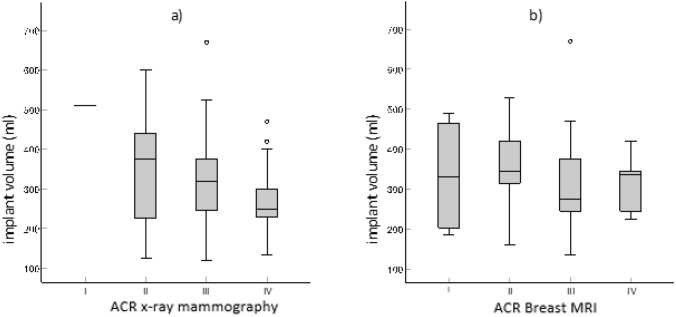
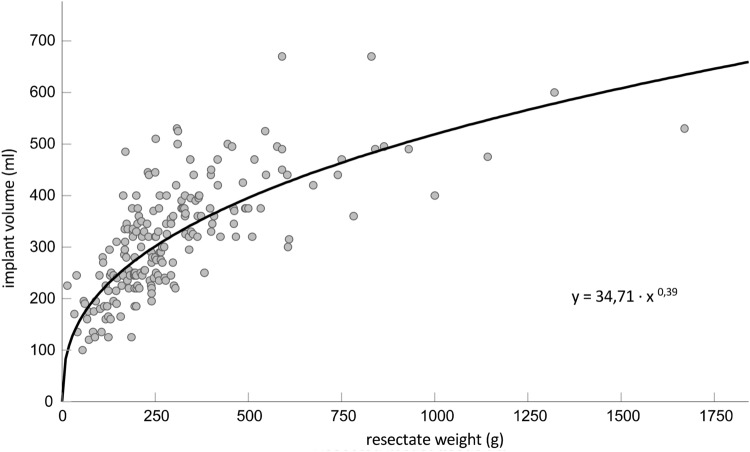
There was no significant correlation between the ACR values and the resected weights [correlation coefficient: mammography:- 0.117 (p = 0.176), MRI - 0.033 (p = 0.756)]. A negative correlation between the implant volumes and both imaging methods could be demonstrated [correlation coefficient: mammography - 0.268; p = 0.002; MRI was - 0.200 (p = 0.055)]. A highly significant correlation between the resected weights and the implant volumes (correlation coefficient 0.744; p < 0.001) was observed. This correlation corresponds to a power function (y = 34.71 x), in which any resected weight can be used for the variable x to calculate the implant volume.
We were able to show that there is a significant correlation between the resected breast tissue and the implant volume. With our novel potency function, the appropriate implant volume can be calculated for any resected weight making it easier for the surgeon to choose a fitting implant in a simple and more objective manner.
目前用于计算乳房重建理想植入物体积的方法是基于对现有乳房体积的术前或术中体积测量,而没有考虑到女性的个体乳房密度。本研究旨在确定有助于改善最佳植入物选择的客观参数。
本回顾性分析纳入了 198 例接受乳房切除术的乳腺癌患者。对乳房 X 线摄影和 MRI 测量的乳房密度(ACR)与切除的乳房组织重量和使用的植入物体积进行了比较。此外,还直接比较了切除的重量与植入物体积,以计算数学函数。
ACR 值与切除的重量之间没有显著相关性[相关系数:乳房 X 线摄影 - 0.117(p = 0.176),MRI - 0.033(p = 0.756)]。可以证明,植入物体积与两种成像方法之间呈负相关[相关系数:乳房 X 线摄影 - 0.268;p = 0.002;MRI 为 - 0.200(p = 0.055)]。切除的重量与植入物体积之间存在高度显著的相关性(相关系数 0.744;p<0.001)。这种相关性对应于幂函数(y = 34.71 x),其中任何切除的重量都可以用作变量 x 来计算植入物体积。
我们能够表明,切除的乳房组织与植入物体积之间存在显著相关性。使用我们的新功效函数,可以根据任何切除的重量计算出合适的植入物体积,从而使外科医生更容易以简单、更客观的方式选择合适的植入物。