Duvalsaint Marvin, Conrad Melissa D, Tukwasibwe Stephen, Tumwebaze Patrick K, Legac Jennifer, Cooper Roland A, Rosenthal Philip J
Department of Medicine, University of California, San Francisco, CA, USA.
Infectious Diseases Research Collaboration, Kampala, Uganda.
Malar J. 2021 Jun 30;20(1):292. doi: 10.1186/s12936-021-03823-x.
Anti-malarial drug resistance may be limited by decreased fitness in resistant parasites. Important contributors to resistance are mutations in the Plasmodium falciparum putative drug transporter PfMDR1.
Impacts on in vitro fitness of two common PfMDR1 polymorphisms, N86Y, which is associated with sensitivity to multiple drugs, and Y184F, which has no clear impact on drug sensitivity, were evaluated to study associations between resistance mediators and parasite fitness, measured as relative growth in competitive culture experiments. NF10 P. falciparum lines engineered to represent all PfMDR1 N86Y and Y184F haplotypes were co-cultured for 40 days, and the genetic make-up of the cultures was characterized every 4 days by pyrosequencing. The impacts of culture with anti-malarials on the growth of different haplotypes were also assessed. Lastly, the engineering of P. falciparum containing another common polymorphism, PfMDR1 D1246Y, was attempted.
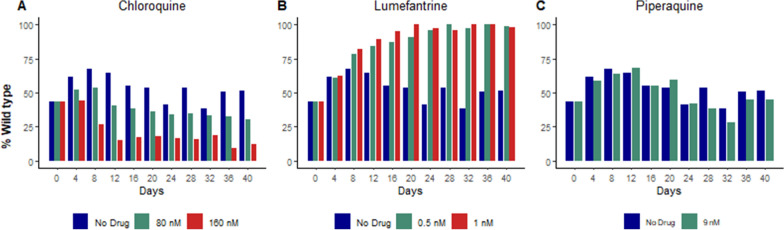
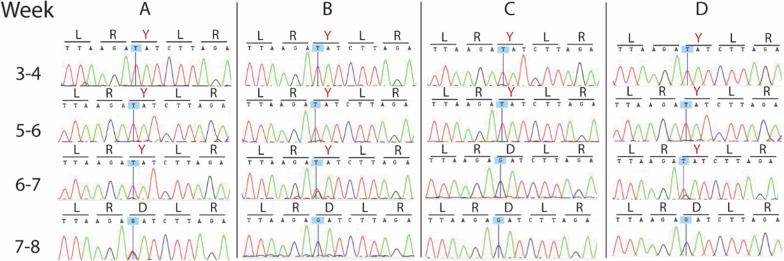
Co-culture results were as follows. With wild type (WT) Y184 fixed (N86/Y184 vs. 86Y/Y184), parasites WT and mutant at 86 were at equilibrium. With mutant 184 F fixed (N86/184F vs. 86Y/184F), mutants at 86 overgrew WT. With WT N86 fixed (N86/Y184 vs. N86/184F), WT at 184 overgrew mutants. With mutant 86Y fixed (86Y/Y184 vs. 86Y/184F), WT and mutant at 86 were at equilibrium. Parasites with the double WT were in equilibrium with the double mutant, but 86Y/Y184 overgrew N86/184F. Overall, WT N86/mutant 184F parasites were less fit than parasites with all other haplotypes. Parasites engineered for another mutation, PfMDR1 1246Y, were unstable in culture, with reversion to WT over time. Thus, the N86 WT is stable when accompanied by the Y184 WT, but incurs a fitness cost when accompanied by mutant 184F. Culturing in the presence of chloroquine favored 86Y mutant parasites and in the presence of lumefantrine favored N86 WT parasites; piperaquine had minimal impact.
These results are consistent with those for Ugandan field isolates, suggest reasons for varied haplotypes, and highlight the interplay between drug pressure and fitness that is guiding the evolution of resistance-mediating haplotypes in P. falciparum.
抗疟药物耐药性可能因耐药寄生虫适应性降低而受到限制。恶性疟原虫假定药物转运蛋白PfMDR1的突变是耐药性的重要促成因素。
评估两种常见的PfMDR1多态性对体外适应性的影响,与多种药物敏感性相关的N86Y以及对药物敏感性无明显影响的Y184F,以研究耐药介质与寄生虫适应性之间的关联,通过竞争培养实验中的相对生长来衡量。对经基因工程改造以代表所有PfMDR1 N86Y和Y184F单倍型的NF10恶性疟原虫株进行共培养40天,每4天通过焦磷酸测序对培养物的基因组成进行表征。还评估了用抗疟药培养对不同单倍型生长的影响。最后,尝试对含有另一种常见多态性PfMDR1 D1246Y的恶性疟原虫进行基因工程改造。
共培养结果如下。当野生型(WT)Y184固定时(N86/Y184与86Y/Y184),86位点的野生型和突变型寄生虫处于平衡状态。当突变型184F固定时(N86/184F与86Y/184F),86位点的突变型寄生虫数量超过野生型。当野生型N86固定时(N86/Y184与N86/184F),184位点的野生型寄生虫数量超过突变型。当突变型86Y固定时(86Y/Y184与86Y/184F),86位点的野生型和突变型寄生虫处于平衡状态。双野生型寄生虫与双突变型寄生虫处于平衡状态,但86Y/Y184的数量超过N86/184F。总体而言,野生型N86/突变型184F寄生虫的适应性低于具有所有其他单倍型的寄生虫。经基因工程改造具有另一种突变PfMDR1 1246Y的寄生虫在培养中不稳定,随着时间推移会回复为野生型。因此,N86野生型在伴有Y184野生型时是稳定的,但在伴有突变型184F时会产生适应性代价。在氯喹存在下培养有利于86Y突变型寄生虫,在双氢青蒿素哌喹存在下培养有利于N86野生型寄生虫;磷酸哌喹的影响最小。
这些结果与乌干达野外分离株的结果一致,提示了单倍型多样的原因,并突出了药物压力与适应性之间的相互作用,这种相互作用正在引导恶性疟原虫中耐药介导单倍型的进化。