Alberto-Silva Carlos, Portaro Fernanda Calheta Vieira, Kodama Roberto Tadashi, Pantaleão Halyne Queiroz, Rangel Marisa, Nihei Ken-Ichi, Konno Katsuhiro
Natural and Humanities Sciences Center, Experimental Morphophysiology Laboratory, Federal University of ABC (UFABC), São Bernardo do Campo, SP, Brazil.
Immunochemistry Laboratory, Butantan Institute, São Paulo, SP, Brazil.
J Venom Anim Toxins Incl Trop Dis. 2021 Jun 11;27:e20200171. doi: 10.1590/1678-9199-JVATITD-2020-0171.
Solitary wasp venoms may be a rich source of neuroactive substances, since their venoms are used for paralyzing preys. We have been exploring bioactive constituents of solitary wasp venoms and, in this study, the component profile of the venom from a solitary scoliid wasp, , was investigated through a comprehensive analysis using LC-MS. Two peptides were synthesized, and their neuroprotective properties were evaluated.
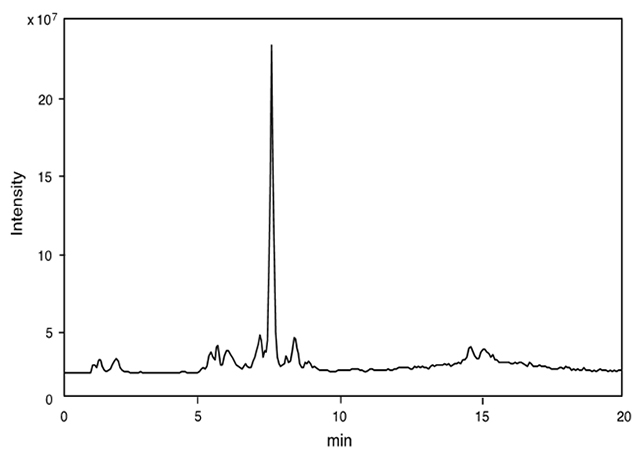
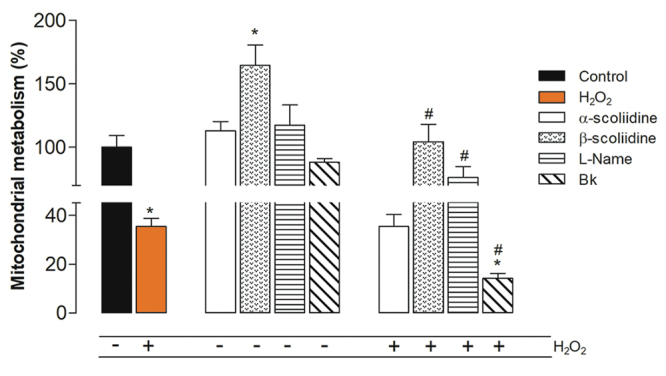
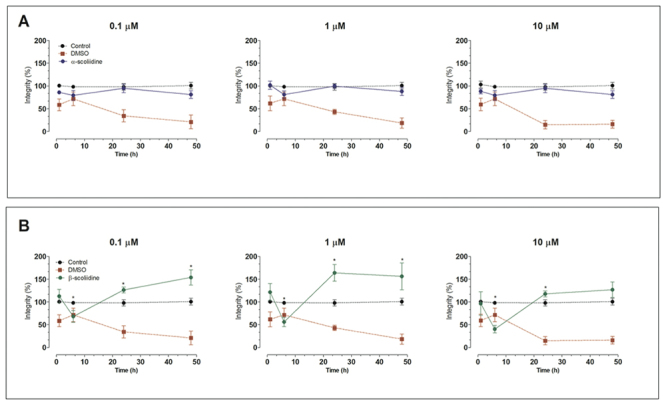
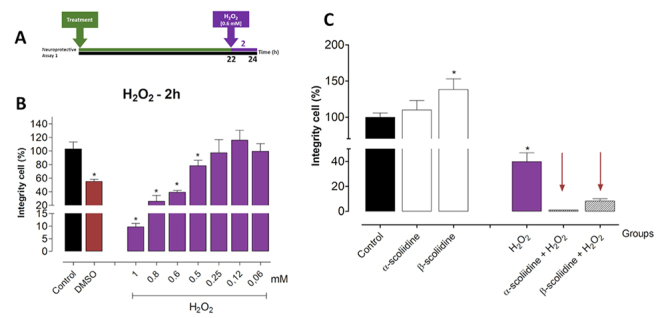
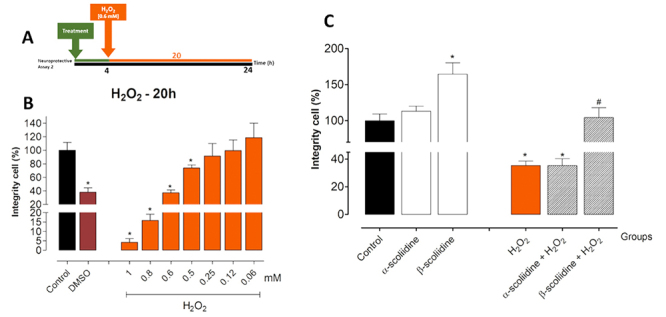
A reverse-phase HPLC connected to ESI-MS was used for LC-MS analyses. Online mass fingerprinting was performed from TIC, and data-dependent tandem mass spectrometry gave the MS/MS spectra. The sequences of two major peptide components were determined by MALDI-TOF/TOF MS analysis, confirmed by solid phase synthesis. Using the synthetic peptides, biological activities were assessed. Cell integrity tests and neuroprotection analyzes using HO as an oxidative stress inducer were performed for both peptides.
Online mass fingerprinting revealed that the venom contains 123 components, and the MS/MS analysis resulted in 33 full sequences of peptide components. The two main peptides, α-scoliidine (DYVTVKGFSPLR) and β-scoliidine (DYVTVKGFSPLRKA), present homology with the bradykinin C-terminal. Despite this, both peptides did not behave as substrates or inhibitors of ACE, indicating that they do not interact with this metallopeptidase. In further studies, β-scoliidine, but not α -scoliidine, showed protective effects against oxidative stress-induced neurotoxicity in PC12 cells through integrity and metabolism cell assays. Interestingly, β-scoliidine has the extension of the KA dipeptide at the C-terminal in comparison with α-scoliidine.
Comprehensive LC-MS and MS/MS analyses from the venom displayed the component profile of this venom. β-scoliidine showed an effective cytoprotective effect, probably due to the observed increase in the number of cells. This is the first report of solitary wasp venom peptides showing neuroprotective activity.
独居黄蜂毒液可能是神经活性物质的丰富来源,因为它们的毒液用于麻痹猎物。我们一直在探索独居黄蜂毒液的生物活性成分,在本研究中,通过液相色谱 - 质谱联用(LC-MS)的综合分析,对一种独居土蜂毒液的成分谱进行了研究。合成了两种肽,并评估了它们的神经保护特性。
使用与电喷雾电离质谱(ESI-MS)相连的反相高效液相色谱(HPLC)进行LC-MS分析。从总离子流色谱图(TIC)进行在线质量指纹分析,数据依赖串联质谱给出二级质谱(MS/MS)谱图。通过基质辅助激光解吸电离飞行时间串联质谱(MALDI-TOF/TOF MS)分析确定两种主要肽成分的序列,并通过固相合成进行确认。使用合成肽评估生物活性。对两种肽都进行了细胞完整性测试以及使用过氧化氢(HO)作为氧化应激诱导剂的神经保护分析。
在线质量指纹分析表明毒液含有123种成分,MS/MS分析得到33个肽成分的完整序列。两种主要肽,α - 土蜂肽(DYVTVKGFSPLR)和β - 土蜂肽(DYVTVKGFSPLRKA),与缓激肽C末端具有同源性。尽管如此,两种肽都不表现为血管紧张素转换酶(ACE)的底物或抑制剂,表明它们不与这种金属肽酶相互作用。在进一步研究中,通过细胞完整性和代谢细胞测定,β - 土蜂肽而非α - 土蜂肽对PC12细胞中氧化应激诱导的神经毒性显示出保护作用。有趣的是,与α - 土蜂肽相比,β - 土蜂肽在C末端有KA二肽的延伸。
对土蜂毒液进行的综合LC-MS和MS/MS分析展示了该毒液的成分谱。β - 土蜂肽显示出有效的细胞保护作用,可能是由于观察到的细胞数量增加。这是关于独居黄蜂毒液肽显示神经保护活性的首次报道。