Hu Feng, Liu Jixuan, Liu Huibo, Li Fan, Wan Minjie, Zhang Manli, Jiang Yanfang, Rao Min
Department of Gastroenterology, The First Hospital of Jilin University, Changchun, China.
Department of Pathology, The First Hospital of Jilin University, Changchun, China.
Front Oncol. 2021 Jun 14;11:700168. doi: 10.3389/fonc.2021.700168. eCollection 2021.
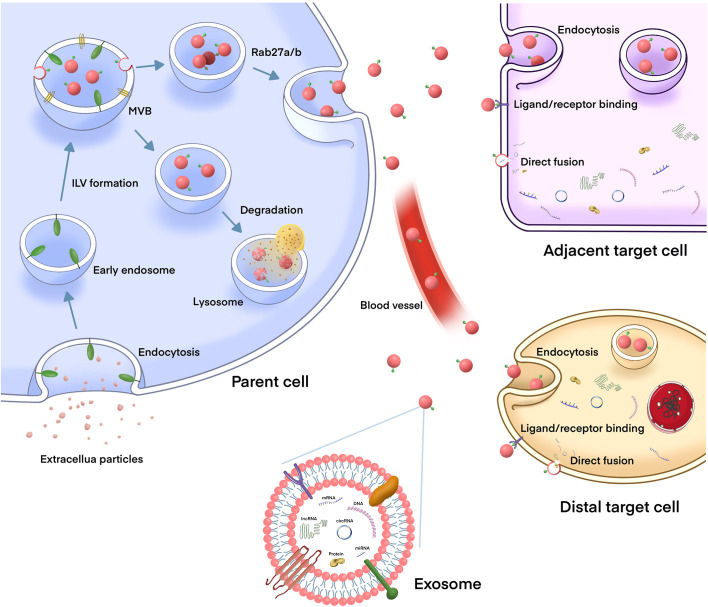
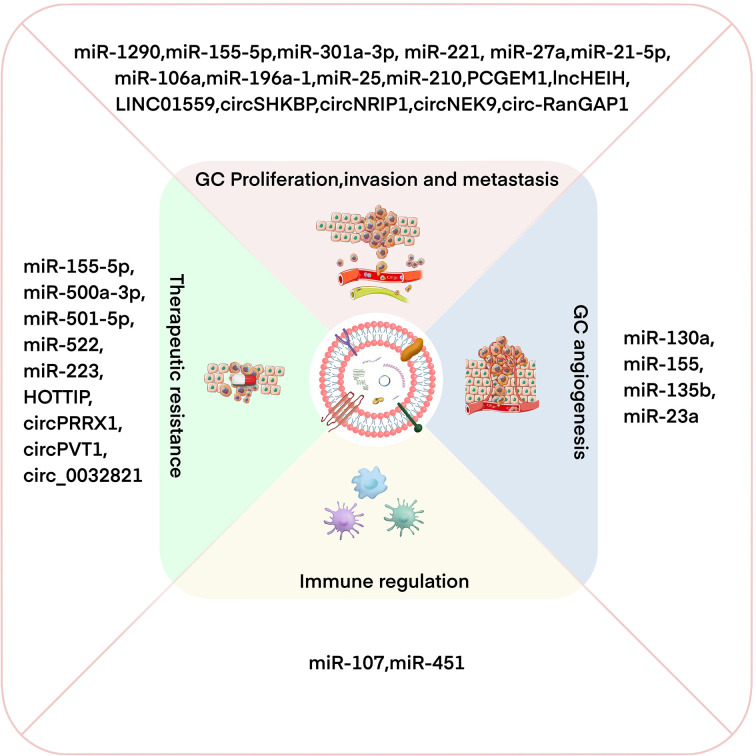
Gastric cancer (GC) is one of the most common fatal cancers worldwide. The communication between GC and other cells in the GC microenvironment directly affects GC progression. Recently, exosomes have been revealed as new players in intercellular communication. They play an important role in human health and diseases, including cancer, owing to their ability to carry various bioactive molecules, including non-coding RNAs (ncRNAs). NcRNAs, including micro RNAs, long non-coding RNAs, and circular RNAs, play a significant role in various pathophysiological processes, especially cancer. Increasing evidence has shown that exosomal ncRNAs are involved in the regulation of tumor proliferation, invasion, metastasis, angiogenesis, immune regulation, and treatment resistance in GC. In addition, exosomal ncRNAs have promising potential as diagnostic and prognostic markers for GC. Considering the biocompatibility of exosomes, they can also be used as biological carriers for targeted therapy. This review summarizes the current research progress on exosomal ncRNAs in gastric cancer, focusing on their biological role in GC and their potential as new biomarkers for GC and therapeutics. Our review provides insight into the mechanisms involved in GC progression, which may provide a new point cut for the discovery of new diagnostic markers and therapeutic strategies.
胃癌(GC)是全球最常见的致命癌症之一。胃癌与胃癌微环境中其他细胞之间的通讯直接影响胃癌的进展。最近,外泌体已被揭示为细胞间通讯的新参与者。由于它们能够携带包括非编码RNA(ncRNAs)在内的各种生物活性分子,它们在人类健康和疾病(包括癌症)中发挥着重要作用。包括微小RNA、长链非编码RNA和环状RNA在内的ncRNAs在各种病理生理过程中,尤其是在癌症中发挥着重要作用。越来越多的证据表明,外泌体ncRNAs参与了胃癌的肿瘤增殖、侵袭、转移、血管生成、免疫调节和治疗耐药性的调控。此外,外泌体ncRNAs作为胃癌的诊断和预后标志物具有广阔的潜力。考虑到外泌体的生物相容性,它们还可以用作靶向治疗的生物载体。本综述总结了目前关于胃癌中外泌体ncRNAs的研究进展,重点关注它们在胃癌中的生物学作用以及作为胃癌新生物标志物和治疗方法的潜力。我们的综述深入探讨了胃癌进展所涉及的机制,这可能为发现新的诊断标志物和治疗策略提供新的切入点。