
睡眠期癫痫性电持续状态的非器质性癫痫性脑病患儿的胼胝体切开术
Corpus callosotomy in pediatric patients with non-lesional epileptic encephalopathy with electrical status epilepticus during sleep.
作者信息
Yokosako Suguru, Muraoka Norihiro, Watanabe Shiena, Kosugi Kenzo, Takayama Yutaro, Iijima Keiya, Kimura Yuiko, Kaneko Yu, Sumitomo Noriko, Saito Takashi, Nakagawa Eiji, Iwasaki Masaki
机构信息
Department of Neurosurgery, National Center Hospital, National Center of Neurology and Psychiatry, Kodaira, Tokyo, Japan.
Department of Child Neurology, National Center Hospital, National Center of Neurology and Psychiatry, Kodaira, Tokyo, Japan.
出版信息
Epilepsy Behav Rep. 2021 Jun 8;16:100463. doi: 10.1016/j.ebr.2021.100463. eCollection 2021.
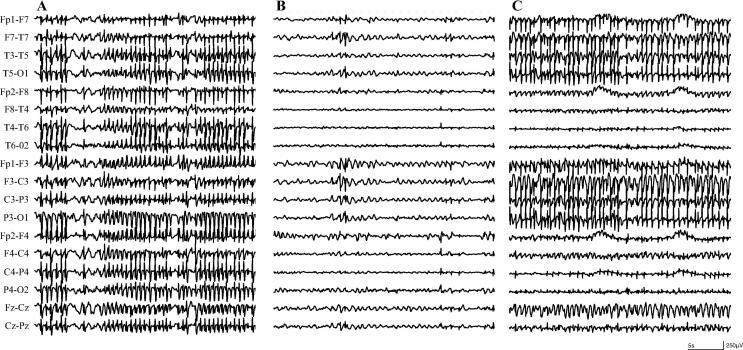
Epileptic encephalopathy with electrical status epilepticus during sleep (ESES) is often refractory to medical treatment and leads to poor cognitive outcomes. Corpus callosotomy may be an effective treatment option for drug-resistant ESES with no focal etiology. We retrospectively identified three patients who underwent corpus callosotomy for drug-resistant ESES in our institution. Electroencephalography (EEG) findings and cognitive functions were evaluated before surgery, at 3 months, 6 months, 1 year, and 2 years after surgery. Age at surgery was 6 years 10 months, 7 years 9 months, and 8 years 4 months, respectively. Period between the diagnosis of ESES and surgery ranged from 7 to 25 months. All patients had no obvious structural abnormalities and presented with cognitive decline despite multiple antiseizure medications and steroid therapies. One patient showed complete resolution of ESES and an improvement of intelligence quotient after surgery. Epileptiform EEG was lateralized to one hemisphere after surgery and spike wave index (SWI) was decreased with moderate improvement in development and seizures in the other 2 patients. SWI re-exacerbated from 6 months after surgery, but without subsequent developmental regression in these 2 patients. Corpus callosotomy may become an important treatment option for drug-resistant ESES in patients with no structural abnormalities.
睡眠期癫痫性脑病伴癫痫性电持续状态(ESES)通常对药物治疗无效,并导致认知预后不良。胼胝体切开术可能是治疗无局灶性病因的耐药性ESES的有效选择。我们回顾性地确定了在我们机构接受胼胝体切开术治疗耐药性ESES的三名患者。在手术前、术后3个月、6个月、1年和2年评估脑电图(EEG)结果和认知功能。手术时的年龄分别为6岁10个月、7岁9个月和8岁4个月。从ESES诊断到手术的时间间隔为7至25个月。所有患者均无明显结构异常,尽管使用了多种抗癫痫药物和类固醇疗法,仍出现认知下降。一名患者术后ESES完全缓解,智商提高。术后一名患者的癫痫样EEG定位于一个半球,另外两名患者的棘波指数(SWI)降低,发育和癫痫发作有中度改善。SWI在术后6个月再次加重,但这两名患者随后没有出现发育倒退。胼胝体切开术可能成为无结构异常患者耐药性ESES的重要治疗选择。

 Zotero 插件