Department of Medical Oncology, National Cancer Center/National Clinical Research Center for Cancer/Cancer Hospital, Chinese Academy of Medical Sciences and Peking Union Medical College, No. 17, Panjiayuannanli, Chaoyang District, Beijing, 100021, China.
Department of Medical Oncology, Harbin Medical University Cancer Hospital, Harbin, 150081, Heilongjiang, China.
Target Oncol. 2021 Sep;16(5):591-599. doi: 10.1007/s11523-021-00823-4. Epub 2021 Jul 1.
Previous clinical trials have demonstrated that entinostat in combination with exemestane had good tolerability and significant clinical efficacy in patients with advanced hormone receptor positive (HR+) and HER2 negative (HER2-) metastatic breast cancer (MBC) in the USA. However, no clinical trials have been conducted in Chinese populations.
To investigate the safety, pharmacokinetics, and pilot efficacy of entinostat with or without exemestane in Chinese postmenopausal patients with locally advanced or metastatic HR+ /HER2- MBC.
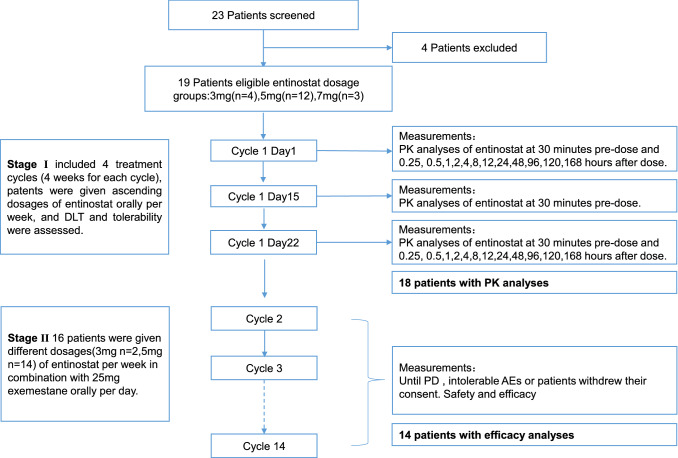
Nineteen patients received entinostat for 4 weeks (dose-limiting toxicity (DLT) observation stage) at 3, 5, or 7 mg/week, with a "3+3" dose-escalation design and in combination with exemestane thereafter (extended treatment stage: entinostat, 3 or 5 mg/week; exemestane, 25 mg/day). An additional 21 patients were enrolled to assess the entinostat (5 mg) plus exemestane (25 mg) pharmacokinetic profile and potential efficacy.
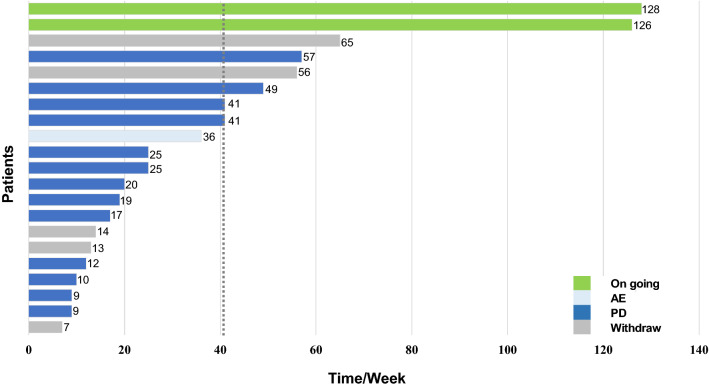
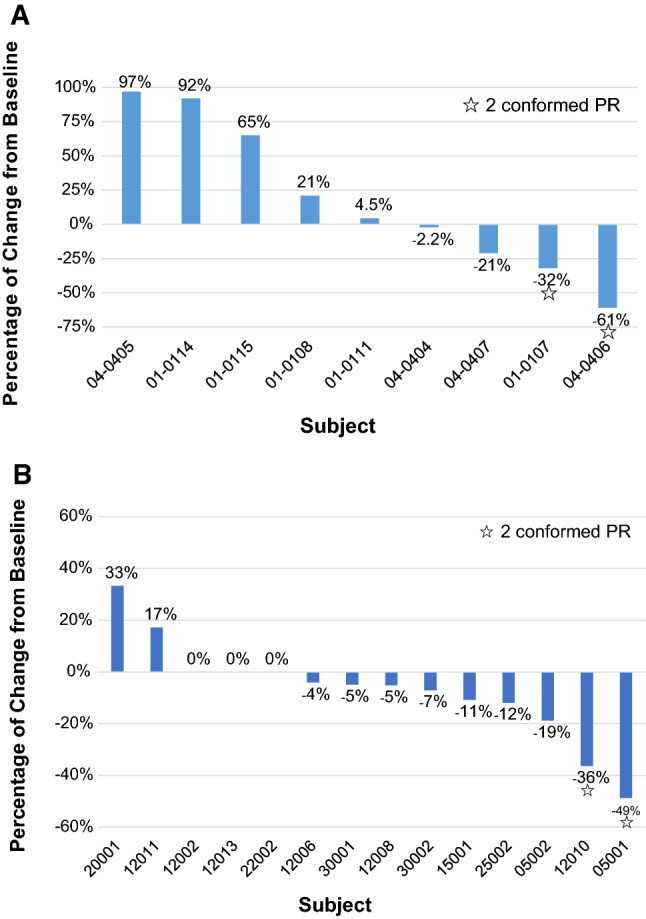
The peak entinostat serum concentration and area under the curve increased dose proportionally, without significant interaction between entinostat and exemestane. Entinostat was well tolerated at all doses. The most common grade 3/4 adverse effects (AEs) included neutropenia (31.6%) and thrombocytopenia (15.8%). In the DLT observation stage, grade 3/4 AEs accounted for 16.7% in the 5 mg group with one suspicious DLT (G3 ventricular tachycardia) and 33.3% in the 7 mg group. In the extended treatment stage, 2/16 patients achieved partial response and three patients experienced stable disease (> 12 weeks). The median progression-free survival was 9.41 months for the additional 21 patients, who experienced grade 3/4 AEs of neutropenia (38%), thrombocytopenia (9.5%), anemia (9.5%), and fatigue (9.5%).
Entinostat with exemestane showed reasonable safety, tolerability, and encouraging efficacy in Chinese patients with HR+/HER2- MBC. These results support further evaluation in a randomized, double-blind Phase III study with a weekly 5 mg entinostat dose in a Chinese population.
NCT02833155.
先前的临床试验表明,依沙替康与依西美坦联合应用于美国晚期激素受体阳性(HR+)和人表皮生长因子受体 2 阴性(HER2-)转移性乳腺癌(MBC)患者时具有良好的耐受性和显著的临床疗效。然而,在中国人群中尚未开展临床试验。
评估依沙替康联合或不联合依西美坦治疗中国绝经后局部晚期或转移性 HR+/HER2-MBC 患者的安全性、药代动力学和初步疗效。
19 例患者接受依沙替康治疗 4 周(剂量限制性毒性[DLT]观察期),剂量为 3、5 或 7 mg/周,采用“3+3”剂量递增设计,此后再联合依西美坦(扩展治疗期:依沙替康 3 或 5 mg/周,依西美坦 25 mg/天)。另外纳入 21 例患者以评估依沙替康(5 mg)联合依西美坦(25 mg)的药代动力学特征和潜在疗效。
依沙替康的血药峰浓度和曲线下面积呈剂量依赖性增加,与依西美坦之间无显著的相互作用。所有剂量的依沙替康均具有良好的耐受性。最常见的 3/4 级不良事件(AE)包括中性粒细胞减少症(31.6%)和血小板减少症(15.8%)。在 DLT 观察期,5 mg 组的 3/4 级 AE 占 16.7%,1 例可疑 DLT(G3 室性心动过速),7 mg 组占 33.3%。在扩展治疗期,16 例患者中有 2 例获得部分缓解,3 例患者疾病稳定(>12 周)。另外 21 例患者的中位无进展生存期为 9.41 个月,这些患者发生 3/4 级 AE,包括中性粒细胞减少症(38%)、血小板减少症(9.5%)、贫血(9.5%)和乏力(9.5%)。
依沙替康联合依西美坦在中国 HR+/HER2-MBC 患者中具有良好的安全性、耐受性和令人鼓舞的疗效。这些结果支持在中国人群中开展一项每周 5 mg 依沙替康剂量的随机、双盲 III 期研究。
NCT02833155。