Watanabe Takashi
Department of Personalized Cancer Immunotherapy, Mie University Graduate School of Medicine, 2-174, Edobashi, Tsu City 514-8507, Japan.
Cancers (Basel). 2021 Jun 13;13(12):2969. doi: 10.3390/cancers13122969.
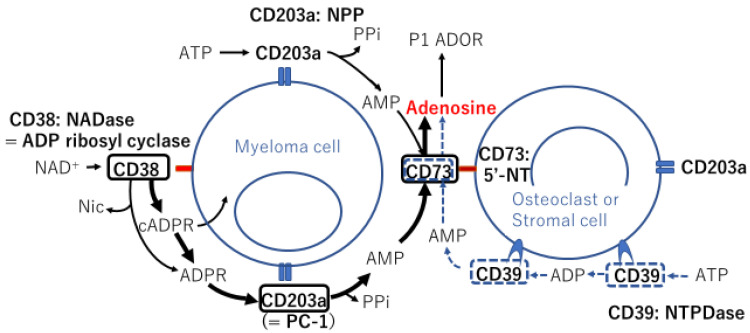
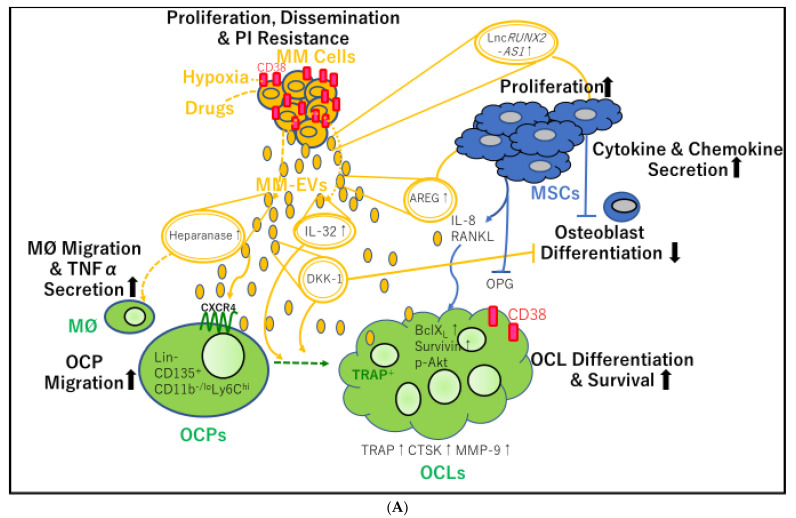
Angiogenesis and immunosuppression promote multiple myeloma (MM) development, and osteolysis is a primary feature of MM. Although immunomodulatory drugs and proteasome inhibitors (PIs) markedly improve the survival of patients with MM, this disease remains incurable. In the bone marrow niche, a chain of ectoenzymes, including CD38, produce immunosuppressive adenosine, inhibiting T cell proliferation as well as immunosuppressive cells. Therefore, anti-CD38 antibodies targeting myeloma cells have the potential to restore T cell responses to myeloma cells. Meanwhile extracellular vesicles (EVs) containing microRNAs, proteins such as cytokines and chemokines, long noncoding RNAs, and PIWI-interacting RNAs have been shown to act as communication tools in myeloma cell/microenvironment interactions. Via EVs, mesenchymal stem cells allow myeloma cell dissemination and confer PI resistance, whereas myeloma cells promote angiogenesis, myeloid-derived suppressor cell proliferation, and osteoclast differentiation and inhibit osteoblast differentiation. In this review, to understand key processes of MM development involving communication between myeloma cells and other cells in the tumor microenvironment, EV cargo and the non-canonical adenosinergic pathway are introduced, and ectoenzymes and EVs are discussed as potential druggable targets for the treatment of MM patients.
血管生成和免疫抑制促进多发性骨髓瘤(MM)的发展,而骨质溶解是MM的主要特征。尽管免疫调节药物和蛋白酶体抑制剂(PIs)显著提高了MM患者的生存率,但这种疾病仍然无法治愈。在骨髓微环境中,包括CD38在内的一系列外切酶会产生免疫抑制性腺苷,抑制T细胞增殖以及免疫抑制细胞。因此,靶向骨髓瘤细胞的抗CD38抗体有可能恢复T细胞对骨髓瘤细胞的反应。同时,含有微小RNA、细胞因子和趋化因子等蛋白质、长链非编码RNA以及PIWI相互作用RNA的细胞外囊泡(EVs)已被证明在骨髓瘤细胞/微环境相互作用中充当通讯工具。通过EVs,间充质干细胞可使骨髓瘤细胞扩散并赋予PI耐药性,而骨髓瘤细胞则促进血管生成、髓源性抑制细胞增殖以及破骨细胞分化,并抑制成骨细胞分化。在本综述中,为了解MM发展过程中涉及骨髓瘤细胞与肿瘤微环境中其他细胞之间通讯的关键过程,引入了EV货物和非经典腺苷能途径,并将外切酶和EVs作为治疗MM患者的潜在可药物化靶点进行了讨论。