Schäfer Anima M, Meyer Zu Schwabedissen Henriette E, Grube Markus
Biopharmacy, Department Pharmaceutical Sciences, University of Basel, Klingelbergstrasse 50, 4056 Basel, Switzerland.
Center of Drug Absorption and Transport (C_DAT), Department of Pharmacology, University Medicine of Greifswald, 17489 Greifswald, Germany.
Pharmaceutics. 2021 Jun 4;13(6):834. doi: 10.3390/pharmaceutics13060834.
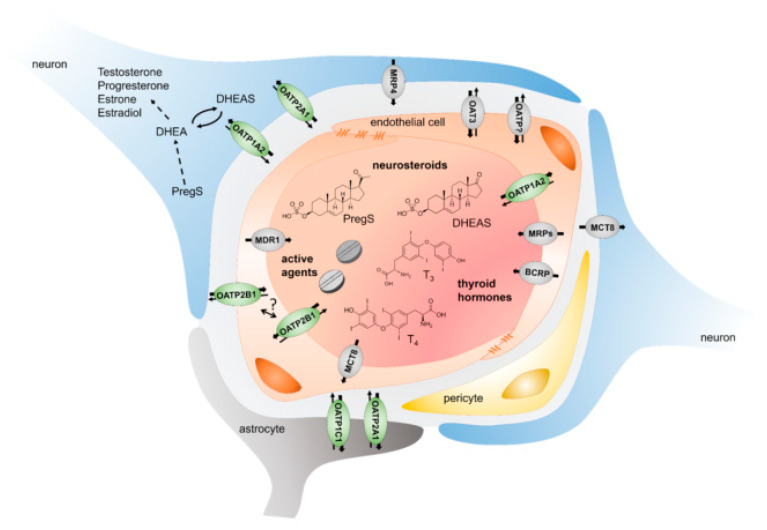
The central nervous system (CNS) is an important pharmacological target, but it is very effectively protected by the blood-brain barrier (BBB), thereby impairing the efficacy of many potential active compounds as they are unable to cross this barrier. Among others, membranous efflux transporters like P-Glycoprotein are involved in the integrity of this barrier. In addition to these, however, uptake transporters have also been found to selectively uptake certain compounds into the CNS. These transporters are localized in the BBB as well as in neurons or in the choroid plexus. Among them, from a pharmacological point of view, representatives of the organic anion transporting polypeptides (OATPs) are of particular interest, as they mediate the cellular entry of a variety of different pharmaceutical compounds. Thus, OATPs in the BBB potentially offer the possibility of CNS targeting approaches. For these purposes, a profound understanding of the expression and localization of these transporters is crucial. This review therefore summarizes the current state of knowledge of the expression and localization of OATPs in the CNS, gives an overview of their possible physiological role, and outlines their possible pharmacological relevance using selected examples.
中枢神经系统(CNS)是一个重要的药理学靶点,但它受到血脑屏障(BBB)的有效保护,这会削弱许多潜在活性化合物的疗效,因为它们无法穿过这一屏障。其中,像P-糖蛋白这样的膜性外排转运体参与了这一屏障的完整性维持。然而,除此之外,人们还发现摄取转运体可将某些化合物选择性摄取到中枢神经系统中。这些转运体定位于血脑屏障以及神经元或脉络丛中。从药理学角度来看,其中有机阴离子转运多肽(OATPs)的代表特别受关注,因为它们介导多种不同药物化合物的细胞摄取。因此,血脑屏障中的OATPs可能为中枢神经系统靶向方法提供了可能性。出于这些目的,深入了解这些转运体的表达和定位至关重要。因此,本综述总结了中枢神经系统中OATPs表达和定位的当前知识状态,概述了它们可能的生理作用,并通过选定的例子概述了它们可能的药理学相关性。