Kim Bong-Seok, Jin Youngseok, Lee Jonghun, Kim Sangdong
Division of Automotive Technology, Daegu Gyeongbuk Institute of Science and Technology (DGIST), Daegu 42988, Korea.
Department of Interdisciplinary Engineering, DGIST, Daegu 42988, Korea.
Sensors (Basel). 2021 Jun 10;21(12):4018. doi: 10.3390/s21124018.
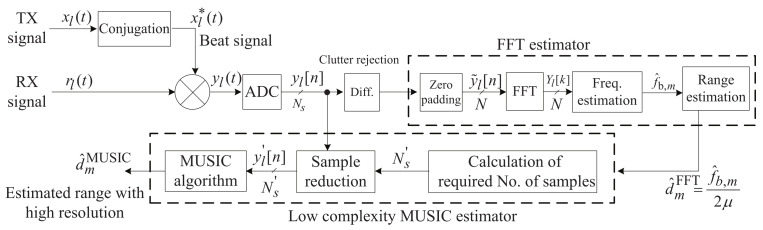
This paper proposes a high-efficiency super-resolution frequency-modulated continuous-wave (FMCW) radar algorithm based on estimation by fast Fourier transform (FFT). In FMCW radar systems, the maximum number of samples is generally determined by the maximum detectable distance. However, targets are often closer than the maximum detectable distance. In this case, even if the number of samples is reduced, the ranges of targets can be estimated without degrading the performance. Based on this property, the proposed algorithm adaptively selects the number of samples used as input to the super-resolution algorithm depends on the coarsely estimated ranges of targets using the FFT. The proposed algorithm employs the reduced samples by the estimated distance by FFT as input to the super resolution algorithm instead of the maximum number of samples set by the maximum detectable distance. By doing so, the proposed algorithm achieves the similar performance of the conventional multiple signal classification algorithm (MUSIC), which is a representative of the super resolution algorithms while the performance does not degrade. Simulation results demonstrate the feasibility and performance improvement provided by the proposed algorithm; that is, the proposed algorithm achieves average complexity reduction of 88% compared to the conventional MUSIC algorithm while achieving its similar performance. Moreover, the improvement provided by the proposed algorithm was verified in practical conditions, as evidenced by our experimental results.
本文提出了一种基于快速傅里叶变换(FFT)估计的高效超分辨率调频连续波(FMCW)雷达算法。在FMCW雷达系统中,样本的最大数量通常由最大可检测距离决定。然而,目标往往比最大可检测距离更近。在这种情况下,即使减少样本数量,也可以在不降低性能的情况下估计目标的距离。基于这一特性,所提出的算法根据使用FFT粗略估计的目标距离,自适应地选择用作超分辨率算法输入的样本数量。所提出的算法采用通过FFT估计距离得到的减少后的样本作为超分辨率算法的输入,而不是由最大可检测距离设置的最大样本数量。通过这样做,所提出的算法实现了与传统多重信号分类算法(MUSIC)相似的性能,MUSIC算法是超分辨率算法的代表,且性能不会下降。仿真结果证明了所提出算法的可行性和性能提升;也就是说,与传统MUSIC算法相比,所提出的算法平均复杂度降低了88%,同时实现了相似的性能。此外,我们的实验结果证明,所提出的算法在实际条件下也有性能提升。