Jóri Balázs, Schatz Stefanie, Kaller Len, Kah Bettina, Roeper Julia, Ramdani Hayat O, Diehl Linda, Hoffknecht Petra, Grohé Christian, Griesinger Frank, Tiemann Markus, Heukamp Lukas C, Falk Markus
Institut für Hämatopathologie Hamburg, Fangdieckstraße 75A, 22547 Hamburg, Germany.
Lung Cancer Network NOWEL, 26129 Oldenburg, Germany.
Cancers (Basel). 2021 Jun 8;13(12):2861. doi: 10.3390/cancers13122861.
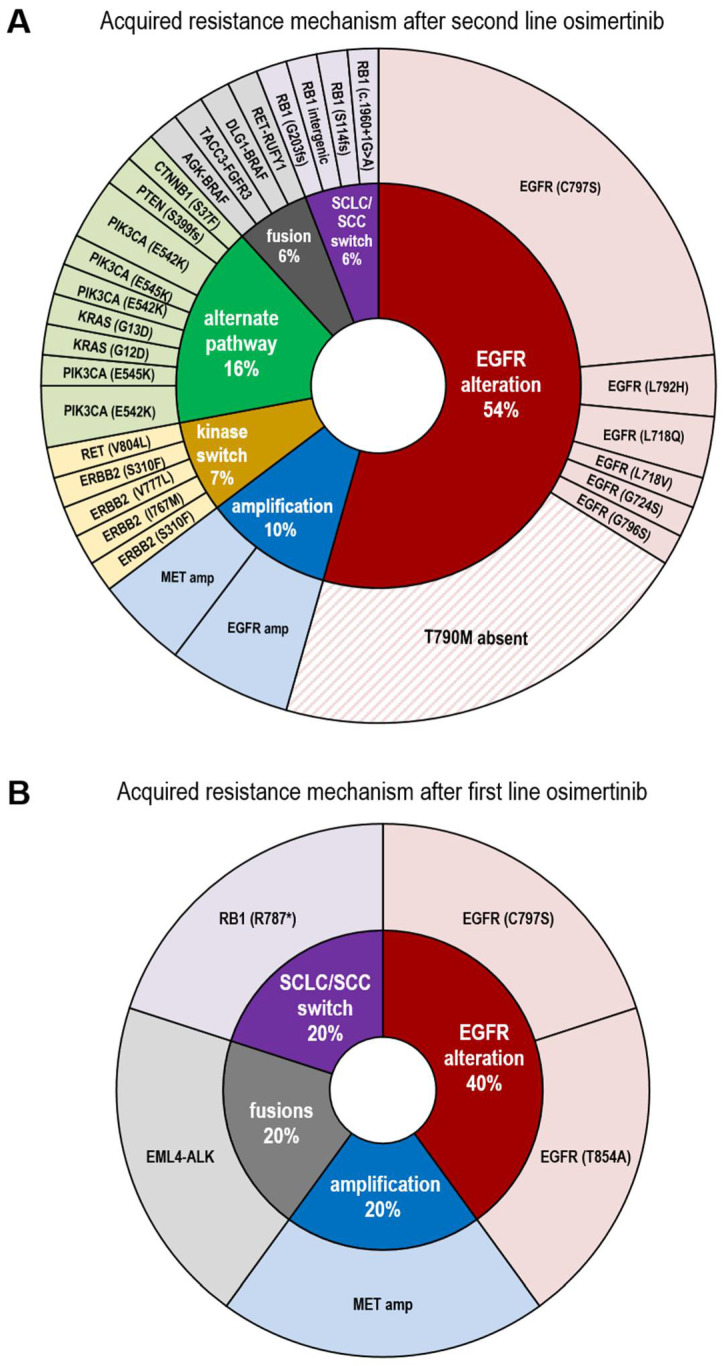
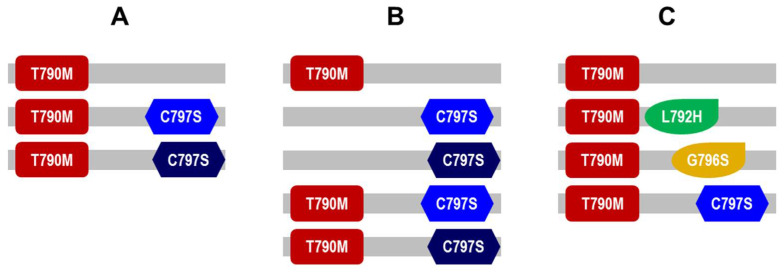
Since 2009, several first, second, and third generation tyrosine kinase inhibitors (TKI) have been approved for targeted treatment of mutated metastatic non-small lung cancer (NSCLC). A vast majority of patients is improving quickly on treatment; however, resistance is inevitable and typically occurs after one year for TKI of the first and second generation. Osimertinib, a third generation TKI, has recently been approved for first line treatment in the palliative setting and is expected to become approved for the adjuvant setting as well. Progression-free survival (PFS) under osimertinib is superior to its predecessors but its spectrum of resistance alterations appears significantly more diverse compared to first and second generation TKI. As resistance mechanisms to osimertinib are therapeutically targetable in some cases, it is important to comprehensively test for molecular alterations in the relapse scenario. Liquid biopsy may be advantageous over tissue analysis as it has the potential to represent tumor heterogeneity and clonal diversification. We have previously shown high concordance of hybrid capture (HC) based next generation sequencing (NGS) in liquid biopsy versus solid tumor biopsies. In this study, we now present real-word data from 56 patients with metastatic NSCLC that were tested by liquid biopsy at the time of disease progression on mostly second line treated osimertinib treatment. We present examples of single and multiple TKI resistance mechanisms, including mutations in multiple pathways, copy number changes and rare fusions of , , and . In addition, we present the added value of HC based NGS to reveal polyclonal resistance development at the DNA level encoding multiple C797S and mutations.
自2009年以来,已有数种第一代、第二代和第三代酪氨酸激酶抑制剂(TKI)被批准用于靶向治疗突变的转移性非小细胞肺癌(NSCLC)。绝大多数患者在治疗后迅速好转;然而,耐药是不可避免的,第一代和第二代TKI通常在治疗一年后出现耐药。奥希替尼是第三代TKI,最近已被批准用于姑息治疗的一线治疗,预计也将被批准用于辅助治疗。奥希替尼治疗下的无进展生存期(PFS)优于其前代药物,但与第一代和第二代TKI相比,其耐药改变谱似乎明显更多样化。由于奥希替尼的耐药机制在某些情况下可作为治疗靶点,因此在复发情况下全面检测分子改变非常重要。液体活检可能比组织分析更具优势,因为它有可能代表肿瘤异质性和克隆多样性。我们之前已经证明,基于杂交捕获(HC)的下一代测序(NGS)在液体活检与实体瘤活检中的一致性很高。在本研究中,我们现在展示了56例转移性NSCLC患者的真实世界数据,这些患者在疾病进展时接受了液体活检,主要接受二线奥希替尼治疗。我们展示了单药和多药TKI耐药机制的实例,包括多个通路的突变、拷贝数变化以及 、 、 和 的罕见融合。此外,我们展示了基于HC的NGS在揭示编码多个C797S和 突变的DNA水平上的多克隆耐药发展方面的附加价值。