Yang D Aaron, Laven Richard A
Jockey Club College of Veterinary Medicine and Life Sciences, City University of Hong Kong, Kowloon, Hong Kong.
School of Veterinary Science, Massey University, Palmerston North 4442, New Zealand.
Vet Sci. 2021 Jun 8;8(6):105. doi: 10.3390/vetsci8060105.
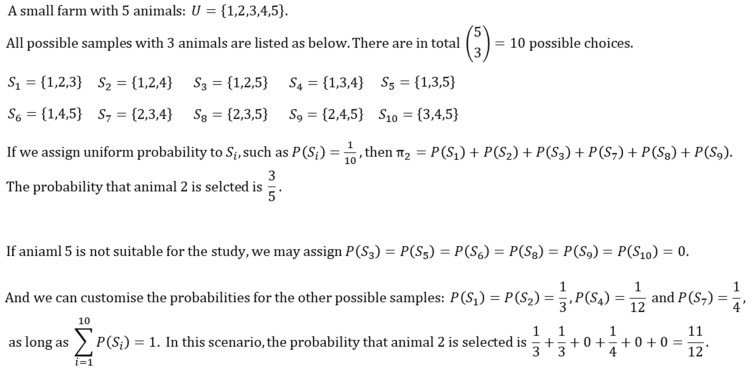
Sample surveys are an essential approach used in veterinary research and investigation. A sample obtained from a well-designed sampling process along with robust data analysis can provide valuable insight into the attributes of the target population. Two approaches, design-based or model-based, can be used as inferential frameworks for analysing survey data. Compared to the model-based approach, the design-based approach is usually more straightforward and directly makes inferences about the finite target population (such as the dairy cows in a herd or dogs in a region) rather than an infinite superpopulation. In this paper, the concept of probability sampling and the design-based approach is briefly reviewed, followed by a discussion of the estimations and their justifications in the context of several different elementary sampling methods, including simple random sampling, stratified random sampling, and one-stage cluster sampling. Finally, a concrete example of a complex survey design (involving multistage sampling and stratification) is demonstrated, illustrating how finding unbiased estimators and their corresponding variance formulas for a complex survey builds on the techniques used in elementary sampling methods.
抽样调查是兽医研究和调查中使用的一种重要方法。通过精心设计的抽样过程获得的样本以及强大的数据分析,可以为目标人群的特征提供有价值的见解。设计型或模型型两种方法可作为分析调查数据的推断框架。与基于模型的方法相比,基于设计的方法通常更直接,直接对有限的目标人群(如一群奶牛或一个地区的狗)进行推断,而不是对无限的超总体进行推断。本文简要回顾了概率抽样的概念和基于设计的方法,随后讨论了在几种不同的基本抽样方法(包括简单随机抽样、分层随机抽样和单阶段整群抽样)背景下的估计及其依据。最后,展示了一个复杂调查设计(涉及多阶段抽样和分层)的具体例子,说明了如何基于基本抽样方法中使用的技术来找到复杂调查的无偏估计量及其相应的方差公式。