
细胞质混合而非核共存能够解释担子菌中的体细胞不亲和性。
Cytoplasmic Mixing, Not Nuclear Coexistence, Can Explain Somatic Incompatibility in Basidiomycetes.
作者信息
Auxier Ben, Scholtmeijer Karin, van Peer Arend F, Baars Johan J P, Debets Alfons J M, Aanen Duur K
机构信息
Laboratory of Genetics, Wageningen University and Research, 6708 PB Wageningen, The Netherlands.
Mushroom Group, Plant Breeding Department, Wageningen University and Research, 6708 PB Wageningen, The Netherlands.
出版信息
Microorganisms. 2021 Jun 8;9(6):1248. doi: 10.3390/microorganisms9061248.
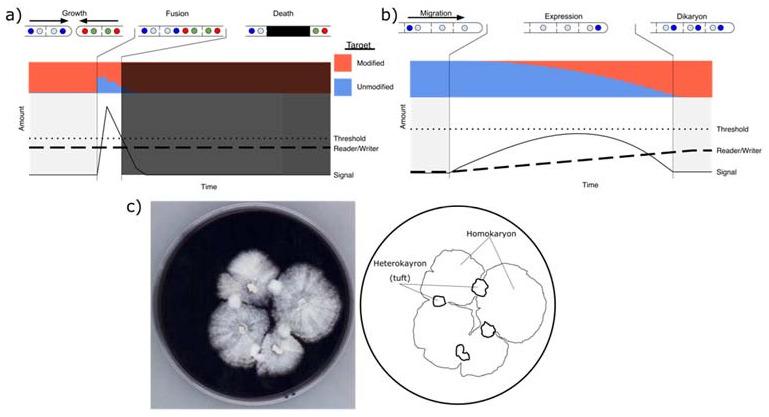
Nonself recognition leading to somatic incompatibility (SI) is commonly used by mycologists to distinguish fungal individuals. Despite this, the process remains poorly understood in basidiomycetes as all current models of SI are based on genetic and molecular research in ascomycete fungi. Ascomycete fungi are mainly found in a monokaryotic stage, with a single type of haploid nuclei, and only briefly during mating do two genomes coexist in heterokaryotic cells. The sister phylum, Basidiomycota, differs in several relevant aspects. Basidiomycete fungi have an extended heterokaryotic stage, and SI is generally observed between heterokaryons instead of between homokaryons. Additionally, considerable nuclear migration occurs during a basidiomycete mating reaction, introducing a nucleus into a resident homokaryon with cytoplasmic mixing limited to the fused or neighboring cells. To accommodate these differences, we describe a basidiomycete model for nonself recognition using post-translational modification, based on a reader-writer system as found in other organisms. This post-translational modification combined with nuclear migration allows for the coexistence of two genomes in one individual while maintaining nonself recognition during all life stages. Somewhat surprisingly, this model predicts localized cell death during mating, which is consistent with previous observations but differs from the general assumptions of basidiomycete mating. This model will help guide future research into the mechanisms behind basidiomycete nonself recognition.
非自身识别导致体细胞不亲和性(SI),真菌学家常用此来区分真菌个体。尽管如此,在担子菌中这一过程仍知之甚少,因为目前所有的SI模型都是基于子囊菌的遗传和分子研究。子囊菌主要处于单核阶段,只有单一类型的单倍体细胞核,仅在交配期间,两个基因组才会在异核体细胞中短暂共存。其姐妹门担子菌门在几个相关方面有所不同。担子菌有一个延长的异核阶段,SI通常在异核体之间而非同核体之间观察到。此外,在担子菌交配反应过程中会发生大量核迁移,将一个细胞核引入驻留的同核体中,细胞质混合仅限于融合或相邻细胞。为适应这些差异,我们基于其他生物体中发现的读写系统,描述了一种利用翻译后修饰进行非自身识别的担子菌模型。这种翻译后修饰与核迁移相结合,使得两个基因组能够在一个个体中共存,同时在所有生命阶段维持非自身识别。有点令人惊讶的是,该模型预测交配过程中会出现局部细胞死亡,这与之前的观察结果一致,但与担子菌交配的一般假设不同。这个模型将有助于指导未来对担子菌非自身识别背后机制的研究。


 Zotero 插件