Sáenz Rodríguez Mery Nair, Cassab Gladys Iliana
Departamento de Biología Molecular de Plantas, Instituto de Biotecnología, Universidad Nacional Autónoma de Mexico, Av. Universidad 2001, Col. Chamilpa, Morelos, Cuernavaca 62210, Mexico.
Plants (Basel). 2021 Jun 23;10(7):1274. doi: 10.3390/plants10071274.
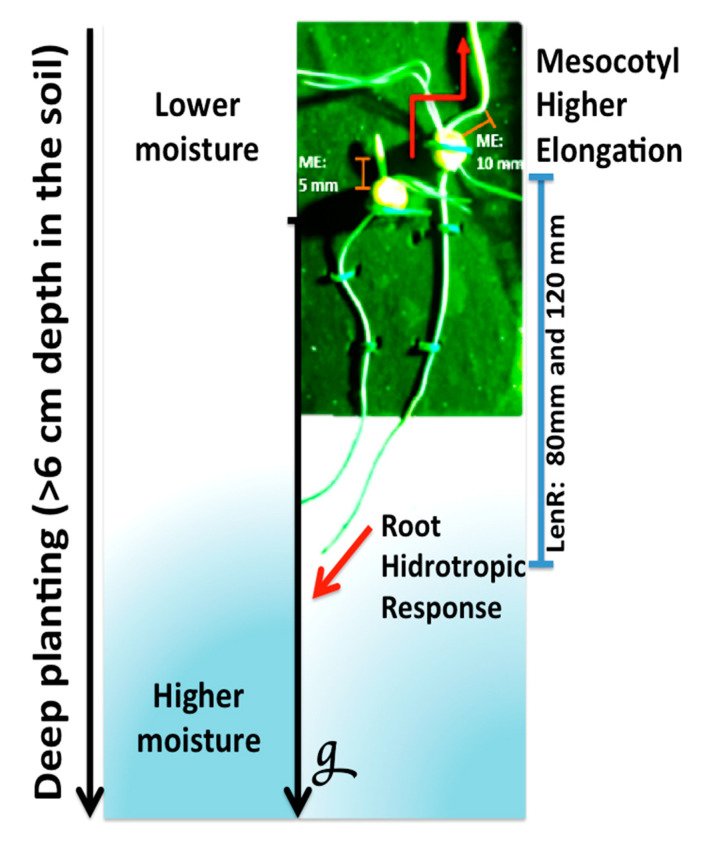
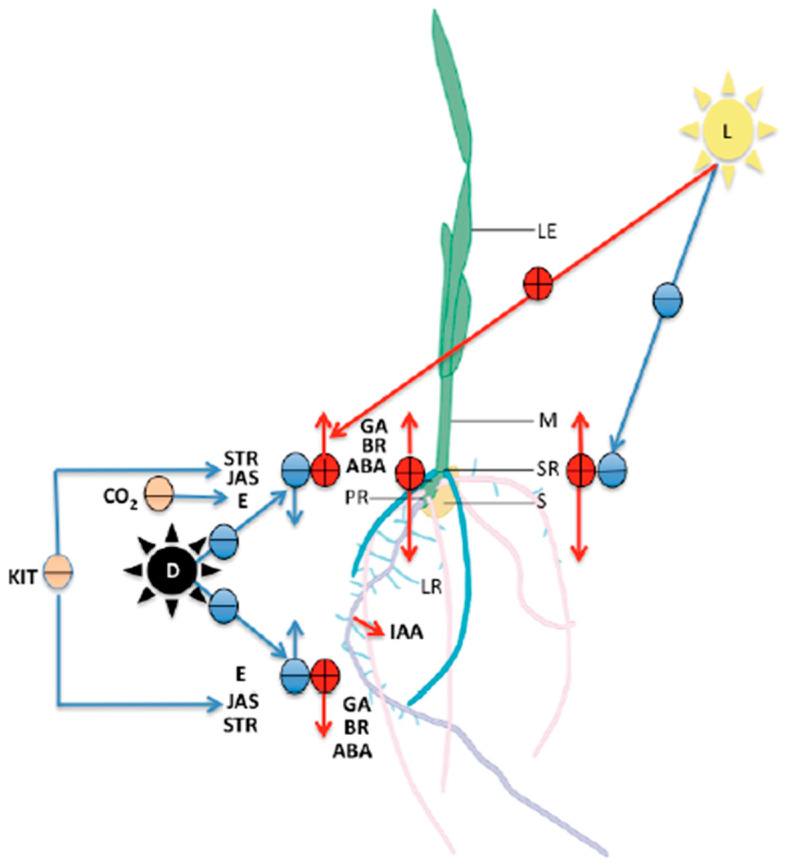
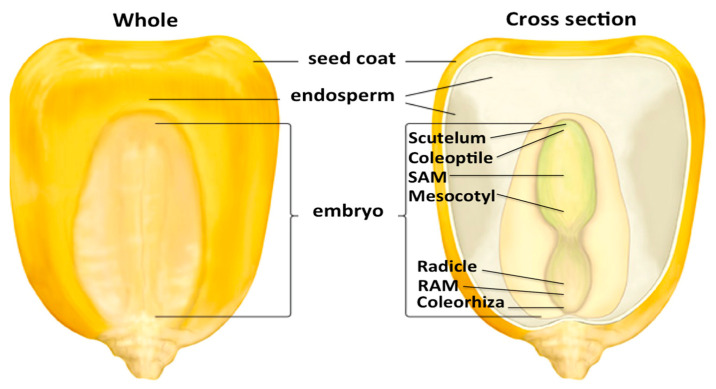
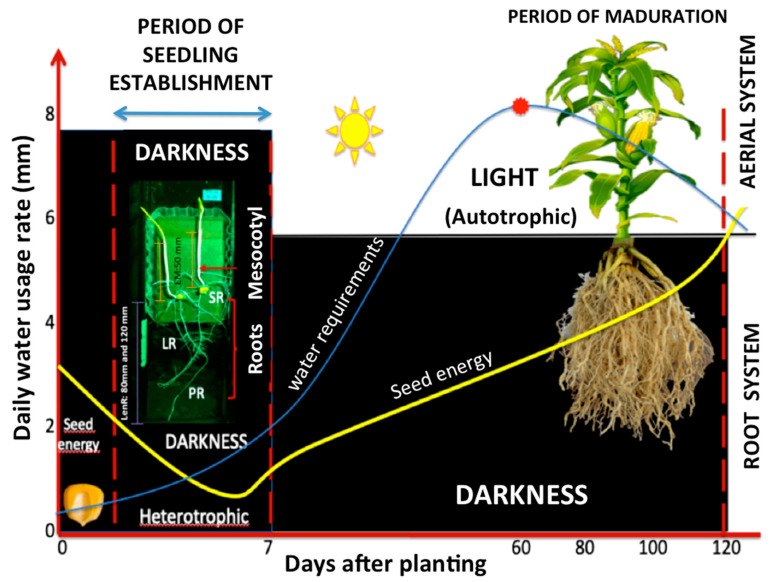
Maize illustrates one of the most complex cases of embryogenesis in higher plants that results in the development of early embryo with distinctive organs such as the mesocotyl, seminal and primary roots, coleoptile, and plumule. After seed germination, the elongation of root and mesocotyl follows opposite directions in response to specific tropisms (positive and negative gravitropism and hydrotropism). Tropisms represent the differential growth of an organ directed toward several stimuli. Although the life cycle of roots and mesocotyl takes place in darkness, their growth and functions are controlled by different mechanisms. Roots ramify through the soil following the direction of the gravity vector, spreading their tips into new territories looking for water; when water availability is low, the root hydrotropic response is triggered toward the zone with higher moisture. Nonetheless, there is a high range of hydrotropic curvatures (angles) in maize. The processes that control root hydrotropism and mesocotyl elongation remain unclear; however, they are influenced by genetic and environmental cues to guide their growth for optimizing early seedling vigor. Roots and mesocotyls are crucial for the establishment, growth, and development of the plant since both help to forage water in the soil. Mesocotyl elongation is associated with an ancient agriculture practice known as deep planting. This tradition takes advantage of residual soil humidity and continues to be used in semiarid regions of Mexico and USA. Due to the genetic diversity of maize, some lines have developed long mesocotyls capable of deep planting while others are unable to do it. Hence, the genetic and phenetic interaction of maize lines with a robust hydrotropic response and higher mesocotyl elongation in response to water scarcity in time of global heating might be used for developing more resilient maize plants.
玉米体现了高等植物胚胎发生过程中最复杂的情况之一,该过程导致早期胚胎发育出独特的器官,如中胚轴、胚根和初生根、胚芽鞘和胚芽。种子萌发后,根和中胚轴的伸长会根据特定的向性(正向和负向重力性以及向水性)朝相反方向进行。向性表现为器官针对多种刺激的差异生长。尽管根和中胚轴的生命周期在黑暗中进行,但其生长和功能受不同机制控制。根沿着重力矢量方向在土壤中分支,将根尖伸展到新区域寻找水分;当水分供应不足时,根的向水反应会被触发,朝向湿度较高的区域。然而,玉米中向水弯曲(角度)的范围很广。控制根向水性和中胚轴伸长的过程仍不清楚;然而,它们受遗传和环境线索影响,以引导其生长来优化早期幼苗活力。根和中胚轴对植物的建立、生长和发育至关重要,因为它们都有助于在土壤中获取水分。中胚轴伸长与一种古老的农业实践——深播有关。这种传统利用了土壤中的残余湿度,并且仍在墨西哥和美国的半干旱地区使用。由于玉米的遗传多样性,一些品系已经发育出能够深播的长中胚轴,而其他品系则不能。因此,在全球变暖时期,具有强大向水反应和更高中胚轴伸长以应对缺水的玉米品系的遗传和表型相互作用,可能用于培育更具韧性的玉米植株。