Department of Food and Nutrition, School of Pharmaceutical Sciences of Araraquara, State University of Sao Paulo-FCFAR/UNESP, Araraquara 14800-903, Brazil.
School of Physical Education and Sports of Ribeirao Preto, Laboratory of Exercise Physiology and Metabolism, University of Sao Paulo (EEFERP-USP), Ribeirao Preto 14040-907, Brazil.
Nutrients. 2021 Jun 23;13(7):2153. doi: 10.3390/nu13072153.
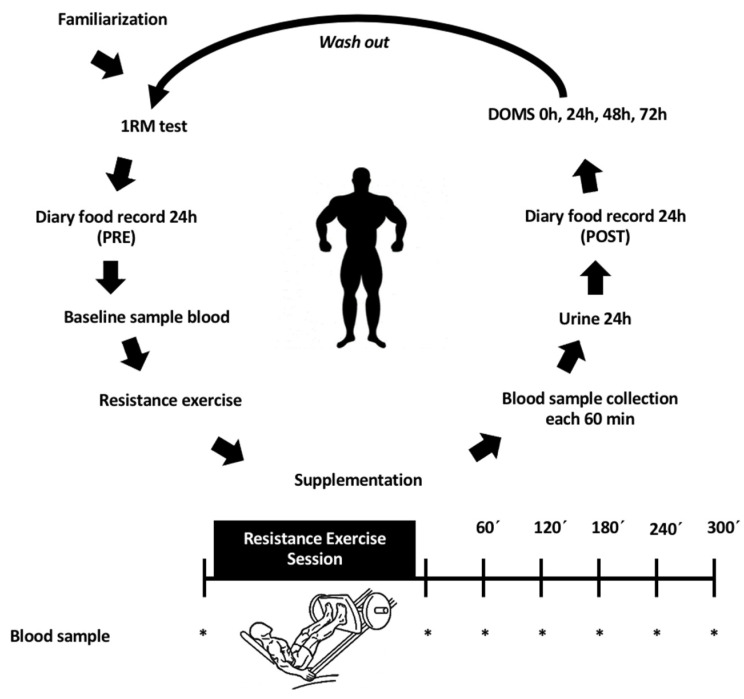
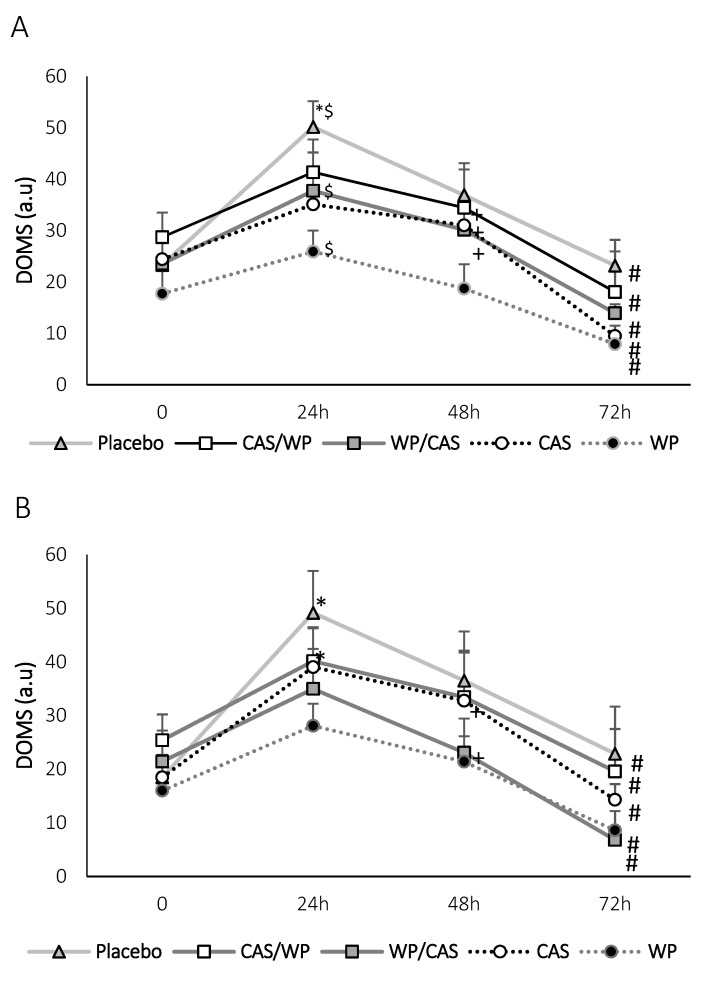
Due to the utilization of milk proteins such as whey protein (WP) and casein as sports nutrition ergogenic aids, the present study investigated the effects of the association of WP and casein in a ratio of 80:20, a similar ratio of human breast milk, on blood branched-chain amino acid (BCAA) profiles, markers of protein metabolism and delayed onset muscle soreness (DOMS), after a single bout of resistance exercise. A double-blind, crossover and acute study was carried out with ten men (age 29 ± 8 years; BMI: 25.4 ± 2.9 kg/m; 77 ± 12 kg; 1.74 ± 0.09 m); each one consumed the following supplements randomly, one per session: WP, CAS (casein), WP/CAS (80% WP/20% CAS), CAS/WP (80% CAS/20% WP) and PLA (placebo). They were also subjected to the following evaluations: the one repetition maximum (1RM) test; resistance training session; blood extraction during each session to determine the BCAA profile; two food records; 3-day evaluation of DOMS (24 h, 48 h and 72 h) and nitrogen balance in each treatment. The intervention resulted in similar nitrogen urinary, creatinine and urea plasma levels and showed a positive nitrogen balance in all the trials. Regarding the BCAAs, the peak occurred at 60 min post-ingestion and remained higher until 120 min for WP, WP/CAS and CAS/WP. The DOMS was significantly lower for WP, WP/CAS and CAS/WP compared to the CAS and PLA treatments. There were no advantages in the association of WP and CAS in the BCAAs profile when compared to WP itself, but it induced a lower DOMS compared to CAS and PLA (Clinical Trial registration number: clinicaltrials.gov, NCT04648384).
由于乳清蛋白(WP)和酪蛋白等牛奶蛋白被用作运动营养促进剂,本研究调查了类似人乳中 80:20 的 WP 和酪蛋白比例的混合物对单次抗阻运动后血液支链氨基酸(BCAA)谱、蛋白质代谢标志物和延迟性肌肉酸痛(DOMS)的影响。采用双盲、交叉和急性研究方法,纳入 10 名男性(年龄 29±8 岁;BMI:25.4±2.9 kg/m;77±12 kg;1.74±0.09 m);每人随机摄入以下补充剂,每次摄入一种:WP、CAS(酪蛋白)、WP/CAS(80% WP/20% CAS)、CAS/WP(80% CAS/20% WP)和 PLA(安慰剂)。他们还接受了以下评估:一次重复最大重量(1RM)测试;抗阻训练;每次训练时抽取血液以确定 BCAA 谱;两份食物记录;3 天的 DOMS 评估(24 h、48 h 和 72 h)和每个治疗组的氮平衡。干预导致尿氮、肌酐和尿素血浆水平相似,并在所有试验中显示出正氮平衡。关于支链氨基酸,摄入后 60 分钟达到峰值,并在 WP、WP/CAS 和 CAS/WP 中保持较高水平直至 120 分钟。与 CAS 和 PLA 治疗相比,WP、WP/CAS 和 CAS/WP 的 DOMS 明显更低。与 WP 本身相比,WP 和 CAS 的联合在支链氨基酸谱中没有优势,但与 CAS 和 PLA 相比,它会引起较低的 DOMS(临床试验注册号:clinicaltrials.gov,NCT04648384)。