Xu Miaomiao, Hu Danting, Liu Xiaoguang, Li Zhaowei, Lu Liming
School of Physical Education and Health, Guangzhou University of Chinese Medicine, Guangzhou 510006, China.
South China Research Center for Acupuncture and Moxibustion, Medical College of Acu-Moxi and Rehabilitation, Guangzhou University of Chinese Medicine, Guangzhou 510006, China.
Nutrients. 2025 Apr 12;17(8):1335. doi: 10.3390/nu17081335.
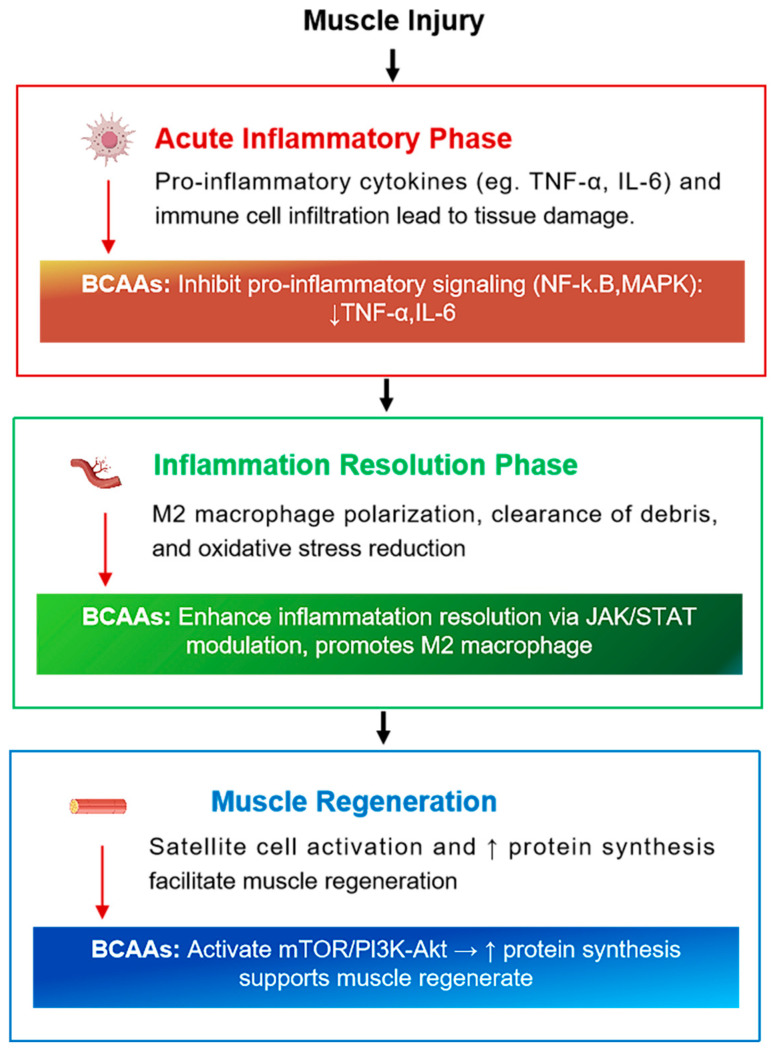
Endurance athletes frequently experience muscle damage and inflammation due to prolonged, high-intensity exercise, which can impair recovery and hinder performance. This review examines the role of branched-chain amino acid (BCAA) supplementation in muscle repair, inflammation modulation, and immune regulation. BCAAs-particularly leucine and isoleucine-activate key molecular pathways, including the mechanistic target of rapamycin (mTOR) and AMP-activated protein kinase (AMPK), to promote muscle protein synthesis and enhance energy metabolism. They also attenuate inflammatory responses by modulating the nuclear factor kappa-light-chain-enhancer of activated B cells (NF-κB), mitogen-activated protein kinase (MAPK), and Janus kinase/signal transducer and activator of transcription (JAK/STAT) pathways, reducing levels of tumor necrosis factor-alpha (TNF-α) and interleukin-6 (IL-6). In addition, BCAAs influence immune function via mechanistic target of rapamycin complex 1 (mTORC1) signaling, enhance autophagy, and mitigate exercise-induced apoptosis. These molecular effects result in reduced muscle soreness, lower muscle damage biomarker levels (e.g., creatine kinase, lactate dehydrogenase), and improved recovery. Practical considerations such as optimal dosage, timing, and co-supplementation with carbohydrates, proteins, or omega-3s are also addressed. While BCAAs show promise as a nutritional strategy for enhancing recovery and controlling inflammation in endurance athletes, further research is needed to refine personalized protocols and clarify long-term effects.
耐力运动员经常因长时间高强度运动而经历肌肉损伤和炎症,这会损害恢复并阻碍表现。本综述探讨了补充支链氨基酸(BCAA)在肌肉修复、炎症调节和免疫调节中的作用。BCAAs(特别是亮氨酸和异亮氨酸)激活关键分子途径,包括雷帕霉素机制靶点(mTOR)和AMP激活的蛋白激酶(AMPK),以促进肌肉蛋白质合成并增强能量代谢。它们还通过调节活化B细胞核因子κB轻链增强子(NF-κB)、丝裂原活化蛋白激酶(MAPK)和Janus激酶/信号转导子和转录激活子(JAK/STAT)途径来减轻炎症反应,降低肿瘤坏死因子-α(TNF-α)和白细胞介素-6(IL-6)的水平。此外,BCAAs通过雷帕霉素机制靶点复合物1(mTORC1)信号传导影响免疫功能,增强自噬,并减轻运动诱导的细胞凋亡。这些分子效应导致肌肉酸痛减轻、肌肉损伤生物标志物水平降低(如肌酸激酶、乳酸脱氢酶),并改善恢复情况。还讨论了诸如最佳剂量、时间以及与碳水化合物、蛋白质或ω-3脂肪酸共同补充等实际考虑因素。虽然BCAAs作为一种营养策略在增强耐力运动员的恢复和控制炎症方面显示出前景,但仍需要进一步研究来完善个性化方案并阐明长期影响。