Department of Medical, Oral and Biotechnological Sciences, University "G. d'Annunzio" Chieti-Pescara, 66100 Chieti, Italy.
Department of Innovative Technologies in Medicine & Dentistry, University "G. d'Annunzio" Chieti-Pescara, 66100 Chieti, Italy.
Cells. 2021 Jun 23;10(7):1587. doi: 10.3390/cells10071587.
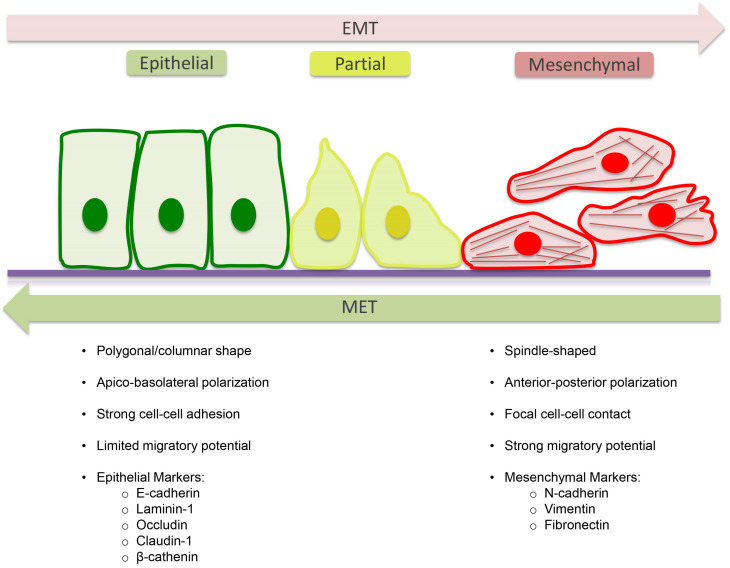
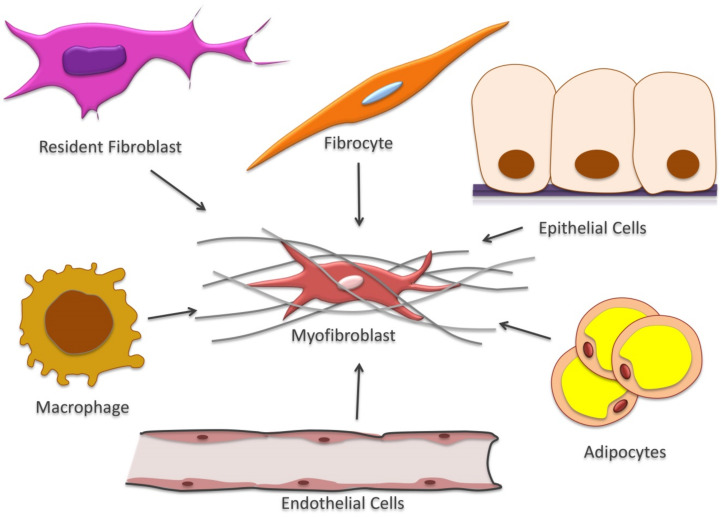
Theepithelial-mesenchymal transition (EMT) is an essential event during cell development, in which epithelial cells acquire mesenchymal fibroblast-like features including reduced intercellular adhesion and increased motility. EMT also plays a key role in wound healing processes, which are mediated by inflammatory cells and fibroblasts. These cells secrete specific factors that interact with molecules of the extracellular matrix (ECM) such as collagens, laminins, elastin and tenascins. Wound healing follows four distinct and successive phases characterized by haemostasis, inflammation, cell proliferation and finally tissue remodeling. EMT is classified into three diverse subtypes: type-1 EMT, type-2 EMT and type-3 EMT. Type-1 EMT is involved in embryogenesis and organ development. Type-2 EMT is associated with wound healing, tissue regeneration and organ fibrosis. During organ fibrosis, type-2 EMT occurs as a reparative-associated process in response to ongoing inflammation and eventually leads to organ destruction. Type-3 EMT is implicated in cancer progression, which is linked to the occurrence of genetic and epigenetic alterations, in detail the ones promoting clonal outgrowth and the formation of localized tumors. The current review aimed at exploring the role of EMT process with particular focus on type-2 EMT in wound healing, fibrosis and tissue regeneration, as well as some recent progresses in the EMT and tissue regeneration field, including the modulation of EMT by biomaterials.
上皮-间充质转化(EMT)是细胞发育过程中的一个基本事件,在此过程中,上皮细胞获得间充质成纤维细胞样特征,包括细胞间黏附力降低和运动能力增强。EMT 在伤口愈合过程中也起着关键作用,该过程由炎症细胞和成纤维细胞介导。这些细胞分泌特定的因子,与细胞外基质(ECM)中的分子相互作用,如胶原、层粘连蛋白、弹性蛋白和腱蛋白。伤口愈合分为四个不同且连续的阶段,特征为止血、炎症、细胞增殖和组织重塑。EMT 分为三种不同的亚型:1 型 EMT、2 型 EMT 和 3 型 EMT。1 型 EMT 参与胚胎发生和器官发育。2 型 EMT 与伤口愈合、组织再生和器官纤维化有关。在器官纤维化中,2 型 EMT 作为一种修复相关的过程发生,以应对持续的炎症,最终导致器官破坏。3 型 EMT 与癌症进展有关,这与遗传和表观遗传改变的发生有关,特别是促进克隆生长和局部肿瘤形成的改变。本综述旨在探讨 EMT 过程的作用,特别是 2 型 EMT 在伤口愈合、纤维化和组织再生中的作用,以及 EMT 和组织再生领域的一些最新进展,包括生物材料对 EMT 的调节。