Leng Junchen, Tu Weishan, Hou Yanbing, Cui Haitao
Key Laboratory of Ministry of Education for Genetics, Breeding and Multiple Utilization of Crops, Plant Immunity Center, Fujian Agriculture and Forestry University, Fuzhou 350002, China.
Plants (Basel). 2021 Jun 21;10(6):1258. doi: 10.3390/plants10061258.
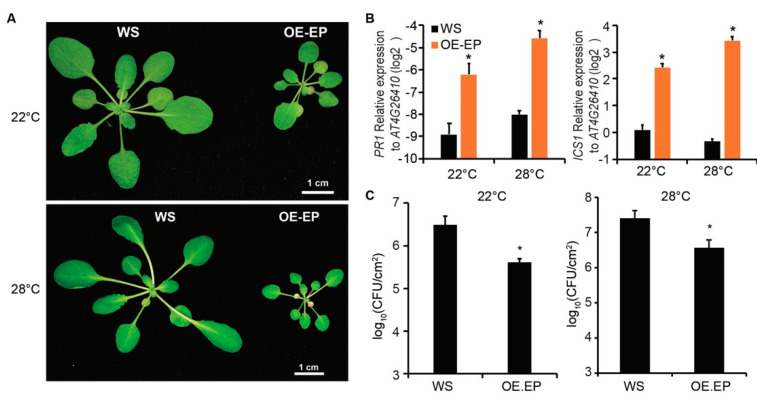
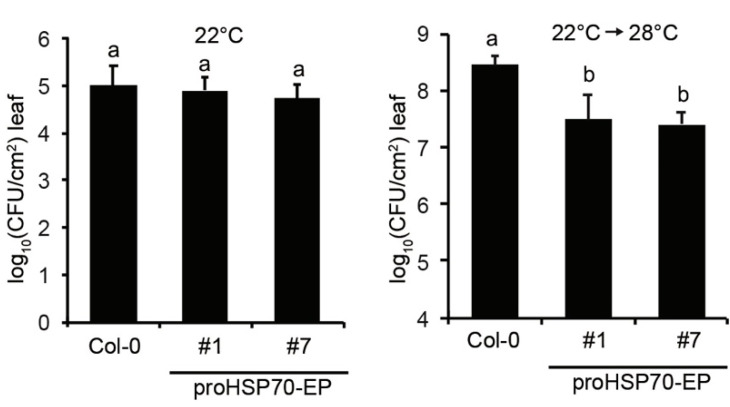
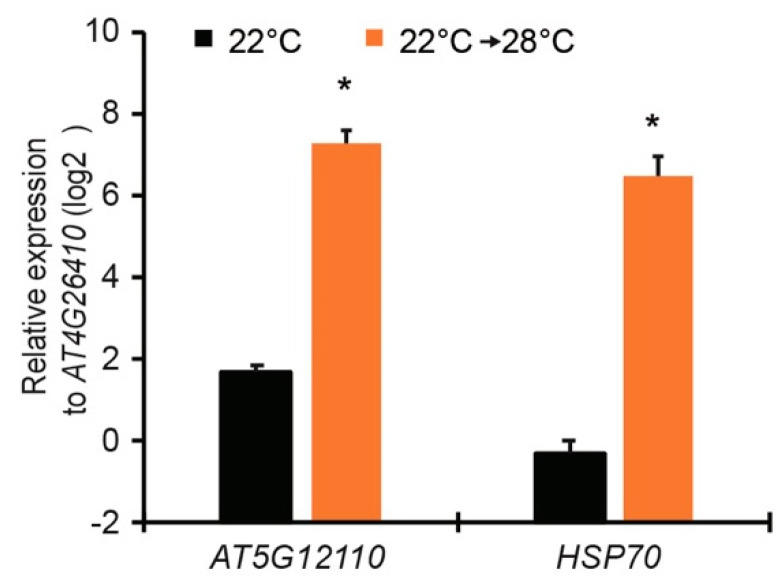
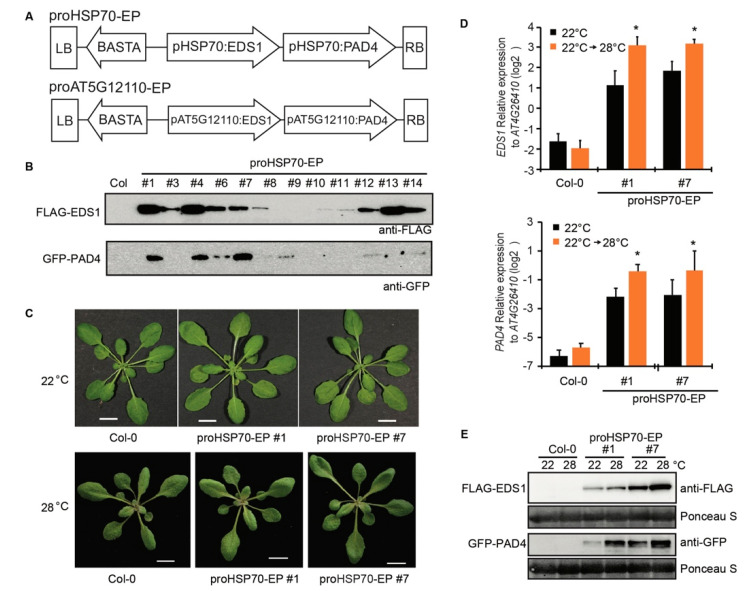
Temperature is one of the most important environmental factors greatly affecting plant disease development. High temperature favors outbreaks of many plant diseases, which threaten food security and turn to be a big issue along with climate change and global warming. Here, we found that concurrent constitutive expression of the key immune regulators and in significantly enhanced resistance to virulent bacterial pathogen pv. at elevated temperature; however, autoimmunity-related growth retardation was also observed on these plants at a normal temperature. To balance this growth-defense trade-off, we generated transgenic plants dual expressing and genes under the control of a thermo-sensitive promoter from the gene, whose expression is highly induced at an elevated temperature. Unlike constitutive overexpression lines, the proHSP70-EP transgenic lines exhibited enhanced resistance to bacterial pathogens at an elevated temperature without growth defects at normal condition. Thus, this study provides a potential strategy for genetic manipulation of plants to deal with the simultaneous abiotic and biotic stresses.
温度是极大影响植物病害发展的最重要环境因素之一。高温有利于许多植物病害的爆发,这威胁到粮食安全,并且随着气候变化和全球变暖而成为一个重大问题。在此,我们发现关键免疫调节因子 和 在 中同时组成型表达,在高温下显著增强了对毒性细菌病原体 pv. 的抗性;然而,在正常温度下这些植物也出现了与自身免疫相关的生长迟缓。为了平衡这种生长 - 防御权衡,我们构建了在来自 基因的热敏启动子控制下双表达 和 基因的转基因植物,该启动子在高温下高度诱导表达。与组成型过表达株系不同,proHSP70 - EP转基因株系在高温下对细菌病原体表现出增强的抗性,在正常条件下没有生长缺陷。因此,本研究为植物基因操作以应对同时存在的非生物和生物胁迫提供了一种潜在策略。