Department of Industrial Engineering, Tel Aviv University, Tel-Aviv 69978, Israel.
Department of Electrical Engineering, Stanford University, Stanford, CA 94305, USA.
Sensors (Basel). 2021 Jun 21;21(12):4245. doi: 10.3390/s21124245.
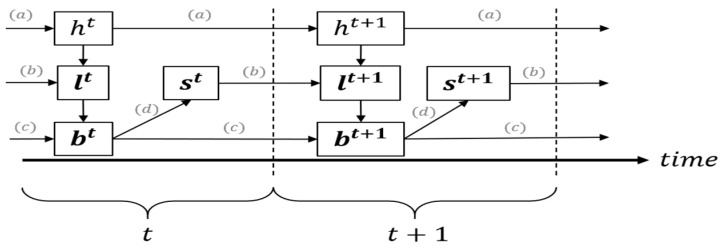
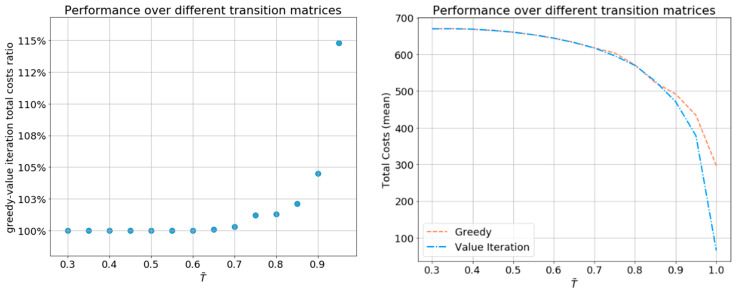
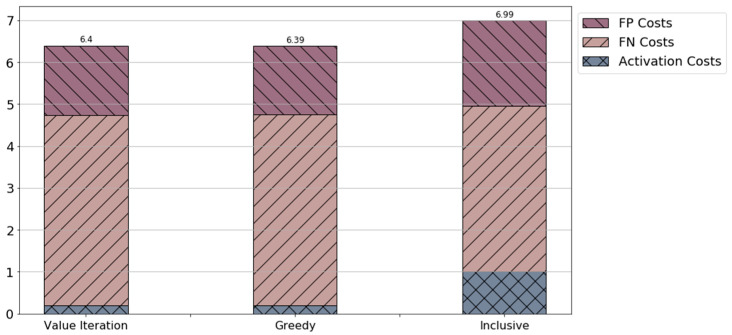
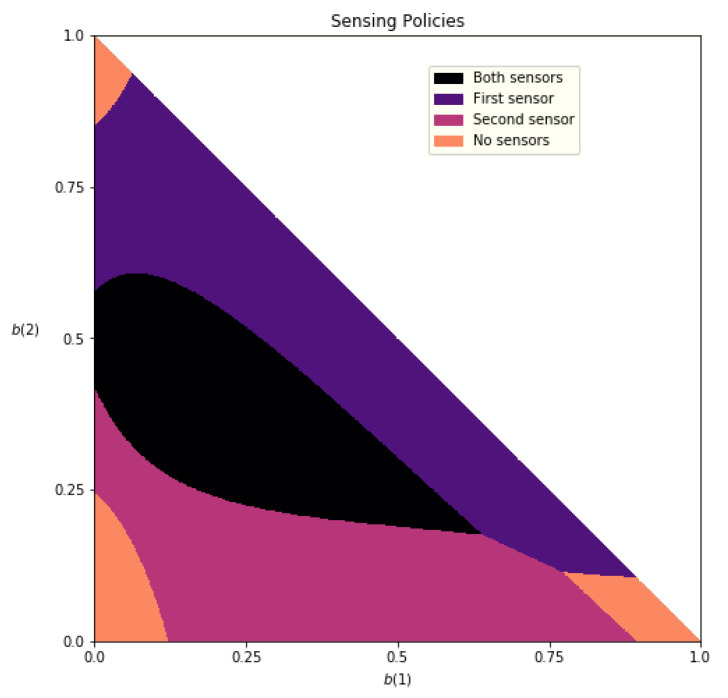
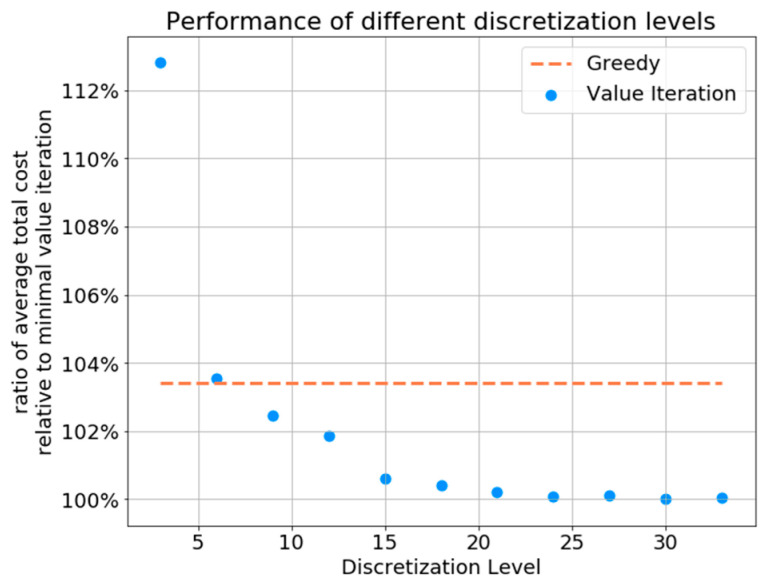
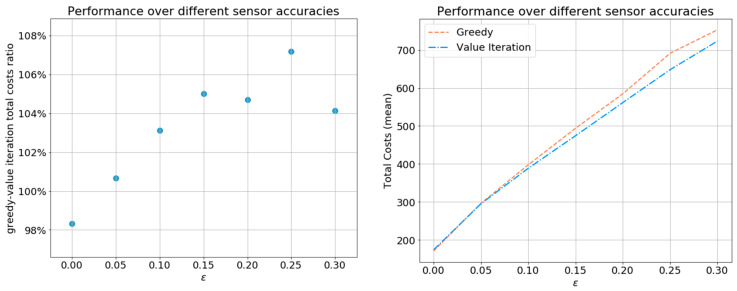
Wireless body area networks (WBANs) have strong potential in the field of health monitoring. However, the energy consumption required for accurate monitoring determines the time between battery charges of the wearable sensors, which is a key performance factor (and can be critical in the case of implantable devices). In this paper, we study the inherent trade-off between the power consumption of the sensors and the probability of misclassifying a patient's health state. We formulate this trade-off as a dynamic problem, in which at each step, we can choose to activate a subset of sensors that provide noisy measurements of the patient's health state. We assume that the (unknown) health state follows a Markov chain, so our problem is formulated as a partially observable Markov decision problem (POMDP). We show that all the past measurements can be summarized as a belief state on the true health state of the patient, which allows tackling the POMDP problem as an MDP on the belief state. Then, we empirically study the performance of a greedy one-step look-ahead policy compared to the optimal policy obtained by solving the dynamic program. For that purpose, we use an open-source Continuous Glucose Monitoring (CGM) dataset of 232 patients over six months and extract the transition matrix and sensor accuracies from the data. We find that the greedy policy saves ≈50% of the energy costs while reducing the misclassification costs by less than 2% compared to the most accurate policy possible that always activates all sensors. Our sensitivity analysis reveals that the greedy policy remains nearly optimal across different cost parameters and a varying number of sensors. The results also have practical importance, because while the optimal policy is too complicated, a greedy one-step look-ahead policy can be easily implemented in WBAN systems.
无线体域网(WBAN)在健康监测领域具有巨大的潜力。然而,准确监测所需的能量消耗决定了可穿戴传感器的电池充电间隔,这是一个关键性能因素(在植入式设备的情况下可能是至关重要的)。在本文中,我们研究了传感器的功耗与错误分类患者健康状态的概率之间的固有权衡。我们将这种权衡表述为一个动态问题,在每个步骤中,我们可以选择激活一组传感器,这些传感器提供患者健康状态的嘈杂测量值。我们假设(未知)健康状态遵循马尔可夫链,因此我们的问题被表述为部分可观测马尔可夫决策问题(POMDP)。我们表明,所有过去的测量值都可以总结为患者真实健康状态的置信状态,这使得可以将 POMDP 问题表述为置信状态上的 MDP。然后,我们通过解决动态规划来比较贪婪一步前瞻策略与最优策略的性能。为此,我们使用了一个开源的连续血糖监测(CGM)数据集,其中包含 232 名患者在六个月内的数据,并从数据中提取了转移矩阵和传感器精度。我们发现,与总是激活所有传感器的最准确策略相比,贪婪策略可以节省 ≈50%的能量成本,同时将错误分类成本降低不到 2%。我们的敏感性分析表明,贪婪策略在不同的成本参数和不同数量的传感器下仍然接近最优。研究结果具有实际意义,因为虽然最优策略过于复杂,但贪婪一步前瞻策略可以很容易地在 WBAN 系统中实现。