Neurology Clinic, Department of Medicine and Surgery, University of Perugia, Santa Maria della Misericordia Hospital, 06132 Perugia, Italy.
Department of Physiology and Pharmacology, Istituto Pasteur-Fondazione Cenci Bolognetti, University of Rome Sapienza, 00185 Rome, Italy.
Int J Mol Sci. 2021 Jun 1;22(11):5991. doi: 10.3390/ijms22115991.
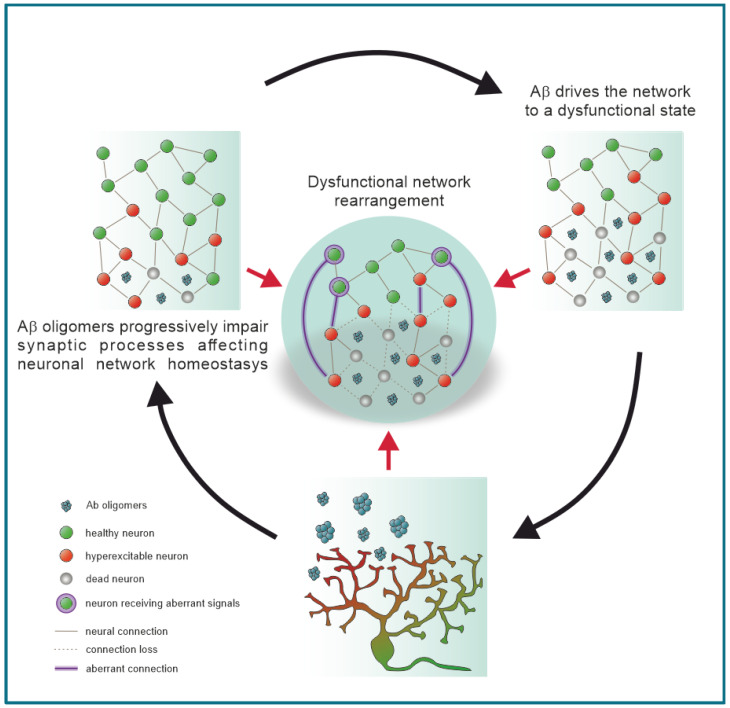
Amyloid-β (Aβ) 1-40 and 1-42 peptides are key mediators of synaptic and cognitive dysfunction in Alzheimer's disease (AD). Whereas in AD, Aβ is found to act as a pro-epileptogenic factor even before plaque formation, amyloid pathology has been detected among patients with epilepsy with increased risk of developing AD. Among Aβ aggregated species, soluble oligomers are suggested to be responsible for most of Aβ's toxic effects. Aβ oligomers exert extracellular and intracellular toxicity through different mechanisms, including interaction with membrane receptors and the formation of ion-permeable channels in cellular membranes. These damages, linked to an unbalance between excitatory and inhibitory neurotransmission, often result in neuronal hyperexcitability and neural circuit dysfunction, which in turn increase Aβ deposition and facilitate neurodegeneration, resulting in an Aβ-driven vicious loop. In this review, we summarize the most representative literature on the effects that oligomeric Aβ induces on synaptic dysfunction and network disorganization.
淀粉样蛋白-β (Aβ) 1-40 和 1-42 肽是阿尔茨海默病 (AD) 中突触和认知功能障碍的关键介质。虽然在 AD 中,Aβ 在斑块形成之前就被发现作为致痫性因素起作用,但在癫痫患者中已经检测到淀粉样蛋白病理学,这些患者患 AD 的风险增加。在聚集的 Aβ 物种中,可溶性寡聚物被认为是造成 Aβ 大部分毒性作用的原因。Aβ 寡聚物通过不同的机制发挥细胞外和细胞内毒性,包括与膜受体相互作用和在细胞膜中形成离子渗透性通道。这些损伤与兴奋性和抑制性神经递质之间的失衡有关,通常导致神经元过度兴奋和神经回路功能障碍,这反过来又增加 Aβ 的沉积并促进神经退行性变,导致 Aβ 驱动的恶性循环。在这篇综述中,我们总结了关于寡聚 Aβ 对突触功能障碍和网络紊乱诱导作用的最具代表性的文献。