Department of Medicine and Surgery, University of Parma, 43126 Parma, Italy.
Medical Oncology Unit, University Hospital of Parma, 43126 Parma, Italy.
Cells. 2021 Jun 16;10(6):1520. doi: 10.3390/cells10061520.
Resistance to EGFR-TKIs constitutes a major challenge for the management of -mutated NSCLC, and recent evidence suggests that deregulation of specific microRNAs (miRNAs) may influence resistance to targeted agents. In this retrospective study, we explored the role of specific plasmatic miRNAs (miR-21, miR-27a and miR-181a) as a surrogate for predicting EGFR-TKI performance in -mutated NSCLC patients.
Plasma samples of 39 advanced -mutated NSCLC patients treated with EGFR-TKIs were collected at different points in time and miRNA levels were assessed by RT-PCR.
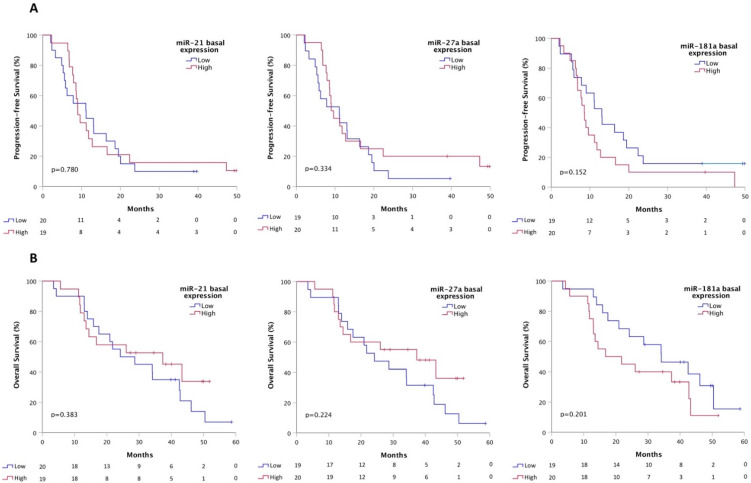
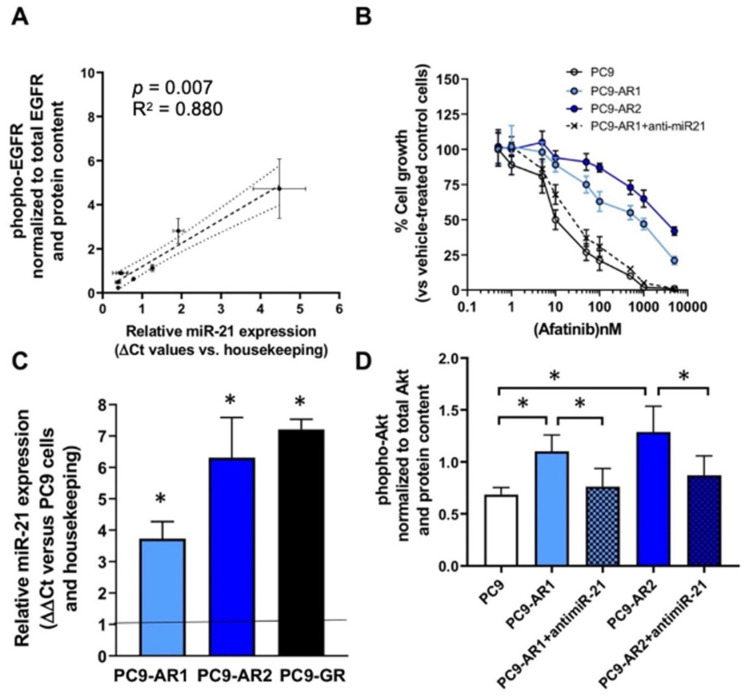
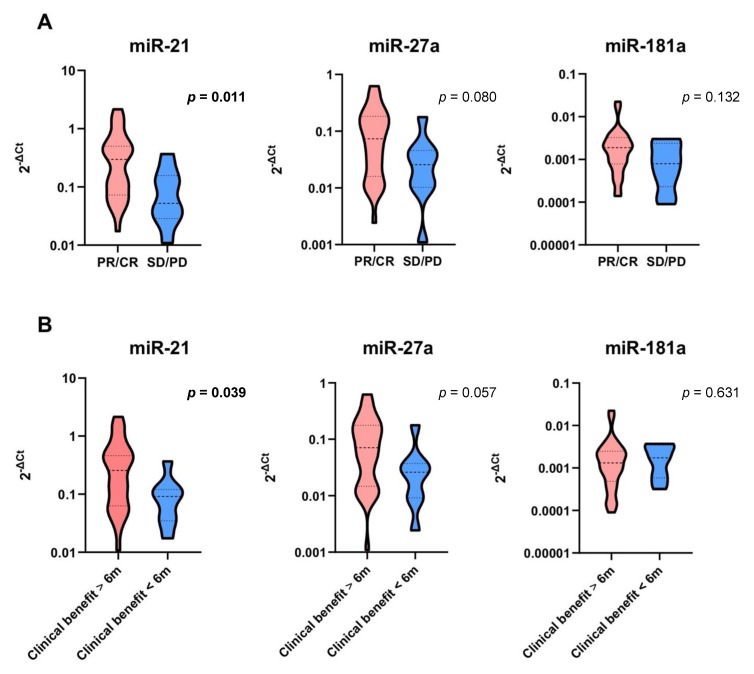
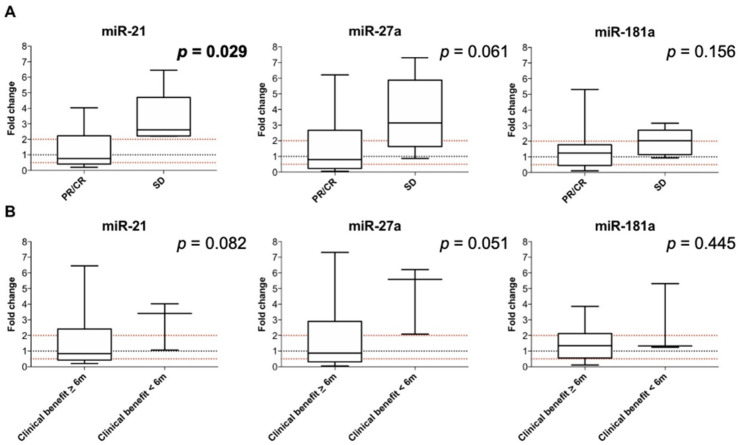
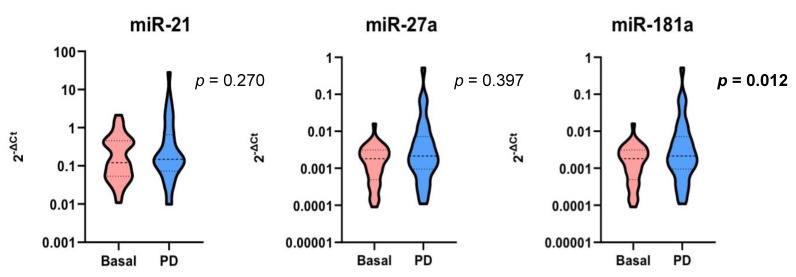
Higher basal values of miR-21 were reported in patients who achieved a partial/complete response (PR/CR) compared to those with stability/progression of disease (SD/PD) ( = 0.011). Along the same line, patients who experienced a clinical benefit lasting at least six months displayed higher basal levels of circulating miR-21 ( = 0.039). However, dynamic evaluation of miRNA values after two months from the start of EGFR-TKI treatment showed that patients who experienced SD had an increase in miR-21 levels (Fold Change [FC] = 2.6) compared to patients achieving PR/CR ( = 0.029). The same tendency was observed for miR-27a (FC = 3.1) and miR-181a (FC = 2.0), although without reaching statistical significance. Remarkably, preclinical studies showed an increase in miR-21 levels in NSCLC cells that became resistant after exposure to EGFR-TKIs.
Our study provides interesting insights on the role of circulating miRNAs, in particular miR-21, and their dynamic change over time in predicting EGFR-TKI response in -mutated NSCLC.
表皮生长因子受体酪氨酸激酶抑制剂(EGFR-TKIs)耐药是管理 - 突变型非小细胞肺癌(NSCLC)的主要挑战,最近的证据表明,特定 microRNAs(miRNAs)的失调可能会影响靶向药物的耐药性。在这项回顾性研究中,我们探讨了特定血浆 miRNAs(miR-21、miR-27a 和 miR-181a)作为预测 - 突变型 NSCLC 患者 EGFR-TKI 疗效的替代标志物的作用。
收集 39 例接受 EGFR-TKI 治疗的晚期 - 突变型 NSCLC 患者的血浆样本,并在不同时间点评估 miRNA 水平。
与疾病稳定/进展(SD/PD)患者相比,获得部分/完全缓解(PR/CR)的患者的 miR-21 基础值更高( = 0.011)。同样,临床获益至少持续 6 个月的患者的循环 miR-21 基础值更高( = 0.039)。然而,在 EGFR-TKI 治疗开始后两个月对 miRNA 值进行动态评估显示,SD 患者的 miR-21 水平升高(FC = 2.6),而 PR/CR 患者的 miR-21 水平降低(FC = 0.2)( = 0.029)。miR-27a(FC = 3.1)和 miR-181a(FC = 2.0)也出现了同样的趋势,尽管没有达到统计学意义。值得注意的是,临床前研究表明,在暴露于 EGFR-TKIs 后变得耐药的 NSCLC 细胞中,miR-21 水平升高。
我们的研究提供了关于循环 miRNAs(尤其是 miR-21)在预测 - 突变型 NSCLC 患者 EGFR-TKI 反应中的作用及其随时间的动态变化的有趣见解。