Mehdizadeh Tanya, Majumdar Himani D, Ahsan Sarah, Tavares Andre L P, Moody Sally A
Department of Anatomy & Cell Biology, School of Medicine and Health Sciences, George Washington University, Washington, DC 20037, USA.
J Dev Biol. 2021 Jun 30;9(3):25. doi: 10.3390/jdb9030025.
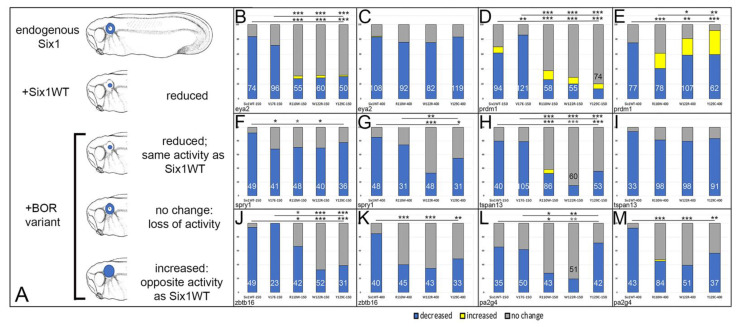
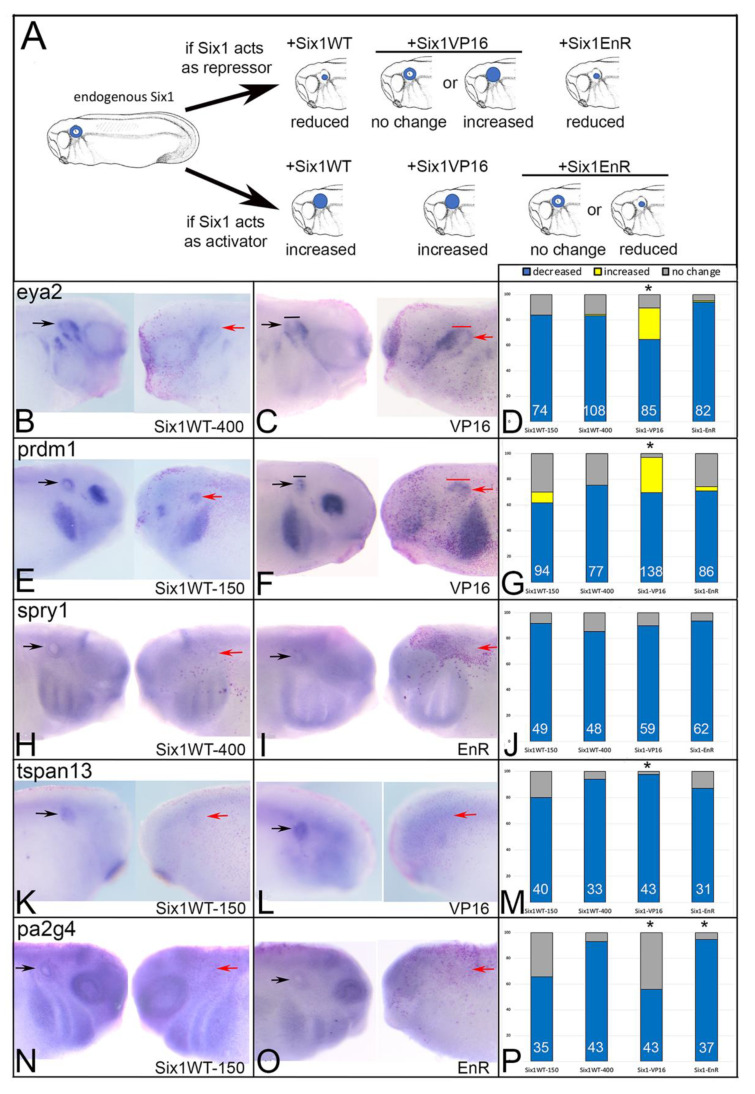
Several single-nucleotide mutations in underlie branchio-otic/branchio-oto-renal (BOR) syndrome, but the clinical literature has not been able to correlate different variants with specific phenotypes. We previously assessed whether variants in either the cofactor binding domain (V17E, R110W) or the DNA binding domain (W122R, Y129C) might differentially affect early embryonic gene expression, and found that each variant had a different combination of effects on neural crest and placode gene expression. Since the otic vesicle gives rise to the inner ear, which is consistently affected in BOR, herein we focused on whether the variants differentially affected the otic expression of genes previously found to be likely Six1 targets. We found that V17E, which does not bind Eya cofactors, was as effective as wild-type Six1 in reducing most otic target genes, whereas R110W, W122R and Y129C, which bind Eya, were significantly less effective. Notably, V17E reduced the otic expression of , whereas R110W, W122R and Y129C expanded it. Since each mutant has defective transcriptional activity but differs in their ability to interact with Eya cofactors, we propose that altered cofactor interactions at the mutated sites differentially interfere with their ability to drive otic gene expression, and these differences may contribute to patient phenotype variability.
几个单核苷酸突变是鳃耳/鳃耳肾(BOR)综合征的基础,但临床文献未能将不同的变异与特定表型联系起来。我们之前评估了辅因子结合域(V17E、R110W)或DNA结合域(W122R、Y129C)中的变异是否可能对早期胚胎基因表达产生不同影响,并发现每个变异对神经嵴和基板基因表达有不同的影响组合。由于耳泡产生内耳,而内耳在BOR中始终受到影响,因此我们在此关注这些变异是否对先前发现可能是Six1靶点的基因的耳表达产生不同影响。我们发现,不与Eya辅因子结合的V17E在降低大多数耳靶基因方面与野生型Six1一样有效,而与Eya结合的R110W、W122R和Y129C则明显效果较差。值得注意的是,V17E降低了[基因名称未给出]的耳表达,而R110W、W122R和Y129C则使其增加。由于每个突变体都有缺陷的转录活性,但在与Eya辅因子相互作用的能力上有所不同,我们提出,突变位点处辅因子相互作用的改变会不同程度地干扰它们驱动耳基因表达的能力,而这些差异可能导致患者表型的变异性。