Braunstein Evan M, Chen Hang, Juarez Felicia, Yang Fanghan, Tao Lindsay, Makhlin Igor, Williams Donna M, Chaturvedi Shruti, Pallavajjala Aparna, Karantanos Theodoros, Martin Renan, Wohler Elizabeth, Sobreira Nara, Gocke Christopher D, Moliterno Alison R
Department of Medicine, Division of Haematology, Johns Hopkins University School of Medicine, Baltimore, MD 21205, USA.
Department of Medicine, Division of Hematology & Oncology, University of Pennsylvania, Philadelphia, PA 19104, USA.
Cancers (Basel). 2021 Jun 29;13(13):3246. doi: 10.3390/cancers13133246.
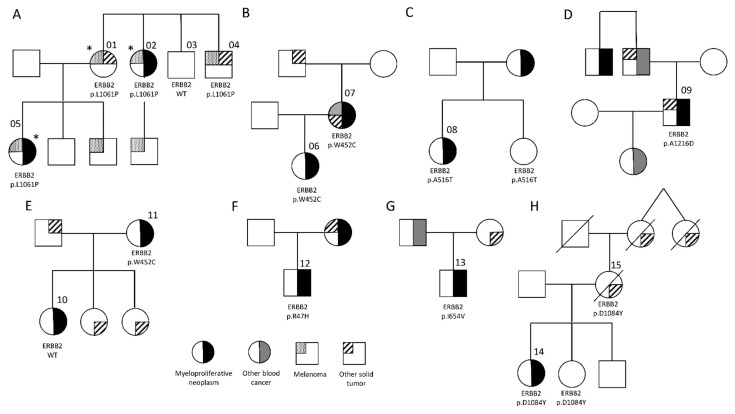
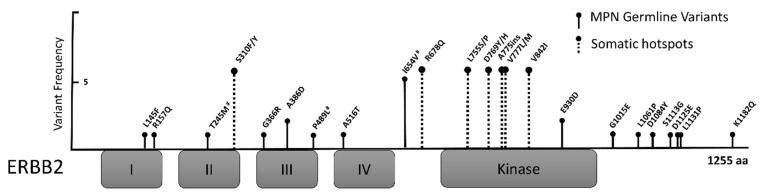
Familial cases of myeloproliferative neoplasms (MPN) are relatively common, yet few inherited risk factors have been identified. Exome sequencing of a kindred with a familial cancer syndrome characterized by both MPN and melanoma produced a germline variant in the gene that co-segregates with disease. To further investigate whether germline variants contribute to MPN predisposition, the frequency of variants was analyzed in 1604 cases that underwent evaluation for hematologic malignancy, including 236 cases of MPN. MPN cases had a higher frequency of rare germline coding variants compared to non-MPN hematologic malignancies (8.9% vs. 4.1%, OR 2.4, 95% CI: 1.4 to 4.0, = 0.0028) as well as cases without a blood cancer diagnosis that served as an internal control (8.9% vs. 2.7%, OR 3.5, 95% CI: 1.4 to 8.3, = 0.0053). This finding was validated via comparison to an independent control cohort of 1587 cases without selection for hematologic malignancy (8.9% in MPN cases vs. 5.2% in controls, = 0.040). The most frequent variant identified, c.1960A > G; p.I654V, was present in MPN cases at more than twice its expected frequency. These data indicate that rare germline coding variants in are associated with an increased risk for development of MPN. The gene is a novel susceptibility locus which likely contributes to cancer risk in combination with additional risk alleles.
骨髓增殖性肿瘤(MPN)的家族性病例相对常见,但已确定的遗传风险因素较少。一个以MPN和黑色素瘤为特征的家族性癌症综合征家族的外显子组测序在与疾病共分离的基因中产生了一个种系变异。为了进一步研究种系变异是否导致MPN易感性,在1604例接受血液系统恶性肿瘤评估的病例中分析了变异的频率,其中包括236例MPN。与非MPN血液系统恶性肿瘤相比,MPN病例中罕见种系编码变异的频率更高(8.9%对4.1%,OR 2.4,95%CI:1.4至4.0,P = 0.0028),以及与作为内部对照的无血癌诊断的病例相比(8.9%对2.7%,OR 3.5,95%CI:1.4至8.3,P = 0.0053)。通过与1587例未选择血液系统恶性肿瘤的独立对照队列进行比较,验证了这一发现(MPN病例中为8.9%,对照中为5.2%,P = 0.040)。鉴定出的最常见变异c.1960A>G;p.I654V在MPN病例中的出现频率是预期频率的两倍多。这些数据表明,该基因中罕见的种系编码变异与MPN发生风险增加有关。该基因是一个新的易感位点,可能与其他风险等位基因共同导致癌症风险。