
热休克转录因子和主要热休克蛋白 Hsp70 在记忆形成和神经保护中的作用。
Role of a Heat Shock Transcription Factor and the Major Heat Shock Protein Hsp70 in Memory Formation and Neuroprotection.
机构信息
Laboratory of Molecular Mechanisms of Biological Adaptation, Engelhardt Institute of Molecular Biology of the Russian Academy of Sciences, 119991 Moscow, Russia.
出版信息
Cells. 2021 Jun 29;10(7):1638. doi: 10.3390/cells10071638.
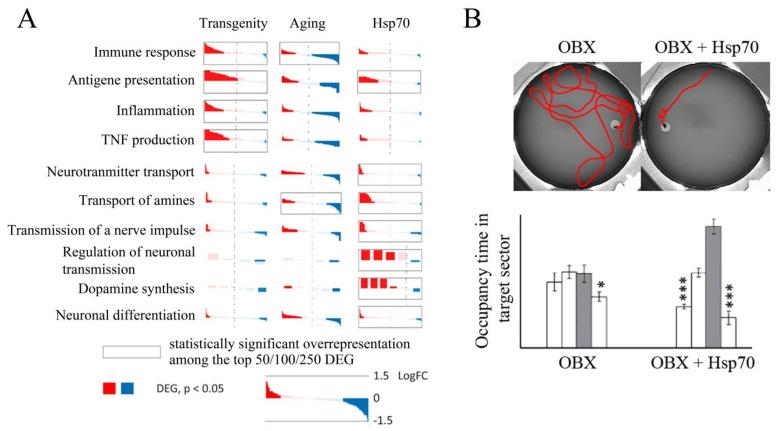
Heat shock proteins (Hsps) represent the most evolutionarily ancient, conserved, and universal system for protecting cells and the whole body from various types of stress. Among Hsps, the group of proteins with a molecular weight of 70 kDa (Hsp70) plays a particularly important role. These proteins are molecular chaperones that restore the native conformation of partially denatured proteins after exposure to proteotoxic forms of stress and are critical for the folding and intracellular trafficking of de novo synthesized proteins under normal conditions. Hsp70s are expressed at high levels in the central nervous system (CNS) of various animals and protect neurons from various types of stress, including heat shock, hypoxia, and toxins. Numerous molecular and behavioral studies have indicated that Hsp70s expressed in the CNS are important for memory formation. These proteins contribute to the folding and transport of synaptic proteins, modulate signaling cascades associated with synaptic activation, and participate in mechanisms of neurotransmitter release. In addition, HSF1, a transcription factor that is activated under stress conditions and mediates Hsps transcription, is also involved in the transcription of genes encoding many synaptic proteins, whose levels are increased in neurons under stress and during memory formation. Thus, stress activates the molecular mechanisms of memory formation, thereby allowing animals to better remember and later avoid potentially dangerous stimuli. Finally, Hsp70 has significant protective potential in neurodegenerative diseases. Increasing the level of endogenous Hsp70 synthesis or injecting exogenous Hsp70 reduces neurodegeneration, stimulates neurogenesis, and restores memory in animal models of ischemia and Alzheimer's disease. These findings allow us to consider recombinant Hsp70 and/or Hsp70 pharmacological inducers as potential drugs for use in the treatment of ischemic injury and neurodegenerative disorders.
热休克蛋白(Hsps)代表了最古老、最保守、最普遍的细胞和全身保护系统,使其免受各种类型的压力。在 Hsps 中,分子量为 70 kDa 的蛋白质组(Hsp70)起着特别重要的作用。这些蛋白质是分子伴侣,可在暴露于蛋白毒性应激形式后恢复部分变性蛋白质的天然构象,并且对于正常条件下新生合成蛋白质的折叠和细胞内运输至关重要。Hsp70 在各种动物的中枢神经系统(CNS)中高表达,可保护神经元免受各种类型的压力,包括热休克、缺氧和毒素。大量的分子和行为研究表明,CNS 中表达的 Hsp70 对记忆形成很重要。这些蛋白质有助于突触蛋白的折叠和运输,调节与突触激活相关的信号级联反应,并参与神经递质释放的机制。此外,转录因子 HSF1 在应激条件下被激活,并介导 Hsps 的转录,也参与编码许多突触蛋白的基因的转录,这些基因的水平在应激下的神经元中增加,并在记忆形成过程中增加。因此,应激激活了记忆形成的分子机制,从而使动物能够更好地记住并随后避免潜在的危险刺激。最后,Hsp70 在神经退行性疾病中有显著的保护潜力。增加内源性 Hsp70 合成的水平或注射外源性 Hsp70 可减少神经退行性变,刺激神经发生,并在缺血和阿尔茨海默病的动物模型中恢复记忆。这些发现使我们能够考虑重组 Hsp70 和/或 Hsp70 药理学诱导剂作为治疗缺血性损伤和神经退行性疾病的潜在药物。


 Zotero 插件